
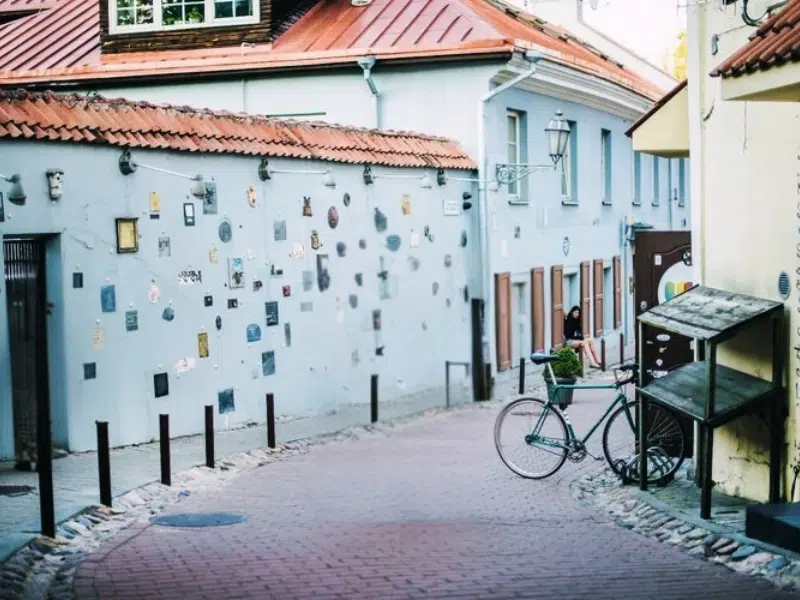
Literatų gatvė, Literati Street, is a short, narrow lane in Vilnius Old Town with a wall covered in more than 200 small artworks, each one dedicated to a writer with a link to Vilnius or Lithuania. A group of artists started the project in 2008 to bring the street back to life, and new pieces are still added. The poet Adam Mickiewicz lived in this lane in 1823, shortly before his arrest.
Literatų Street at a glance
- Where: Vilnius Old Town, a lane about 140 metres long that turns off Pilies Street, the main street running down to Cathedral Square.
- Created: the artists' idea dates from 2008; the first works went up in 2009, when Vilnius was a European Capital of Culture.
- What it is today: a free open-air gallery of more than 200 plaques, panels and small objects, made by volunteer artists and still growing.
- Time needed: 15–30 minutes, longer if you stop to read the names and quotations.
From St Michael's Lane to Literati Street
The lane has changed its name several times. Late 18th-century documents call it St Michael's Lane, and in the mid-19th century it was renamed Pokrovo, after the Orthodox Church of the Intercession (Pokrov) that stood at the end of the street from the 14th to the 16th century. The present name is usually explained by the printing houses and bookshops that once worked here. A second explanation points to Adam Mickiewicz, the poet claimed by Poland, Lithuania and Belarus alike: in 1823 he rented an attic flat in a four-storey house on the street. He was living here when the tsarist authorities began arresting members of the Philomaths, a secret student society, and in October that year he was arrested himself and held in the Basilian monastery.
By the early 2000s the lane was a quiet, slightly neglected passage. In 2008 a group of artists came up with the idea of filling its wall with tributes to writers, and the first plaques appeared in 2009, the year Vilnius was a European Capital of Culture. At first the project focused on Lithuanian poets, then it opened up to writers from anywhere, as long as they had some connection to Vilnius or Lithuania. Artists take part as volunteers, and the collection keeps growing: there are now well over 200 works, honouring both famous names and writers few visitors will have heard of.
What to look for
- Adam Mickiewicz: the best-known name on the wall, honoured here because he lived on this very street.
- Joseph Brodsky and Tomas Venclova: the Russian poet and his Lithuanian friend. Brodsky visited Lithuania often, and the two are both remembered on the wall.
- Stendhal: the French novelist passed through Lithuania with Napoleon's army, so he has a place here too.
- Jonathan Franzen: the American author earned his plaque with The Corrections (2001), in which one character travels to post-Soviet Vilnius.
- The variety of the works: miniature paintings, ceramics, metal plates, glass and wood, with portraits, quotations, book replicas and abstract designs. Look for the unusual one made with a set of teeth.
Tips for your visit
- Come in daylight. The lane is narrow and the works are small, so morning or early afternoon light makes them much easier to read.
- Look up as well as at eye level: plaques fill the wall from waist height to well above your head, and your phone's zoom helps with the higher ones.
- Do not touch or lean on the works. Many are fragile, hand-made pieces fixed to an old wall.
- Start or finish on Pilies Street and combine the lane with St Anne's Church and the university a few minutes away.
Nearby
- Pilies Street: the old town's main street, lined with souvenir stalls and cafés, leading down to Cathedral Square.
- St Anne's Church: the late Gothic red-brick church from around 1500. A popular legend says Napoleon wanted to carry it back to Paris in the palm of his hand.
- Vilnius University: founded in 1579, with a series of linked courtyards and St John's Church.
- Cathedral Square: the large square with the white neoclassical cathedral, its separate bell tower and the hill of Gediminas' Tower behind it.
See Vilnius with World City Trail
Our Vilnius scavenger hunt turns the old town into a game you play on your phone. The route links 10 stops and takes around 3 hours, with about 58 minutes of walking. Literatų Street is one of the stops, along with the Gate of Dawn and Town Hall Square. You can play in English, German, French, Italian, Spanish or Dutch.
If you prefer a different format, there is also a self-guided walking tour and an outdoor escape game in Vilnius.
Play the Vilnius scavenger hunt →
Take the self-guided walking tour of Vilnius →
Play the outdoor escape game in Vilnius →
Facts checked in October 2026.