
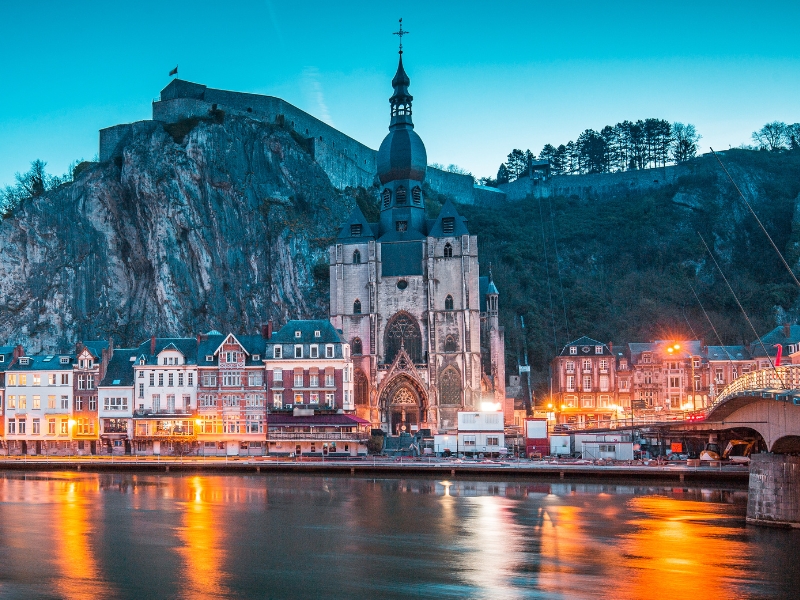
The Collegiate Church of Notre-Dame is the Gothic church squeezed between the river Meuse and the sheer limestone cliff in Dinant, right below the citadel. Its pear-shaped bell tower is the town's emblem and appears on almost every photo of Dinant. The church owes its Gothic form to the cliff itself: in 1227 a mass of rock broke away and crushed the Romanesque church that stood here before.
Notre-Dame de Dinant at a glance
- Where: on the right bank of the Meuse at the end of the Pont Charles de Gaulle, at the foot of the cliff crowned by the citadel.
- Built: rebuilt in Gothic style from the 13th century after the rockfall of 1227; the bulb-shaped bell tower was added in 1556, and the church was restored again in 1919–1923.
- What it is today: an active Catholic parish church, listed as Walloon heritage since 1941, which visitors can enter outside services.
- Time needed: 20–30 minutes for the church and the view from the bridge.
Rockfall, war and fire
A Romanesque church stood here first. In December 1227 a huge slab of rock broke off the promontory above and crushed it; some sources give the date as 1228. The town rebuilt in Gothic style, using local limestone and models brought from Burgundy and Champagne. Dinant had a hard time in the centuries that followed: the church was damaged when the troops of Philip the Good, Duke of Burgundy, sacked the town in 1466, and again by fire in the 16th century. The bulbous tower that finished the church in 1556 had originally been designed for the town hall.
In August 1914, during the German invasion of Belgium, the German army killed hundreds of civilians in Dinant and shelled and burned much of the town, including the church. The architect Chrétien Veraart rebuilt it between 1919 and 1923. An earlier restoration in the 19th century, by Jules-Jacques Van Ysendijck and others, had already tried to give the building back the unity of its 13th-century style.
What to look for
- The bell tower: a slender pear-shaped spire set against the rock face behind it. Victor Hugo, who travelled along the Meuse, is said to have mocked it as a giant water jug.
- The rock: look up from the square to see how close the cliff stands to the apse, and imagine the boulders of 1227.
- The great stained-glass window by the glass maker Gustave Ladon, which tells the story of salvation and is often described as one of the largest in Europe.
- The interior: three naves, monolithic columns and tall windows with tracery, in the sober Gothic style of the Meuse valley.
- Paintings by Antoine Wiertz, the Romantic painter born in Dinant in 1806, and an 11th-century baptismal font that survived from the earlier church.
Two neighbours: the saxophone and the church
Dinant's other claim to fame is Adolphe Sax, the inventor of the saxophone, born here in 1814. The Pont Charles de Gaulle in front of the church is lined with giant saxophones painted in the colours of different countries, so the classic view combines both: coloured saxophones on the bridge, the bulb tower behind them and the citadel on the cliff above.
Tips for your visit
- For the classic photo, cross the Meuse and look back from the left bank: the church, the cliff and the citadel fit into one frame.
- The church is a place of worship: keep your voice down and avoid visiting during Mass. Opening times vary, so check with the tourist office before a special trip.
- Come back in the late afternoon, when the sun lights up the bridge and the façade.
- Go up to the citadel, reached by cable car or a long stairway beside the church, for a view straight down onto the tower.
Nearby
- Citadel of Dinant: the fortress on the cliff above the church, with a view over the town and the Meuse valley.
- Maison de Monsieur Sax: a small exhibition about Adolphe Sax on the street named after him, a few minutes' walk away.
- Pont Charles de Gaulle: the bridge in front of the church, decorated with oversized saxophones.
- Rocher Bayard: a tall needle of rock beside the road just south of the town. Legend says it was split by the hoof of Bayard, the magic horse of the four Aymon brothers.
See Dinant with World City Trail
Our Dinant scavenger hunt turns the old town into a game you play on your phone. The route links 10 stops and takes around 2 hours, with about 25 minutes of walking, and includes the Adolphe Sax monument and the Maison de Monsieur Sax. You can play in English, German, French, Italian, Spanish and Dutch.
If you prefer a different format, there is also a self-guided walking tour and an outdoor escape game in Dinant.
Play the Dinant scavenger hunt →
Take the self-guided walking tour of Dinant →
Play the outdoor escape game in Dinant →
Facts checked in October 2026.