
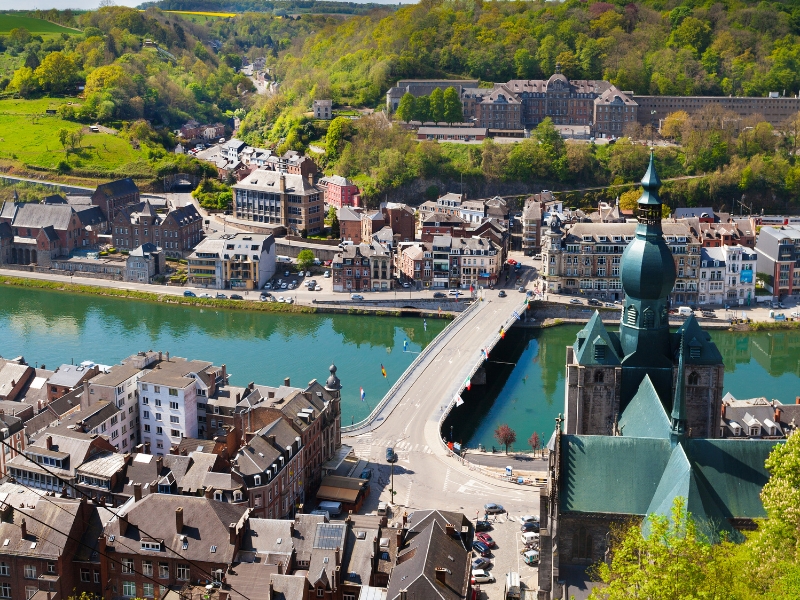
The Pont Charles de Gaulle is Dinant's main bridge over the Meuse, running straight towards the collegiate church with its onion-shaped spire and the citadel on the cliff above. It is named after Charles de Gaulle, who was wounded here as a young French lieutenant on 15 August 1914. Today it is better known for the giant painted saxophones along its railings, a salute to Adolphe Sax, the inventor of the saxophone, who was born in Dinant.
Pont Charles de Gaulle at a glance
- Where: across the Meuse in the centre of Dinant, linking the station side on the left bank with the collegiate church and the old town on the right bank.
- Named after: Charles de Gaulle, later leader of Free France and President of the French Republic, who fought here in the First World War.
- What it is today: a busy road and pedestrian bridge lined with large saxophone sculptures, each painted to represent a different country.
- Time needed: 15–20 minutes to cross slowly, look at the saxophones and take photos of the town front.
A battle for the bridge in 1914
In August 1914 the German army invaded Belgium, and French troops moved up to defend the crossings of the Meuse at Dinant. On 15 August German forces attacked. Lieutenant Charles de Gaulle of the French 33rd Infantry Regiment led his section in a counterattack towards the bridge and was hit in the leg only a few metres from its entrance. He dragged himself into a nearby house and was treated at a first-aid post at the château of Bouvignes before being evacuated.
A week later Dinant suffered one of the worst atrocities of the German invasion. On 23 August 1914 German troops, convinced that civilians were firing on them, executed around 674 men, women and children and burned much of the town. Germany only issued an official apology in 2001. The bridge, the riverbank and the memorials around town are part of the story of that summer, which shaped how Dinant remembers the war.
What to look for
- The saxophones: tall, brightly painted sculptures along both sides of the bridge, each standing in front of a national flag and decorated in its own style.
- The statue of Charles de Gaulle at the foot of the bridge, which recalls the lieutenant wounded here in 1914.
- The view upstream and downstream: the Meuse valley with its steep limestone cliffs, a classic image of the Belgian Ardennes.
- The collegiate church of Notre-Dame straight ahead, its bulb-shaped spire set against the rock face.
- The citadel on the cliff top above the church, with the cable car climbing towards it.
Adolphe Sax and his instrument
Adolphe Sax was born in Dinant in 1814, the son of an instrument maker. He moved to Paris and in 1846 patented the saxophone, the instrument that made his name famous around the world. Dinant celebrates him everywhere: the saxophones on the bridge, a life-size statue of Sax sitting on a bench in the street named after him, and La Maison de Monsieur Sax, a small free interpretation centre near the house where he was born.
Tips for your visit
- Cross on foot rather than by car: the pavements give you time to look at each saxophone and the flags.
- For the classic photo of the church and citadel, stand on the left bank near the start of the bridge.
- Early morning or late afternoon light works best for photos of the cliff and the town front reflected in the river.
- The bridge carries traffic, so stay on the pavement when you stop for pictures.
Nearby
- Collégiale Notre-Dame: the Gothic church with its bulb spire and one of the largest stained-glass windows in Europe, just across the bridge.
- Citadel of Dinant: reached by a cable car or a staircase of 408 steps, with wide views over the town and the valley.
- La Maison de Monsieur Sax: a short walk away, with the bronze Adolphe Sax on his bench nearby.
- Rocher Bayard: a tall needle of rock beside the road south of the centre, linked to the legend of the horse Bayard.
See Dinant with World City Trail
Our Dinant scavenger hunt turns the old town into a game you play on your phone. The route links 10 stops and takes around 2 hours, with about 25 minutes of walking. Among its stops are the Adolphe Sax monument and La Maison de Monsieur Sax. You can play in English, German, French, Italian, Spanish and Dutch.
If you prefer a different format, there is also a self-guided walking tour and an outdoor escape game in Dinant.
Play the Dinant scavenger hunt →
Take the self-guided walking tour of Dinant →
Play the outdoor escape game in Dinant →
Facts checked in October 2026.