
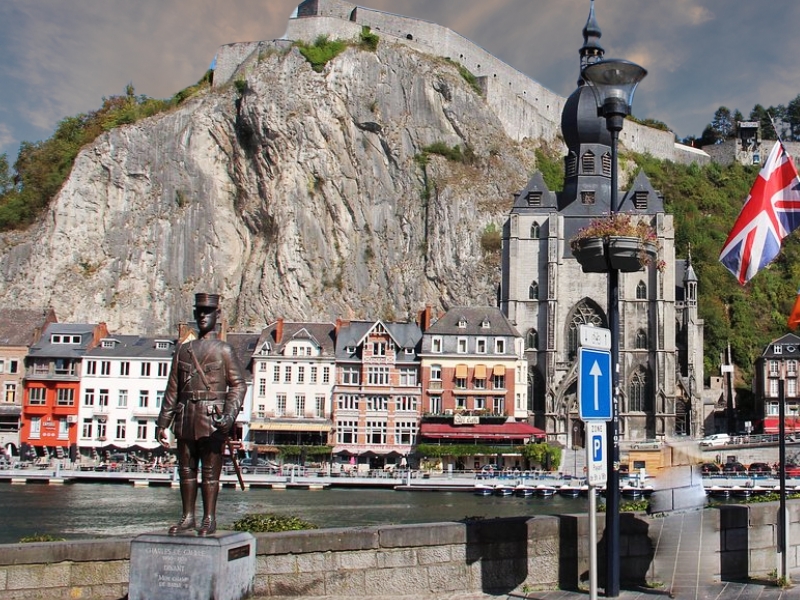
The statue of Charles de Gaulle in Dinant stands beside the Meuse, a few steps from the bridge that now carries his name. It marks the place where the future leader of Free France and President of the Republic, then a 23-year-old lieutenant, was wounded on 15 August 1914, in one of the first battles of the First World War. The figure is made of copper by a local dinandier, a nod to the metalworking craft that takes its name from Dinant.
The de Gaulle statue at a glance
- Where: Avenue Cadoux, on the riverside next to the Pont Charles de Gaulle, in the centre of Dinant.
- Unveiled: 15 August 2014, exactly 100 years after de Gaulle was wounded here.
- By: Guido Clabots, described by the town as the last dinandier (coppersmith) of Dinant, who designed and made the statue.
- What it is today: a First World War memorial paid for by a public appeal for donations and supported by the Fondation Charles de Gaulle in Paris.
- Time needed: about 10 minutes, or half an hour if you also walk across the bridge and look back at the town.
A lieutenant on the bridge, August 1914
In August 1914 the German army invaded Belgium, and French troops moved up to hold the line of the Meuse. Charles de Gaulle, born in Lille in 1890, was a lieutenant in the 33rd Infantry Regiment, which he had joined in 1912 under Colonel Philippe Pétain. On 15 August German troops attacked Dinant and the French fought back for the river crossing. De Gaulle was hit in the leg as he led his men towards the bridge; a newspaper of the time reported that a bullet had broken his fibula. In a diary he wrote weeks later in a hospital in Lyon, he remembered falling and a soldier falling dead on top of him. He was given first aid at the château of Bouvignes, just downstream, and evacuated to France.
It was the first of three wounds. He was hurt again in 1915, and in March 1916 he was wounded and captured at Douaumont, near Verdun, and spent the rest of the war as a prisoner despite five escape attempts. Dinant suffered far worse that month: on 23 August 1914 German troops killed 674 civilians and burned much of the town. The bridge was later named after de Gaulle, and in 2012 the town council voted to put up a monument at the place where he was wounded, in time for the centenary. The statue was unveiled during the commemorations on 15 August 2014.
What to look for
- The copper: most statues are cast in bronze, but this one is made of copper, the traditional material of the Dinant coppersmiths.
- The plaque beside the statue, which explains why de Gaulle is remembered at this spot.
- The bridge: in 1914 French soldiers fought for this crossing. Today the Pont Charles de Gaulle is lined with giant saxophones painted in the colours of different countries, in honour of Adolphe Sax, who was born in Dinant.
- The citadel on the cliff above the town, the high ground over the river that made Dinant so hard to hold in August 1914.
Dinanderie: a craft named after a town
The word dinanderie, used in French and in English for decorative work in brass and copper, comes from Dinant. In the Middle Ages the town's metalworkers were known far beyond the Meuse valley for their bowls, candlesticks and lecterns, until the troops of Philip the Good, Duke of Burgundy, sacked the town in 1466. Having a Dinant coppersmith make the de Gaulle statue links the memorial to that older story.
Tips for your visit
- For the best view, walk across the Pont Charles de Gaulle and look back: the statue, the saxophones, the Collegiate Church of Notre-Dame and the citadel come together in one picture.
- Come in the morning or early evening, when the riverside is quieter than in the middle of a summer day.
- If the events of 1914 interest you, look out for the other memorials around the town, such as the Mur des Fusillés on Rue Daoust, which remembers civilians shot in August 1914.
- This is a memorial: take your photos, but do not climb on the statue or its base.
Nearby
- Collegiate Church of Notre-Dame: the Gothic church with the pear-shaped bell tower, squeezed between the river and the cliff.
- Citadel of Dinant: the fortress on the rock above the town, reached by cable car or a long stairway, with a wide view of the Meuse valley.
- Maison de Monsieur Sax: a small exhibition about Adolphe Sax, the inventor of the saxophone, on the street named after him.
- Adolphe Sax monument: a bronze Adolphe Sax sitting on a bench in front of the Maison de Monsieur Sax, a favourite spot for photos.
See Dinant with World City Trail
Our Dinant scavenger hunt turns the old town into a game you play on your phone. The route links 10 stops and takes around 2 hours, with about 25 minutes of walking, and includes the Adolphe Sax monument and the Maison de Monsieur Sax. You can play in English, German, French, Italian, Spanish and Dutch.
If you prefer a different format, there is also a self-guided walking tour and an outdoor escape game in Dinant.
Play the Dinant scavenger hunt →
Take the self-guided walking tour of Dinant →
Play the outdoor escape game in Dinant →
Facts checked in October 2026.