
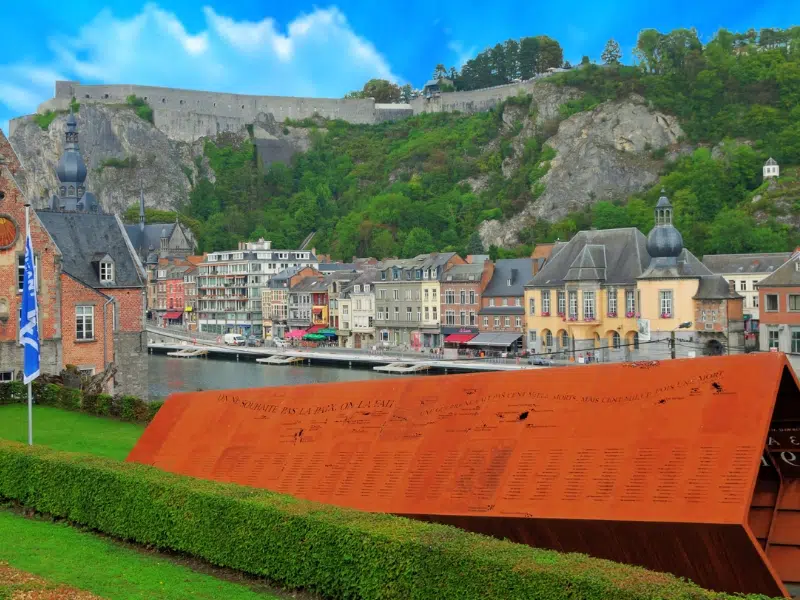
Dinant is best known for its citadel, its onion-domed collegiate church and Adolphe Sax, but its memorials to the victims of 1914 tell the town's hardest story. On 23 August 1914 and the days that followed, German troops executed 674 civilians, men, women and children, and burned around two-thirds of the town. Plaques, monuments and walls marked with names across Dinant remember them, the largest at the Tschoffen wall, where the single biggest execution took place.
The 1914 memorials at a glance
- Where: across Dinant on the right bank of the Meuse, with the main execution site, the Tschoffen wall, in the Rivages and Saint-Nicolas district south of the centre.
- When: they remember the massacre of 23 August 1914; plaques and monuments were set up in the years after the war.
- What it is today: a set of memorial sites, from monuments to simple plaques with names, that together form the town's memory of August 1914.
- Time needed: 15 minutes at a single memorial, two hours or more to follow the main sites on foot.
The sack of Dinant
When Germany invaded neutral Belgium in August 1914, Dinant, a town of under 8,000 people in a narrow valley on the Meuse, lay on the line of the advance. On 6 August the burgomaster ordered residents to hand in their weapons and warned them not to resist. On 15 August French troops threw back a German attempt to cross the river, and the townspeople cheered when the French flag rose over the citadel. A week later the Saxon troops returned. Convinced, wrongly, that civilians were firing on them as francs-tireurs, they turned on the population.
On 23 August soldiers went through the districts of the town, rounding up residents, shooting them in groups and setting fire to houses. At the garden wall of Maurice Tschoffen, about 137 men were lined up and roughly 109 were killed; at the Bourdon wall, 89 hostages were shot and 76 died. In all, 674 victims were identified, including women and babies. The massacre became one of the best-known episodes of what was called the Rape of Belgium, and Germany officially apologised to Belgium and to the victims' descendants only in 2001.
What to look for
- The lists of names: many memorials record every victim, often with ages, so you can see whole families taken at once.
- The Tschoffen wall area, scene of the largest single execution of 23 August.
- The monument near the Rocher Bayard, which remembers the women and children who were killed.
- The plaque at the Athénée on Rue Saint-Pierre, with the names of teachers and pupils who died.
- Smaller plaques on houses and walls along the streets, including Rue Saint-Jacques, where the first violence broke out.
Counting the victims
Even the number of dead has its own history. In 1915, during the occupation, the Benedictine Dom Norbert Nieuwland compiled the first list of victims, with 606 names. By 1922 the count had risen to 674. Just before the centenary in 2014, researchers revised the list again, confirming 674 identified victims plus three people whose identities are unknown. When you read the names on Dinant's walls, you are reading the result of more than a century of careful work to make sure no one was forgotten.
Tips for your visit
- Approach the memorials quietly; they are places of mourning for local families as well as monuments.
- Read the names and ages: the victims ranged from babies to elderly people.
- Walk south along the Meuse to see how narrow the valley is: it helps explain how the town was trapped.
- Plan your route before you set off: the memorial sites are spread out along the long, narrow riverside town.
Nearby
- Collegiate Church of Notre-Dame: the Gothic church with its onion-shaped bell tower, at the foot of the cliff.
- Citadel of Dinant: the fortress on the rock above the town, reached by cable car or by a long flight of steps.
- Adolphe Sax monument and Maison de Monsieur Sax: the bench statue and small museum honouring the inventor of the saxophone, born in Dinant.
- Rocher Bayard: the tall, thin rock needle by the road south of the town.
See Dinant with World City Trail
Our Dinant scavenger hunt turns the town into a game you play on your phone. The route links 10 stops and takes around 2 hours, with about 25 minutes of walking. It includes the Adolphe Sax monument and the Maison de Monsieur Sax. You can play in English, German, French, Italian, Spanish or Dutch.
If you prefer a different format, there is also a self-guided walking tour and an outdoor escape game in Dinant.
Play the Dinant scavenger hunt →
Take the self-guided walking tour of Dinant →
Play the outdoor escape game in Dinant →
Facts checked in October 2026.