
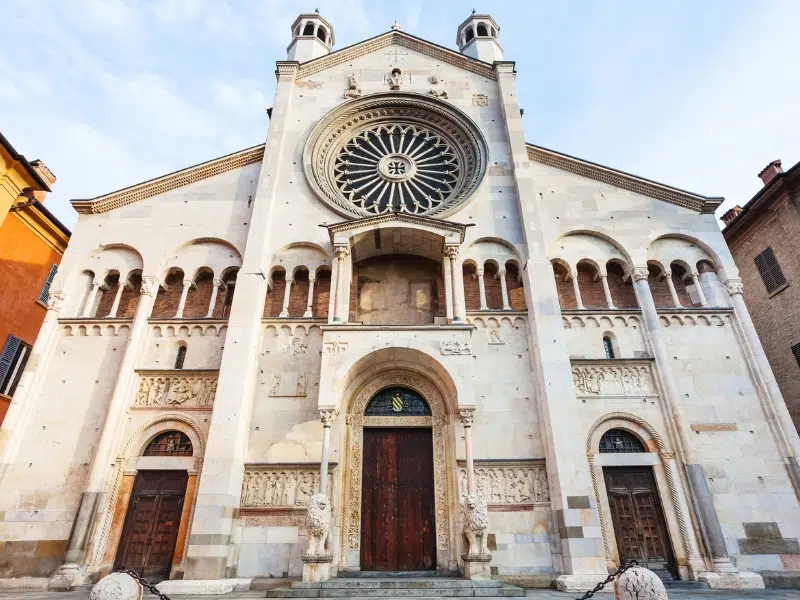
Modena Cathedral (Duomo di Modena) is the Romanesque church on the Piazza Grande, begun in 1099 by the architect Lanfranco, with sculpture by Wiligelmo. Together with its bell tower, the Ghirlandina, and the square, it has been a UNESCO World Heritage Site since 1997. Look closely at its north door: it carries what may be the earliest monumental sculpture of the legend of King Arthur.
Modena Cathedral at a glance
- Where: between Piazza Grande and Corso Duomo, in the centre of Modena's old town.
- Built: begun on 9 June 1099; consecrated by Pope Lucius III on 12 July 1184; work continued into the early 14th century.
- By: the architect Lanfranco and the sculptor Wiligelmo, followed by the Campionese masters, a family workshop of builders and sculptors from Campione.
- What it is today: the cathedral of the Archdiocese of Modena-Nonantola, dedicated to the Assumption of the Virgin and to Saint Geminianus, the city's patron saint, whose tomb is in the crypt.
- Time needed: 30–45 minutes for the outside and the interior, more if you also climb the Ghirlandina.
A cathedral built over a saint's tomb
The cathedral stands over the grave of Saint Geminianus, a fourth-century bishop of Modena. In 1099 the townspeople began a new, larger church to honour him, and the plaque on the facade records both the date and the names of the two men behind it: Lanfranco, the architect, and Wiligelmo, the sculptor. Restoration work has shown that the brick structure is faced with stone taken from the ruins of Roman Modena, which is why some blocks carry fragments of older carving.
Pope Lucius III consecrated the church in 1184, but the building went on growing. From the late 12th to the 14th century the Campionese masters added the large rose window, the side doors, the Porta Regia on the Piazza Grande and the marble parapet and pulpit above the crypt. In 1997 UNESCO listed the cathedral, the Ghirlandina and the Piazza Grande as one of the finest examples of Romanesque art in Europe. In 2007 the funeral of the tenor Luciano Pavarotti, Modena's most famous son, was held here.
What to look for
- Wiligelmo's Genesis reliefs on the main facade: the creation of Adam and Eve, the Original Sin, Cain and Abel, and Noah's ark, carved in the early 12th century.
- The two lions under the columns of the main doorway. They date from Roman times and were reused by the medieval builders.
- The founding plaque on the facade, held up by the prophets Enoch and Elijah. Its Latin verses give the date 1099 and praise Wiligelmo's sculpture.
- The Porta della Pescheria on the north side, near the Ghirlandina: the door frame shows the twelve months as farming scenes, and the arch above shows knights from the Arthurian legend.
- The Porta Regia on the Piazza Grande side, in rose-coloured marble, built by the Campionese masters.
- Inside: the marble parapet above the crypt with scenes of the Passion, including the Last Supper, and in the crypt the tomb of Saint Geminianus and Guido Mazzoni's painted terracotta group known as the 'Madonna della pappa'.
King Arthur on a church door
The arch over the Porta della Pescheria shows armed horsemen attacking a castle to free a captive woman. Some of the figures are labelled with names, among them 'Artus de Bretania', King Arthur of Britain. Scholars date the carving to somewhere between about 1120 and 1140, though the date is still debated. If the earlier dates are right, the relief is older than the first written versions of the Arthurian stories that made them famous across Europe, which suggests the tales were already told by travellers and pilgrims in northern Italy. Note that the small carved panels on the roof above are copies; the originals are in the cathedral's stone museum.
Tips for your visit
- Walk all the way around the outside before going in: the north door and the Porta Regia are as rewarding as the main facade.
- The cathedral is a place of worship: visit outside Mass times, keep quiet and cover shoulders and knees.
- The Musei del Duomo next to the cathedral hold original sculptures, including the roof panels from the north side.
Nearby
- Torre Ghirlandina: the cathedral's 86-metre bell tower, Modena's landmark, which can be climbed for a view over the rooftops.
- Piazza Grande and the Palazzo Comunale: the town hall on the square, with the medieval statue known as the Bonissima on its corner.
- Palazzo Ducale and the Ducal Gardens: the vast former palace of the Este dukes, now a military academy, and the public gardens beside it, a few minutes' walk away.
- Mercato Albinelli: Modena's covered food market from 1931, just south of the Piazza Grande, good for local cheese, ham and balsamic vinegar.
See Modena with World City Trail
Our Modena scavenger hunt turns the old town into a game you play on your phone. The route links 10 stops and takes around 2 hours, with about 23 minutes of walking. It takes you to places such as the Ducal Gardens and the tribute to Luciano Pavarotti. You can play in English, German, French, Italian, Spanish or Dutch.
If you prefer a different format, there is also a self-guided walking tour and an outdoor escape game in Modena.
Play the Modena scavenger hunt →
Take the self-guided walking tour of Modena →
Play the outdoor escape game in Modena →
Facts checked in October 2026.