
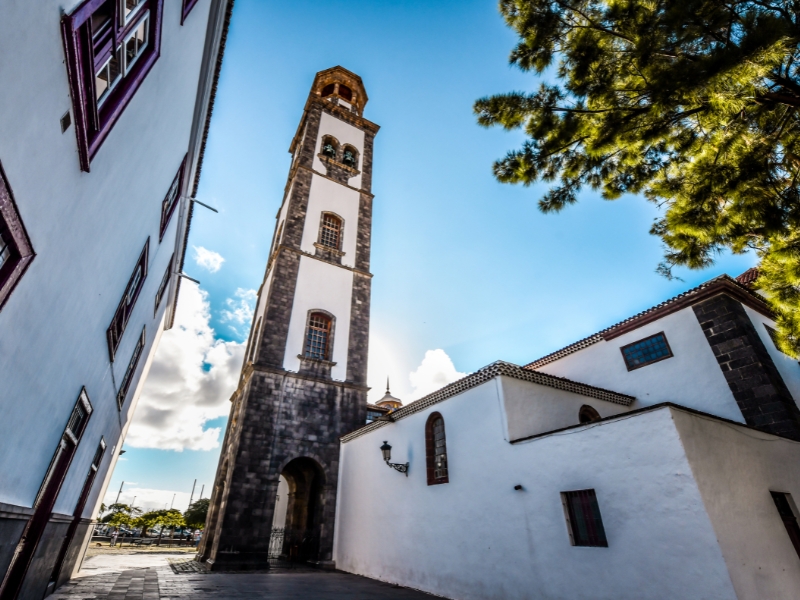
The Iglesia de Nuestra Señora de la Concepción is the main church of Santa Cruz de Tenerife, and its tall bell tower is one of the landmarks of the old centre. It stands close to the spot where the Castilian conquerors landed and held their first Mass, and it keeps the Cruz de la Conquista, the cross said to have been planted when the city was founded in 1494. It is also the only church in the Canary Islands with five naves.
The Iglesia de la Concepción at a glance
- Where: Plaza de la Iglesia, beside the Barranco de Santos ravine, a few minutes' walk from Plaza de España.
- Built: begun around 1500; rebuilt after a fire in 1652, with the present bell tower added in 1786.
- By: founded by the priest Juan Guerra; the building you see is mostly 17th- and 18th-century work.
- What it is today: the city's main parish church, often called the cathedral of Santa Cruz although it is not a cathedral; protected as a site of cultural interest.
- Time needed: 20 to 30 minutes, including the interior if it is open.
From the first chapel to a five-nave church
In 1494 the Castilian commander Alonso Fernández de Lugo landed on this part of the coast to begin the conquest of Tenerife. A cross was planted on the shore, and the name of the city, Santa Cruz, Holy Cross, comes from it. Around 1500 the priest Juan Guerra began a church dedicated to the Holy Cross on the site of the conquerors' first chapel, making it one of the first churches on the island. In 1638 it was renamed for the Immaculate Conception.
A fire destroyed the church in 1652, and it was rebuilt the following year. Over the next century and a half it grew into a large building with five naves on a Latin-cross plan, in a sober Tuscan style typical of Canarian church architecture. The bell tower that dominates the skyline of the old town was completed in 1786. Inside, the church gathered many of the city's most precious religious works, which is why people in Santa Cruz still treat it as their main church.
What to look for
- The bell tower of 1786, the most recognisable part of the church and a good landmark from the waterfront.
- The Cruz de la Conquista, the cross linked to Fernández de Lugo's landing in 1494 and the founding of the city.
- The Gothic image of the Virgen de la Consolación, the city's historic patron, for whom Fernández de Lugo raised a chapel in 1496.
- The Capilla de los Carta, an 18th-century chapel off the sacristy with a richly carved altarpiece, considered by many the finest part of the church.
- The main altar with the Immaculate Conception by the Canarian sculptor Fernando Estévez, and the organ brought from London in 1862.
The church that is not a cathedral
Locals often call the Concepción the cathedral of Santa Cruz, but the island's cathedral is actually in San Cristóbal de La Laguna, the old capital up in the hills. The nickname shows how central this church is to the city's identity: it holds the cross that gave Santa Cruz its name, the image of its patron St James and many of the treasures used in the big processions of Holy Week and Corpus Christi.
Tips for your visit
- The church is an active parish; visit outside Mass times and dress respectfully.
- For the best photo of the tower, stand on the far side of the Barranco de Santos, where you can see the church above the ravine.
- Combine it with a morning at the Mercado de Nuestra Señora de África, a short walk away across the ravine.
Nearby
- TEA Tenerife Espacio de las Artes: a modern art centre designed by Herzog & de Meuron, right by the Barranco de Santos.
- Mercado de Nuestra Señora de África: the city's colourful covered market, a few minutes' walk away.
- Plaza de España: the large square by the sea with its lake and the monument to the fallen, the centre of the city.
See Santa Cruz de Tenerife with World City Trail
Our Santa Cruz de Tenerife scavenger hunt turns the city into a game you play on your phone. The route takes around three hours, with about 48 minutes of walking. You can play in English, German, French, Italian, Spanish or Dutch.
If you prefer a different format, Santa Cruz de Tenerife also has a self-guided walking tour and an outdoor escape game.
Play the Santa Cruz de Tenerife scavenger hunt →
Take the self-guided walking tour of Santa Cruz de Tenerife →
Play the outdoor escape game in Santa Cruz de Tenerife →
Facts checked in October 2026.