
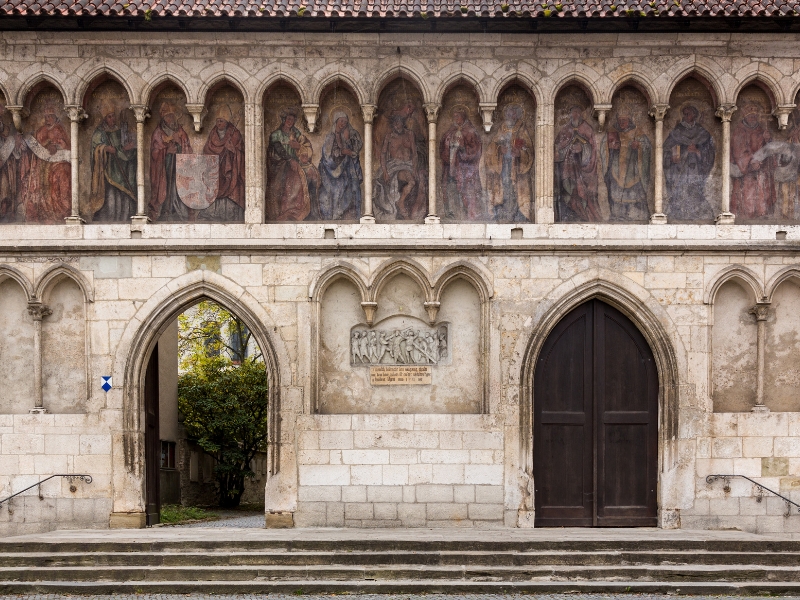
The Basilica of St Emmeram is the church of a former Benedictine abbey on the southern edge of Regensburg's old town, next to the palace of the Thurn und Taxis family. Behind a plain medieval exterior hides a Baroque interior by the Asam brothers, and beneath it lie crypts more than a thousand years old. It is also a royal burial place: Arnulf of Carinthia and Louis the Child, two East Frankish kings, are buried here.
St Emmeram at a glance
- Where: on Emmeramsplatz, at the southern edge of the old town, beside Schloss Thurn und Taxis.
- Built: Carolingian core from the late 8th century; west transept and Wolfgang crypt around 1050; freestanding bell tower 1575–1579; Baroque interior 1731–1733.
- By: the Baroque interior is the work of the brothers Cosmas Damian Asam (frescoes) and Egid Quirin Asam (stucco).
- What it is today: a Catholic parish church, a minor basilica since 1964 and part of the UNESCO World Heritage site 'Old Town of Regensburg with Stadtamhof'.
- Time needed: 30–45 minutes.
From royal abbey to princely palace
The abbey grew up around the grave of St Emmeram, a bishop who was killed in the 7th century and whose remains were brought to Regensburg. The church took shape under Bishop-Abbot Sintpert, who held office from 768 to 791. Around 980 Abbot Ramwold added an outer crypt to the east, and around 1050 the monks built a large west transept with a hall crypt for the relics of St Dionysius and St Wolfgang, the bishop of Regensburg canonised here in 1052 by Pope Leo IX, with Emperor Henry III present. Fires in 1166 and 1642 destroyed much of the furnishings, and between 1731 and 1733 the Asam brothers gave the nave its present Baroque look.
In 1731 the abbey became a prince-abbey, but its independence did not last. In 1810, during the secularisation of church lands, it was handed to the Thurn und Taxis family, the princes who ran the postal service of the Holy Roman Empire. They turned the monastery into their residence, Schloss St. Emmeram, which the family still owns. The church itself stayed in use as a parish church. Pope Paul VI raised it to a minor basilica on 5 March 1964.
What to look for
- The north portal reliefs: three stone figures from around 1052 showing Christ enthroned with St Emmeram and St Dionysius, among the earliest reliefs of their kind in Germany.
- The freestanding Renaissance bell tower, built between 1575 and 1579 partly from stone taken from Roman buildings.
- The Asam nave: pastel stucco and ceiling frescoes, with the high altar of 1669 showing the martyrdom of St Emmeram.
- The crypts: the Carolingian ring crypt still surrounds Emmeram's grave, and the Romanesque Wolfgang crypt holds St Wolfgang's burial place.
- The tombs and monuments: 83 funerary monuments in all, including memorials to Arnulf of Carinthia and Louis the Child and the historian Johannes Aventinus.
- The five-metre epitaph of Prince Alexander Ferdinand von Thurn und Taxis, put up in 1777, an early sign of the family's link with the church.
The legend of St Emmeram
Emmeram's story comes from a biography written by Bishop Arbeo of Freising around the middle of the 8th century, so treat it as part history, part legend. According to it, he was a Frankish bishop who stayed at the court of the Bavarian duke in Regensburg. When the duke's daughter Uta became pregnant, Emmeram is said to have taken the blame to protect the real father, and set off on a journey to Rome. Uta's brother Lantpert caught up with him at Helfendorf, south of Munich, and had him tortured and killed. He was buried at Aschheim, and the legend says that once the truth came out, his body was laid on a raft that floated up the Danube to Regensburg by itself.
Tips for your visit
- Come in the morning on a weekday, when the church is quiet and the light comes through the side windows onto the stucco.
- Parts of the crypts are not always open; ask in the church, and keep away from the altar area during services.
- Combine your visit with a guided tour of Schloss Thurn und Taxis next door, which includes the medieval cloister of the former abbey.
Nearby
- Schloss Thurn und Taxis: the former abbey buildings, now the family's palace, with state rooms and the old cloister on guided tours.
- Regensburg Cathedral: the Gothic cathedral of St Peter, with its twin spires, a short walk north through the old town.
- Neupfarrplatz: the square on the site of the medieval Jewish quarter, with an underground document centre showing its remains.
- Kepler Monument: a small classical temple in the park near the main station, honouring the astronomer Johannes Kepler, who died in Regensburg in 1630.
See Regensburg with World City Trail
Our Regensburg scavenger hunt turns the old town into a game you play on your phone. The route links 10 stops and takes around 3 hours, with about 46 minutes of walking. The Basilica of St Emmeram is one of the stops, along with the Kepler Monument. You can play in English, German, French, Italian and Dutch.
If you prefer a different format, there is also a self-guided walking tour and an outdoor escape game in Regensburg.
Play the Regensburg scavenger hunt →
Take the self-guided walking tour of Regensburg →
Play the outdoor escape game in Regensburg →
Facts checked in October 2026.