
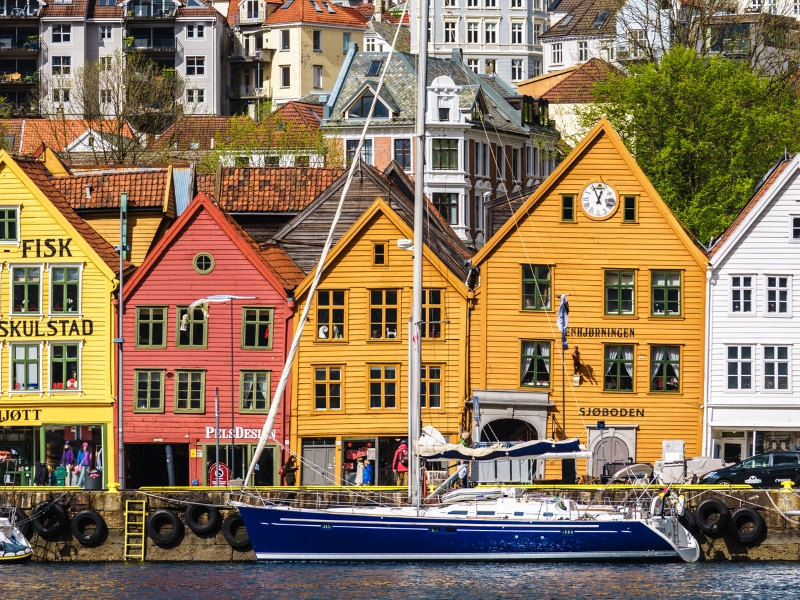
Bryggen is the row of steep-gabled wooden buildings along the east side of Vågen, the old harbour of Bergen. From around 1350 to 1754 it was the base of the Hanseatic merchants in Norway, who traded stockfish from the north for grain from the rest of Europe. Most of the houses you see were rebuilt after a fire in 1702, on the same plots and with the same methods as the medieval ones, which is why UNESCO listed the wharf as a World Heritage Site in 1979.
Bryggen at a glance
- Where: on the east side of Vågen harbour, between the Fish Market and Bergenhus Fortress.
- Built: most of the present buildings date from after the fire of 1702; the layout of plots and passages goes back to the Middle Ages.
- What it is today: a World Heritage Site of around 60 wooden buildings, used for shops, workshops, restaurants and museums.
- Time needed: about an hour to walk the passages, longer if you visit the museums.
From German wharf to World Heritage Site
Bryggen simply means the wharf. Bergen grew up around this harbour in the 11th century, and archaeologists have found piers here from around 1100. In about 1350 the Hanseatic League set up a trading office, or Kontor, in Bergen, and for four centuries German merchants controlled the trade from these buildings, which is why the quay was long called Tyskebryggen, the German Wharf. Merchants and their apprentices lived, worked and stored goods in long, narrow rows of houses: offices and living rooms at the front, warehouses in the middle, and kitchens and shared assembly rooms at the back.
Wooden buildings packed this tightly burned again and again. After the great fire of 1702 the merchants rebuilt on the old plots, following the old plan and building techniques. The Hanseatic office came to an end in 1754, when the properties passed to Norwegian owners. Later demolitions and a fire in 1955 left only about a quarter of the historic buildings standing. The 1955 fire also opened the ground for a long excavation that uncovered hundreds of runic inscriptions, many of them everyday messages carved on wooden sticks.
What to look for
- The gables facing the harbour: each one marks a separate property, called a gård, that runs a long way back from the quay.
- The narrow wooden passages between the rows, with galleries and outside staircases on the upper floors. Step in from the quay and walk all the way to the back.
- Walls and floors that lean visibly, a sign of three centuries of settling and repairs on this waterfront.
- Small stone storehouses at the back of the plots, built as fireproof stores for the most valuable goods.
- St Mary's Church rising behind Bryggen: the oldest building in the area and the church of the German merchants.
Two museums, one under restoration
Bryggens Museum stands on the ground cleared by the 1955 fire and shows finds from the excavation, including runic inscriptions and the remains of early wooden buildings. The Hanseatic Museum's main building, Finnegården, has been closed for a major restoration since 2018, with work expected to last until around 2027. Meanwhile its exhibition is shown at Schøtstuene, the merchants' old assembly rooms, so check which parts are open before you go.
Tips for your visit
- Come early in the morning or in the evening, when the passages are quiet and the light on the gables is soft.
- For the classic view of the whole row of gables, look across from the opposite side of the harbour.
- These are working buildings with shops and offices: keep your voice down in the passages and stay off private galleries.
- Walk Bryggen as part of a loop from the Fish Market at one end to Bergenhus Fortress at the other.
Nearby
- Bergenhus Fortress: one of the oldest fortresses in Norway, with the medieval Haakon's Hall, a few minutes' walk north.
- St Mary's Church: the Romanesque church just behind Bryggen, the oldest building in this part of the city.
- Fish Market: at the head of the harbour, good for seafood and for the view back towards Bryggen.
- Fløibanen: the funicular up Mount Fløyen starts a short walk inland and gives the best view over the city and harbour.
See Bergen with World City Trail
Our Bergen scavenger hunt turns the city centre into a game you play on your phone. The route links 10 stops and takes around 1.5 hours, with about 37 minutes of walking. It includes the National Stage, the Sailor's Monument and Bergen Cathedral.
If you prefer a different format, there is also a self-guided walking tour and an outdoor escape game in Bergen.
Play the Bergen scavenger hunt →
Take the self-guided walking tour of Bergen →
Play the outdoor escape game in Bergen →
Facts checked in October 2026.