
Perched majestically at the confluence of the Sava and Danube rivers, Kalemegdan in Belgrade is far more than just a park; it is the historical, cultural, and spiritual heart of the Serbian capital. This sprawling complex, encompassing the formidable Belgrade Fortress and the surrounding parkland, is a living chronicle of millennia of conquest, destruction, and rebirth. It stands as a powerful symbol of Belgrade’s resilience and its strategic importance, offering visitors a profound journey through the layers of Roman, Byzantine, Serbian, Ottoman, and Austro-Hungarian history.

A Fortress Forged Through Millennia: The Birth of Singidunum
The history of Kalemegdan in Belgrade dates back to antiquity, with archaeological evidence suggesting continuous habitation since the Neolithic period. However, its true significance as a fortified settlement began with the Romans. Around the 1st century AD, the Romans established a legionary fortress here, naming the settlement Singidunum. This formidable Roman castrum was built on the strategic plateau, protecting the northern borders of the Roman Empire.
Throughout the Byzantine era (from the 4th to 12th centuries), Singidunum, and its fortress, remained a crucial stronghold, constantly contested by various invading forces, including the Goths, Huns, Avars, and Slavs. Each successive power would rebuild, reinforce, and adapt the fortifications, adding new layers to its formidable walls.
The medieval Serbian state gained control of Belgrade at various points, particularly under Stefan Lazarević in the early 15th century. Lazarević, during his reign from 1402 to 1427, declared Belgrade the capital of Serbia and undertook a massive reconstruction of the fortress, transforming it into one of the most advanced military fortifications of its time. He built a new citadel, a magnificent palace, and a strong defensive wall connecting it to the city.
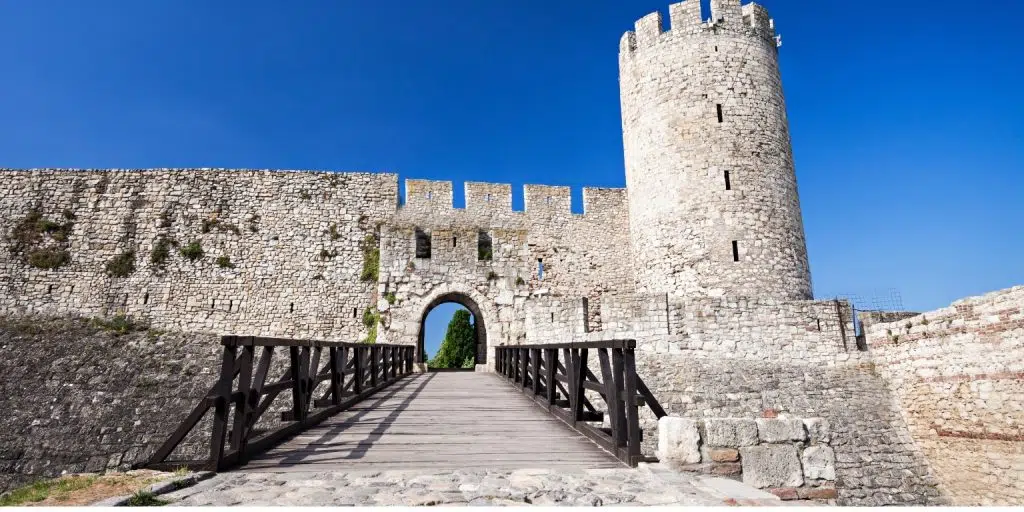
Ottoman and Austro-Hungarian Eras: A Battleground of Empires
The Ottoman Empire eventually conquered Belgrade in 1521, holding it for over three centuries, despite several brief occupations by the Habsburg Monarchy. During the Ottoman period, the fortress, which they called Kalemegdan (from the Turkish words kale meaning “fortress” and meydan meaning “field” or “square,” referring to the parade ground), was heavily reinforced. The distinctive Clock Tower (Sahat Kula) was added during the Austro-Hungarian occupation in the early 18th century, and the baroque gates were also added during this period. The various gates, walls, and bastions reflect the distinct architectural styles and defensive strategies of these competing empires.
The fortress was handed over to Serbian control in 1867 (which is also the year the Ottomans definitively left Belgrade), marking the end of foreign military presence. After this, the area began its transformation from a purely military stronghold into a public park.

Kalemegdan Park: A Place of Peace and Monuments
The vast parkland surrounding the fortress, which also bears the name Kalemegdan, began to take shape in the late 19th century. It was envisioned as a green oasis for the citizens, transforming former parade grounds and military zones into landscaped gardens, promenades, and recreational areas. This transformation accelerated in the early 20th century and continued throughout the Yugoslav era.
Today, Kalemegdan Park is Belgrade’s largest and most beautiful park, offering a wealth of attractions:
- Victor Monument: The iconic Pobednik (Victor) Monument, a symbol of Belgrade, was erected in 1928 to commemorate Serbia’s victory over the Ottoman and Austro-Hungarian empires during the Balkan Wars and World War I. Sculpted by Ivan Meštrović, it stands on the highest plateau, offering breathtaking views of the confluence of the Sava and Danube.
- Military Museum: Housed within the fortress, this museum, established in 1878, showcases over 3,000 military objects from ancient times to the present day.
- Belgrade Zoo: Founded in 1936, it is one of the oldest zoos in Europe.
- Roman Well: A mysterious and deep well with a debated purpose, dating from the Austro-Hungarian period (early 18th century).
- Ruzica Church and St. Petka’s Chapel: These quaint and historically significant churches, largely rebuilt in the early 20th century (after WWI), are nestled within the fortress walls.
- The Gates and Walls: Explore numerous gates like the Zindan Gate, Stambol Gate, and Leopold’s Gate, and walk along the ancient battlements.
Kalemegdan in Belgrade, with its origins as a Roman fortress in the 1st century AD and its transformation into a beloved public park starting after 1867, encapsulates the very soul of the city. It is a place where history breathes, offering panoramic views, tranquil green spaces, and an unparalleled journey through the layers of empires that shaped Belgrade into the vibrant capital it is today.