
Amidst the timeless grandeur of Pisa’s Piazza dei Miracoli—the Square of Miracles—where the ancient stones of the Baptistery, Cathedral, and Leaning Tower stand as testaments to medieval glory, a more modern, yet equally poignant, figure rests on the manicured lawn. The Angelo Caduto, or “Fallen Angel,” is a striking bronze sculpture that offers a powerful contrast to the Romanesque masterpieces surrounding it. Created by the renowned Polish sculptor Igor Mitoraj, this work invites visitors to look beyond the iconic monuments and contemplate a more human and tragic story: that of vulnerability, imperfection, and the fall from grace.

Igor Mitoraj: The Modern Sculptor of Myth
Igor Mitoraj (1944-2014) was a master of his craft, known for his monumental bronze and marble sculptures that often reinterpreted classical themes and mythological figures. His works are characterized by their deliberate fragmentation and a sense of ruin, as if they have been unearthed from a long-lost civilization. This approach was a direct commentary on the enduring beauty of classical art and the fragility of human existence. The Angelo Caduto is a quintessential example of his style, presenting a powerful figure that is both god-like in its form and heartbreakingly mortal in its state of decay.

The Symbolism of the Fallen Angel
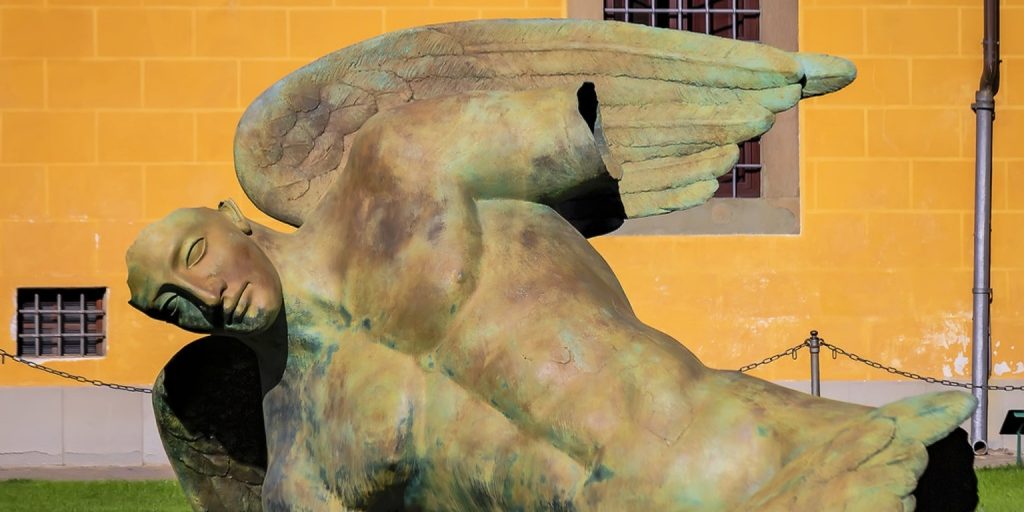
Placed in a location where a legendary angel once flew, the Angelo Caduto in Pisa is often seen as a symbolic reinterpretation of the myth of Icarus. The sculpture depicts a winged figure—a god, a hero, or an angel—whose journey has ended in a catastrophic fall. The figure is missing its limbs, and its head is bent, suggesting not just physical ruin but profound defeat. One of its wings is prominently displayed, broken and torn, with a screaming head embedded in its folds, a haunting detail that captures the agony of the fall.
The work’s placement near the Leaning Tower adds another layer of symbolism, as both structures represent a kind of physical imperfection, one a triumph of engineering and the other a tragic defeat of a mythical being.
The Angelo Caduto is more than just a piece of modern art; it is a meditation on the human condition. It represents the hero who has flown too close to the sun, the ideal that has failed, and the beauty that exists even in a state of disrepair. Mitoraj’s art challenges viewers to consider the beauty in imperfection and the poignancy of ruin. The sculpture serves as a quiet and powerful statement that stands in conversation with the more triumphant, perfect beauty of the medieval monuments nearby.
Finding the Angel: A Walk Through the Piazza
For those visiting the Square of Miracles, finding the Angelo Caduto is an essential part of the experience. The sculpture is located on the green lawn, and while it may not be as prominent as the Tower, its emotional weight is undeniable. Its presence adds a contemporary layer to the historical narrative of the square, reminding us that art, like history, is a continuous story. The contrast between the weathered stone of the medieval buildings and the sleek, broken bronze of the Angelo Caduto is a visual metaphor for the passage of time and the evolution of artistic expression.
The Angelo Caduto in Pisa is not a piece of history, but it is a vital part of Pisa’s modern identity. It stands as a testament to the city’s role as a cultural hub where the old and the new can coexist in powerful harmony. It is a symbol of both the city’s rich artistic legacy and its embrace of contemporary expression. A visit to the Piazza dei Miracoli is not complete without taking a moment to reflect on this beautiful, haunting, and deeply human work of art.