
While millions of visitors flock to Pisa each year for a glimpse of its Leaning Tower, a short walk away lies a different kind of marvel, one that holds the true essence of the city’s complex and powerful history. The Piazza dei Cavalieri (Knight’s Square) is a masterwork of Renaissance urban planning, a place where a medieval civic heart was transformed into a symbol of a new dynastic order. This elegant square, with its stunning palaces and deep-rooted legends, serves as a poignant reminder of Pisa’s journey from a formidable maritime republic to a city under Medici rule.
From Medieval Hub to Renaissance Stage
The history of Piazza dei Cavalieri is one of dramatic transformation. In the Middle Ages, the square was known as Piazza delle Sette Vie and served as Pisa’s political and civic center. It was here that public meetings were held and political decisions were made. However, after Pisa was conquered by Florence in the 15th century, the Florentine rulers sought to erase the memories of the city’s rebellious past. In the 16th century, Grand Duke Cosimo I de’ Medici commissioned the great artist and architect Giorgio Vasari to redesign the square and create a grand headquarters for a new military order.
Vasari’s vision was a complete overhaul. He unified the space by creating a cohesive architectural scheme and turning the square into a showpiece for the newly founded Order of Saint Stephen. This order was established to defend the Tuscan coastline from Ottoman and pirate raids, and the square became its ceremonial and administrative home.
A Collection of Architectural Masterpieces
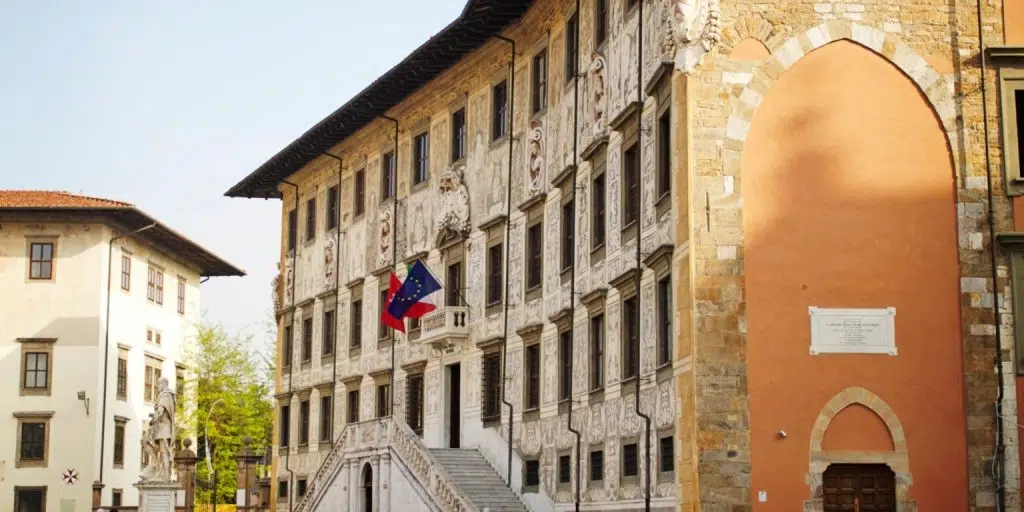
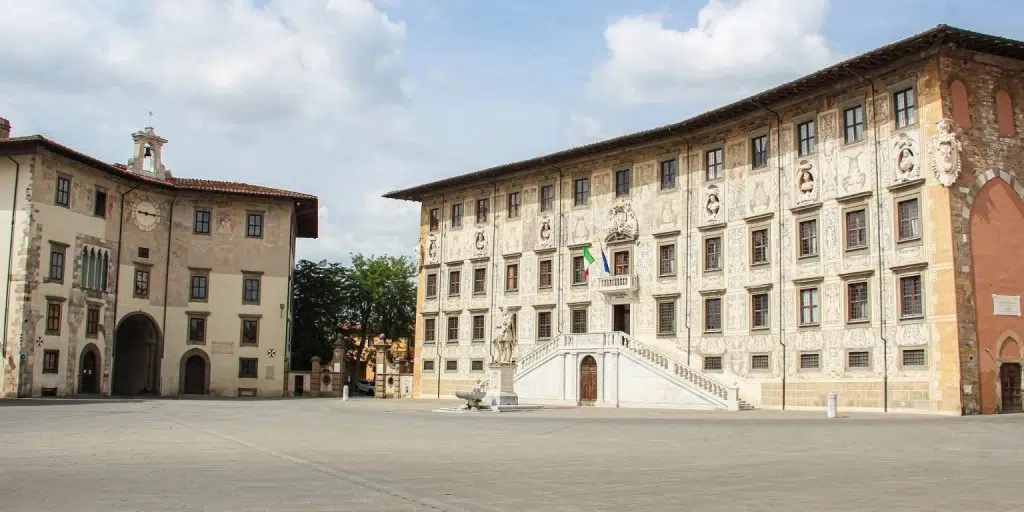
The most prominent building on the square is the Palazzo della Carovana (Palace of the Caravan), which served as the Order of Saint Stephen’s main office and training center. Its facade, designed by Vasari, is a magnificent example of sgraffito, a technique that involves scratching away a surface layer to reveal a contrasting color beneath. The intricate geometric and allegorical patterns, along with the busts of the Medici Grand Dukes, symbolize the order’s power and its loyalty to the Florentine rulers. Today, the palazzo houses the prestigious Scuola Normale Superiore di Pisa, one of Italy’s most elite universities, continuing the square’s legacy as a center of intellectual life.
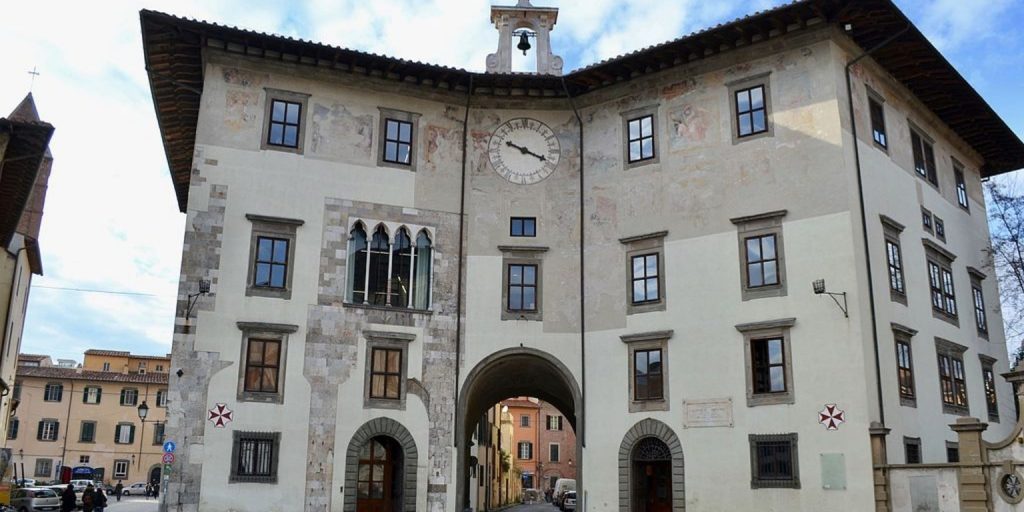
Directly across from the palace stands the Palazzo dell’Orologio (Palace of the Clock), another key building of the square. Vasari’s genius is on full display here, as he seamlessly connected two medieval towers with a beautiful arch and a central clock. One of these towers is the infamous “Tower of Hunger,” where Count Ugolino della Gherardesca and his family were starved to death in 1289, a tragedy immortalized in Dante’s Inferno. The palace serves as a powerful link between Pisa’s medieval past and its Renaissance present.
The Enduring Heart of the City
At the center of the piazza stands a statue of Cosimo I de’ Medici, a permanent reminder of the power shift that shaped the square. The Piazza dei Cavalieri is a public space that tells a story of conflict, transformation, and enduring pride. It stands as a testament to the city’s rich history, from its days as a fierce maritime republic to its role as a beacon of academic excellence. The Piazza dei Cavalieri in Pisa is an essential visit for anyone who wishes to understand the deep and complex layers of this truly remarkable city.
World City Trail’s Scavenger Hunt Guides you through the best places of Pisa with a unique way. Don’t miss the chance to learn more about Pisa while playing.