
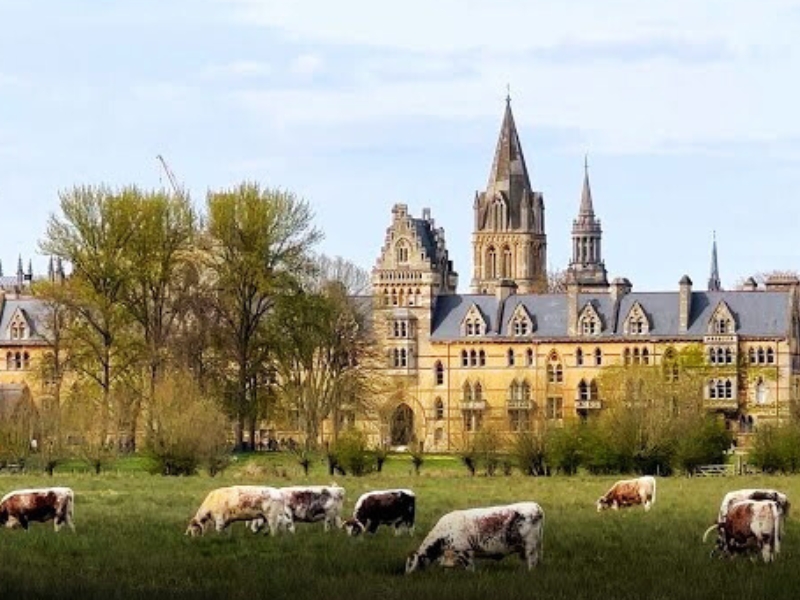
This guide links five places in central Oxford that tell the city's story from very different angles: the Ashmolean Museum, the blue plaques on the city's houses, the library of All Souls College, the Story Museum and Christ Church Meadow. They sit along one north-to-south line through the centre, so you can walk from the museum on Beaumont Street to the rivers south of Christ Church in a single outing, with a lot of history and a little countryside on the way.
The Ashmolean Museum
The Ashmolean opened on 24 May 1683 and is described as Britain's first public museum. It began with the cabinet of curiosities that Elias Ashmole gave to the University of Oxford in 1677, a collection he had acquired from the gardeners and collectors John Tradescant the Elder and his son. The first museum stood on Broad Street; that original building, the Old Ashmolean, has housed the History of Science Museum since 1924.
The museum you visit today is on Beaumont Street. Its classical front was designed by Charles Cockerell and built between 1841 and 1845 as the University Galleries. Behind it, a large extension by the architect Rick Mather opened in November 2009, with bright, open galleries arranged around the theme of cultures meeting and influencing each other. The Ashmolean is one of the stops on our Oxford scavenger hunt.
- The Alfred Jewel, a small Anglo-Saxon object of gold, enamel and rock crystal with an Old English inscription that reads "Alfred ordered me to be made".
- The Messiah Stradivarius, a violin made by Antonio Stradivari and kept in near-mint condition.
- Powhatan's Mantle, a ceremonial cloak of deer hide decorated with shell, linked to the Powhatan chief in Virginia, which came to the museum with the Tradescant collection.
The blue plaques of Oxford
As you walk through Oxford, look up at the walls: oval blue plaques mark the houses where remarkable people lived or worked. Most of them are put up by the Oxfordshire Blue Plaques Board, founded in 1999 to commemorate "very remarkable residents and, occasionally, historic events". The city of Oxford alone has more than 80 of its plaques, and together they read like a map of who made the city, from scientists and architects to a marmalade maker.
The people on the plaques are not only famous academics. Many were women whose work was overlooked in their own time, local tradespeople and campaigners. Spotting plaques is a good way to slow down on busy streets such as Broad Street and the High Street, and to notice the ordinary houses between the colleges.
- 83 High Street: Sarah Cooper, who made the marmalade that became famous as Frank Cooper's Oxford marmalade.
- 12 King Edward Street: Ivy Williams, the first woman called to the Bar in England and Wales, in 1922.
- St Helen's Passage, the narrow lane off New College Lane: the birthplace of Jane Burden, who became the wife and model of William Morris. Nearby on New College Lane, another plaque records that the astronomer Edmond Halley lived there.
The library of All Souls College
All Souls was founded in 1438 by King Henry VI and Archbishop Henry Chichele to remember those who died in the Hundred Years' War. It is unusual even by Oxford standards: it has no undergraduate students, only fellows, and its fellowship examination has been called the hardest exam in the world. Its library, the long building facing Radcliffe Square, was designed by Nicholas Hawksmoor, begun in 1716 and completed in 1751.
The library was paid for by a bequest of £10,000 and a large book collection from Christopher Codrington, a former fellow who died in 1710. His wealth came largely from sugar plantations in Barbados and Antigua, worked by enslaved Africans. In 2018 the college placed a plaque on the library "in memory of those who worked in slavery on the Codrington Plantations in the West Indies", and in November 2020 it stopped using the name Codrington Library: it is now simply the Library at All Souls College. His marble statue by Henry Cheere still stands inside.
- The memorial plaque, made of Yorkshire limestone to match the colonnade, to the right of the library entrance; you can see it from Radcliffe Square.
- The sundial designed by Christopher Wren, a fellow of the college, in 1658 for the chapel; since 1877 it has been above the central entrance to the library, in the quadrangle.
The Story Museum
The Story Museum on Pembroke Street, a short walk from Christ Church, is a museum about stories rather than objects, fitting for a city linked with Lewis Carroll, J.R.R. Tolkien and C.S. Lewis. It was founded in 2003 and moved into Rochester House, a former post office and telephone exchange. After a redevelopment completed in 2020, the building holds a theatre, a learning studio and themed rooms where children and adults step inside famous books. The Story Museum is one of the stops on our Oxford scavenger hunt.
- The Enchanted Library, a set of wood-panelled rooms where you walk into key moments from eight stories, from the wardrobe of fur coats that leads to Narnia to a game of noughts and crosses linked to Malorie Blackman's novel.
- Small Worlds, a room for children under five inspired by picture books and nursery rhymes, and an indoor forest of traditional tales from around the world.
Christ Church Meadow
Christ Church Meadow is a roughly triangular stretch of open land between the River Thames (called the Isis in Oxford), the River Cherwell and Christ Church, the college founded under Henry VIII on the site of Cardinal Wolsey's earlier foundation. The meadow belongs to the college but is open to the public during the day. The lower parts near the river are grazed by English Longhorn cattle, while the upper parts are used as sports fields, and the college boathouses line the Thames, where the rowing races of Eights Week and Torpids take place.
The meadow has some unexpected stories. On 4 October 1784, the pastry cook James Sadler took off from here in a hot-air balloon, the first ascent by an Englishman, and landed safely near Woodeaton. Plans after the Second World War for a relief road across the meadow were fought for years and finally defeated in 1971. Christ Church Meadow is the last stop on our Oxford scavenger hunt, and Christ Church itself is a stop just before it.
- The Meadow Building, the college range in Venetian Gothic style that faces the meadow, built in 1862–66 to designs by Thomas Deane.
- Dead Man's Walk, the path along the northern edge below Merton College; it is said to follow the route of medieval Jewish funerals to the old Jewish cemetery, and the plaque to James Sadler's flight is on the Merton wall here.
- Broad Walk and Poplar Walk, the two main paths: Broad Walk runs along the top of the meadow, and Poplar Walk, laid out in 1872 by Dean Henry Liddell, the father of Alice Liddell, leads down to the river.
How to see them in one walk
Start at the Ashmolean on Beaumont Street, then walk east to Broad Street and turn into New College Lane, where you'll find the Halley plaque and St Helen's Passage. From there it is a short step to Radcliffe Square and the library of All Souls. Walk down to the High Street to see the Sarah Cooper plaque at number 83, then cut through to St Aldate's and Pembroke Street for the Story Museum. Finish at Christ Church and go through the War Memorial Garden to Broad Walk and the meadow, ideally late in the afternoon, when the light on the college buildings is soft.
See Oxford with World City Trail
Our Oxford scavenger hunt turns the city centre into a game you play on your phone. The route links 10 stops, from Oxford Castle & Prison to Christ Church Meadow, and the Ashmolean Museum, the Story Museum and Christ Church Meadow from this guide are all stops, along with the Covered Market, the History of Science Museum, the Bodleian Library, the Radcliffe Camera and Christ Church. At each stop you solve a puzzle and learn a story, at your own pace.
There is also a self-guided walking tour and an outdoor escape game in Oxford, for people who prefer a different format.
Play the Oxford scavenger hunt →
Take the self-guided walking tour of Oxford →
Play the outdoor escape game in Oxford →
Facts checked in October 2026.