
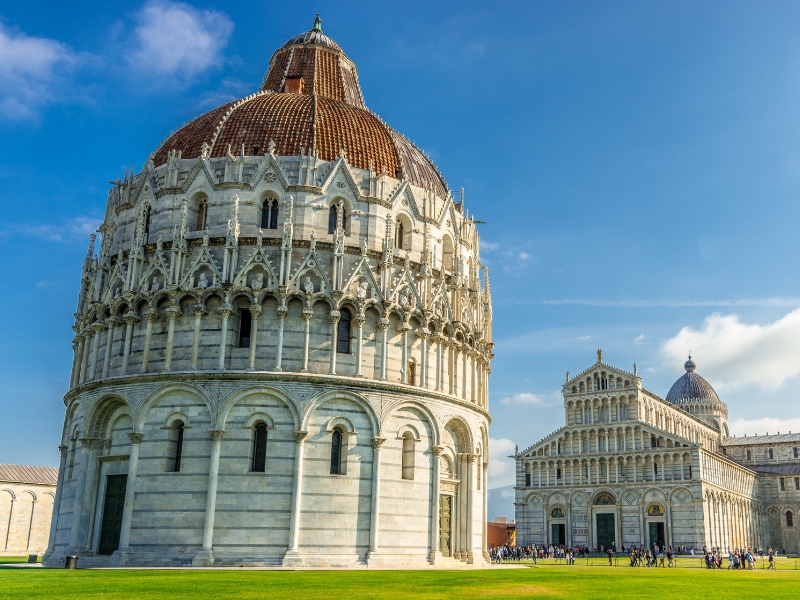
This guide covers four places that tell the story of Pisa as a power, first at sea and then under the Medici: the Cathedral and the Baptistery on the Piazza dei Miracoli, and Piazza dei Cavalieri with the Palazzo dell'Orologio in the middle of town. The first two were paid for by a rich maritime republic; the square was rebuilt after that republic had fallen to Florence. They sit on the same short walk, so you can see all four in one outing.
Pisa Cathedral
The Cathedral of Santa Maria Assunta was begun in 1063–64 by the architect Buscheto, and it was paid for with the spoils of Pisan raids on Muslim-held Sicily, including Palermo. Some of the granite columns inside are said to come from a mosque in Palermo. The church was consecrated by Pope Gelasius II in 1118, and the architect Rainaldo later lengthened the nave and designed the facade of grey and white marble with four rows of small open arcades. It set the model for what is now called Pisan Romanesque, a style copied in churches from Lucca to Sardinia.
A fire in 1595 destroyed much of the interior, including the roof and the main bronze doors, so many of the furnishings date from the years after. A few older treasures survived. In the apse, the figure of Saint John in the great mosaic of Christ enthroned is the last documented work by Cimabue, from 1302. The pulpit by Giovanni Pisano, carved between 1302 and 1310, was taken apart after the fire and only put back together in 1926, with a few pieces missing.
- The Porta di San Ranieri, the door facing the Leaning Tower, with bronze panels cast around 1180 by Bonanno Pisano: the only door that survived the fire.
- The bronze lamp in the nave known as Galileo's lamp. The story that it inspired his ideas on the pendulum is a legend: the lamp you see was hung after his observations, and the older one is kept in the Camposanto.
- The tomb of Emperor Henry VII, carved by Tino di Camaino after the emperor died in 1313 while at war with Florence, and the relics of Saint Ranieri, the patron saint of Pisa.
Baptistery of San Giovanni
The round Baptistery facing the cathedral front was begun in 1152 by an architect called Diotisalvi, who left his name and the date carved inside. Work dragged on for two centuries: the lower level with its round arches is Romanesque, while Nicola Pisano and later his son Giovanni gave the upper floors their Gothic gables and pinnacles, and the building was only finished in 1363. Over 54 metres high, it is the largest baptistery in Italy, and it leans slightly towards the cathedral, because it stands on the same soft ground as the tower.
Inside, the main surprise is the sound. The double dome holds a single note for several seconds, and staff regularly sing a few notes to show how the echoes build into a chord. Next to the font stands the pulpit by Nicola Pisano, dated 1260, whose marble reliefs of the life of Christ draw on Roman sarcophagi and are seen as an early step towards Renaissance sculpture.
- The octagonal font from 1246 by Guido Bigarelli da Como, made for baptism by immersion, with a bronze Saint John the Baptist by Italo Griselli in the middle.
- The roof from outside: the half facing the cathedral is covered in lead, the half facing the sea in red tiles.
- The upper gallery, from where you can look down into the font and across to the cathedral facade.
Piazza dei Cavalieri
In the Middle Ages this was the political centre of the city, the square where the Commune of Pisa had its palaces. In 1558 Grand Duke Cosimo I de' Medici, who now ruled Pisa from Florence, had Giorgio Vasari rebuild it as the seat of a new crusading order of knights, the Order of Saint Stephen, founded in 1561 to fight pirates in the Mediterranean. The old public palaces were refaced in Renaissance style, and the square became a stage for Medici power.
The long building with the black and white sgraffito decoration is the Palazzo della Carovana, the knights' headquarters, which now belongs to the Scuola Normale Superiore, a university college set up under Napoleon. Next to it, the church of Santo Stefano dei Cavalieri was designed by Vasari and built between 1565 and 1569; inside hang flags and trophies the knights captured from Ottoman and North African ships. The square is one of the stops of our scavenger hunt.
- The statue of Cosimo I in armour in front of the Palazzo della Carovana, made by Pietro Francavilla in the 1590s, with one foot on a dolphin as a sign of power over the sea.
- The fountain below the statue, which was switched on again in 2021 after twenty years without water.
- The marble facade of Santo Stefano, designed by Don Giovanni de' Medici, and the carved wooden ceiling inside with paintings of the order's sea battles.
Palazzo dell'Orologio
The Clock Palace closes the north side of the square with an arch over the street. It was built between 1603 and 1608, perhaps to a design left by Vasari, by joining two medieval buildings: the palace of the Captain of the People on the left and an old tower on the right. The arch between them carries the clock that gave the palace its name in 1696, when it was moved here from the church of Santo Stefano. The knights used the building as an infirmary, and today it holds the library of the Scuola Normale.
The tower on the right has a grim past. In 1288 Count Ugolino della Gherardesca, who had ruled Pisa, was locked in it with his sons and grandsons, and in 1289 they starved to death. Dante tells the story in Canto XXXIII of the Inferno and calls the tower the Muda; it is still known as the Tower of Hunger. The remains of the medieval tower were brought back to light in a restoration in the late 1970s.
- The traces of the medieval tower walls in the right-hand part of the facade.
- The clock and the bell above the arch, and the coats of arms of the knights on the front.
How to see them in one walk
Start in Piazza dei Cavalieri and look at the square as a whole: the Palazzo della Carovana, Santo Stefano and the statue of Cosimo I, then the Palazzo dell'Orologio. Walk under its arch and head north-west through the old streets to the Piazza dei Miracoli. Visit the Cathedral first, then cross the lawn to the Baptistery and climb to its gallery. If you have time, go on to the Leaning Tower and the Camposanto on the same square. In summer it is worth booking tickets for the Piazza dei Miracoli ahead.
See Pisa with World City Trail
Our Pisa scavenger hunt turns the city into a game you play on your phone. The route links 10 stops, from Keith Haring's Tuttomondo mural to the Baptistery, and Piazza dei Cavalieri, the Cathedral and the Baptistery are all stops, along with Santa Maria della Spina, Palazzo Blu, Piazza Garibaldi, the statue of Galileo Galilei, the Palazzo della Carovana and the Leaning Tower. At each stop you solve a puzzle and learn a story, at your own pace.
There is also a self-guided walking tour and an outdoor escape game in Pisa, for people who prefer a different format.
Play the Pisa scavenger hunt →
Take the self-guided walking tour of Pisa →
Play the outdoor escape game in Pisa →
Facts checked in October 2026.