
Old Quebec is the only city north of Mexico that has kept its fortified walls, and its history is easy to read in its buildings: French, then British, then Canadian. This guide follows four places from the Upper Town down to the river: Quebec City Hall, the Anglican Cathedral of the Holy Trinity, Montmorency Park on the edge of the cliff, and Place Royale, where the city began in 1608. Together they show how the city was governed, how the British left their mark, and where it all started.
Quebec City Hall
The city hall on Rue des Jardins was inaugurated on 15 September 1896. Its architect, Georges-Émile Tanguay, mixed several styles, with classical details, medieval touches and the steep roofs and turrets of the Châteauesque style that was popular in Canada at the time. The site has a long past: for well over a century it was occupied by the Jesuit college, which after the British conquest became a barracks and was finally pulled down in 1878. Before 1896 the council met in a private house. The building has been a National Historic Site of Canada since 1984, and it is the first stop of our scavenger hunt.
- The way the building follows the slope of the hill, so that one side is higher than the other.
- The small garden beside the building, one of the few green spaces inside the walls of the Upper Town.
Cathedral of the Holy Trinity
A few steps away, just off Place d'Armes, stands a church that looks as if it had been carried over from London. The Cathedral of the Holy Trinity was built between 1800 and 1804 and consecrated on 28 August 1804, and it was the first Anglican cathedral built outside the British Isles. It was designed by two military officers, William Robe and William Hall, in the Palladian style, taking St Martin-in-the-Fields in London as a model. King George III paid for it and sent a Bible, prayer books and a set of communion silver.
It stands on the site of a monastery of the Récollet friars, whose chapel had been shared by Catholics and Anglicans after 1760. When the monastery burned in 1796, the British decided to build a proper seat for the new Anglican diocese of Quebec. Its first bishop, Jacob Mountain, is buried under the choir.
- The royal pew in the upper gallery, marked with the royal coat of arms and kept for members of the royal family and their representatives.
- The silver given by George III, displayed in a side aisle.
- The eight bells cast at the Whitechapel foundry in London and hung in 1830, the oldest change-ringing peal in Canada. The local belief that the oak pews came from Windsor Forest is a myth: the wood is local.
Montmorency Park
At the top of Côte de la Montagne, where the road drops down to the Lower Town, a small park sits on the edge of the cliff with cannons along the wall and a wide view over the St Lawrence. Its history is political. Bishop Saint-Vallier built his palace here in the 1690s, and from 1792 the building served as the parliament of Lower Canada. Later buildings on the same spot housed the parliaments of Lower Canada, the Province of Canada and Quebec, until the last one burned in the 1880s and the site became a park.
The park is named after Henri II de Montmorency, viceroy of New France from 1619 to 1625, and it has been a National Historic Site since 1949. It is one of the stops of our scavenger hunt.
- The monument by Alfred Laliberté to Louis Hébert, Marie Rollet and Guillaume Couillard, the first farming family of New France, with a plaque listing early settlers on the back.
- The statue of George-Étienne Cartier, one of the Fathers of Confederation, and the cannons pointing over the river and the roofs of the Lower Town.
Place Royale
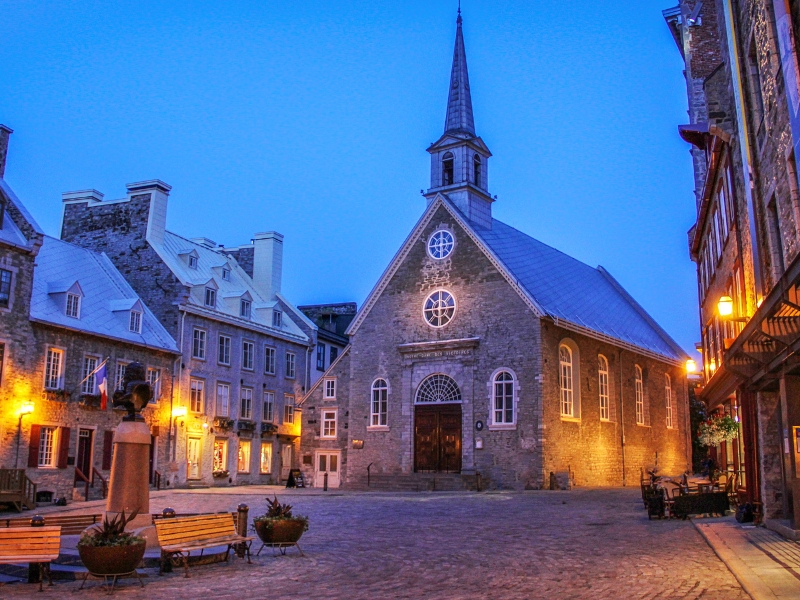
Down by the river, this small square is where Samuel de Champlain founded Quebec in 1608, building his fortified Habitation. In the 1620s it became the town's first market square, and it took the name Place Royale in 1686, when a bust of Louis XIV was set up in the middle; the bust you see today was installed in 1931. After the British period the square lost much of its French look, and from 1970 a large restoration project removed later additions and brought back the stone houses with steep roofs and tall chimneys of New France.
On one side stands Notre-Dame-des-Victoires, a stone church begun in 1688 on the site of Champlain's Habitations; stones from the second Habitation are still in its walls. It is named after two French victories over British fleets, in 1690 and 1711. Ironically, it was destroyed in the British siege of 1759 and rebuilt afterwards. Place Royale is part of the Historic District of Old Québec, a UNESCO World Heritage Site since 1985, and one of the stops of our scavenger hunt.
- The bust of Louis XIV in the middle of the square.
- The plain facade and small bell tower of Notre-Dame-des-Victoires, one of the oldest stone churches in Canada.
- The stone houses around the square, with firewalls rising above the roofs to stop fires spreading, a typical feature of New France towns.
How to see them in one walk
Start at City Hall on Rue des Jardins and walk past Place d'Armes to the Cathedral of the Holy Trinity. Continue towards the river to Montmorency Park at the top of Côte de la Montagne, and enjoy the view. Then go down the hill, either along Côte de la Montagne or by the Breakneck Steps, to the Lower Town and Place Royale. You can return to the Upper Town on the funicular next to the Breakneck Steps or on foot. In winter, the steps and slopes can be icy, so wear good shoes.
See Old Quebec with World City Trail
Our Quebec City scavenger hunt turns the old town into a game you play on your phone. The route links 10 stops, from City Hall to the Fresque du Petit-Champlain, and City Hall, Montmorency Park and Place Royale are all stops, along with the Notre-Dame basilica, Place d'Armes, the Château Frontenac, Dufferin Terrace, the Fresque des Québécois and the Breakneck Steps. The Cathedral of the Holy Trinity is not on the route, but it is right next to Place d'Armes. At each stop you solve a puzzle and learn a story, at your own pace.
There is also a self-guided walking tour and an outdoor escape game in Quebec City, for people who prefer a different format.
Play the Quebec City scavenger hunt →
Take the self-guided walking tour of Quebec City →
Play the outdoor escape game in Quebec City →
Facts checked in October 2026.