
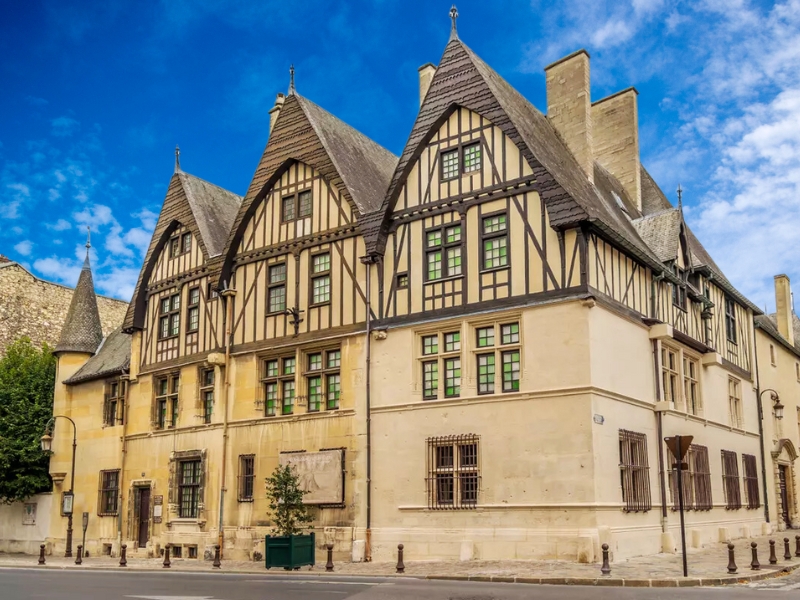
This guide covers five places in Reims that tell the city's story from Roman times to 1945: Square Colbert in front of the station, the Roman Porte de Mars, the Museum of the Surrender, the Musée-Hôtel Le Vergeur on Place du Forum and the Palais du Tau beside the cathedral. They sit on one walk from the station to the cathedral, and each shows a different chapter: Roman Durocortorum, a merchant town, the coronation city of the French kings and the end of the Second World War in Europe.
Square Colbert
Square Colbert is the garden you see first when you walk out of Reims station. It was laid out in 1828 and redesigned about thirty years later as an English-style garden, with winding paths, lawns, trees and flower beds, at the time the railway station was built. It sits between the station and Place Drouet d'Erlon, the long pedestrian square that leads into the city centre. Square Colbert is the starting point of our Reims scavenger hunt.
- The bronze statue of Jean-Baptiste Colbert in the middle of the garden, by the sculptor Eugène Guillaume, put up in 1860. Colbert, born in Reims in 1619, was the minister who ran the finances and trade of Louis XIV.
- The pedestal, designed by the architect Théodore Ballu, who also worked on the rebuilding of the Paris city hall.
Porte de Mars
A short walk north of the station stands the Porte de Mars, a Roman triumphal arch built in the first part of the 3rd century AD, when Reims was Durocortorum, one of the main cities of Roman Gaul. It is about 32 metres long and 13 metres high and has three wide arches. In 1228 it was built into the archbishops' castle, and after the castle was pulled down in 1595 it stayed inside the city walls with its openings blocked. It was rediscovered in 1667 but only fully freed when the walls were taken down in the 1840s and 1850s. The arch is one of the stops on our scavenger hunt.
- The carved ceilings of the passageways: look up to find Romulus and Remus with the she-wolf, and scenes of farm work.
- The relief of Leda and the swan, one of the carvings that survived the centuries inside the walls.
Museum of the Surrender
In an ordinary red-brick technical school on what is now Rue Franklin Roosevelt, General Eisenhower set up the Supreme Headquarters Allied Expeditionary Force (SHAEF) in February 1945. In the map room on the first floor, at 2.41 in the morning on 7 May 1945, General Alfred Jodl signed the unconditional surrender of the German armed forces. General Walter Bedell Smith signed for the Western Allies, General Ivan Susloparov for the Soviet Union, and General François Sevez countersigned as a witness for France. Fighting was to stop on 8 May at 11.01 pm.
The building is now the Lycée Roosevelt, and the room became the Musée de la Reddition in 1985, forty years after the victory. Archives, uniforms and objects tell the story of the months before the surrender, and the map room itself, with the maps on its walls behind glass, is the main reason to come. The museum is not on our scavenger hunt route, but it is close to the station and the Porte de Mars.
- The map room, kept with the operations maps that lined its walls in 1945.
- The table where the act of surrender was signed, and the list of who sat around it.
Musée-Hôtel Le Vergeur
On Place du Forum, the old market square laid out over the Roman forum, stands the Hôtel Le Vergeur, a house whose oldest parts go back to the 13th century. It belonged to wealthy merchants, and its two levels of vaulted cellars suggest that wine was once traded here. In the 19th century it was owned by Madame Clicquot-Ponsardin, the widow behind the Veuve Clicquot champagne house, and her heirs.
In 1910 the house was bought by Hugues Krafft (1853–1935), a traveller and collector who had journeyed in the Middle East and East Asia. After the First World War damaged it, he rebuilt it and gave space to the collections of the Société des Amis du Vieux Reims, the society of the Friends of Old Reims. On his death his furniture and art became the core of the museum. Donors later added its most famous pieces: complete original series of Albrecht Dürer's engravings The Apocalypse and The Large Passion. The museum is one of the stops on our scavenger hunt.
- Across the square, the Cryptoportique: the half-buried Roman gallery of the forum, another stop on the route, which shows what lies beneath Place du Forum.
Palais du Tau
Next to the cathedral stands the Palais du Tau, for centuries the palace of the archbishops of Reims. Its name, first recorded in 1131, comes from its old T-shaped plan, like the Greek letter tau. The chapel of 1207 is the oldest part to survive; the palace was rebuilt in Gothic style in 1498–1509 and given its present Baroque look between 1671 and 1710 by Jules Hardouin-Mansart and Robert de Cotte. It was badly damaged by fire on 19 September 1914, and repairs were only finished after the Second World War.
The palace had a set part in every coronation. The king was dressed here, walked to the cathedral to be crowned, and came back for the coronation banquet. The first recorded banquet was in 990 and the last in 1825, for Charles X. Since 1972 the palace has been the museum of the cathedral and the coronations, with original statues from the cathedral, woven wall hangings and pieces of the treasury, and in 1991 it became a UNESCO World Heritage Site together with the cathedral and the former Abbey of Saint-Remi. The palace has been through a long renovation with a new museum route, so check that it is open before you go.
- The 12th-century coronation chalice traditionally called the chalice of Saint Remi.
- The 15th-century wall hanging showing the coronation of Clovis, and the large statues taken down from the cathedral facade.
How to see them in one walk
Start at Square Colbert as you leave the station and walk north to the Porte de Mars. From there turn east to Rue Franklin Roosevelt and the Museum of the Surrender. Then head south into the old town to Place du Forum for the Cryptoportique and the Musée-Hôtel Le Vergeur, and carry on to the cathedral square, where the Palais du Tau stands right beside the cathedral. Allow extra time for the two museums.
See Reims with World City Trail
Our Reims scavenger hunt turns the city centre into a game you play on your phone. The route links 10 stops, from Square Colbert to Place Drouet d'Erlon, and Square Colbert, the Porte de Mars and the Musée-Hôtel Le Vergeur are all stops, along with the Cryptoportique, Place Royale, the Carnegie Library, the cathedral, the Palais de Justice and the Opéra.
There is also a self-guided walking tour and an outdoor escape game in Reims, for people who prefer a different format.
Play the Reims scavenger hunt →
Take the self-guided walking tour of Reims →
Play the outdoor escape game in Reims →
Facts checked in October 2026.