
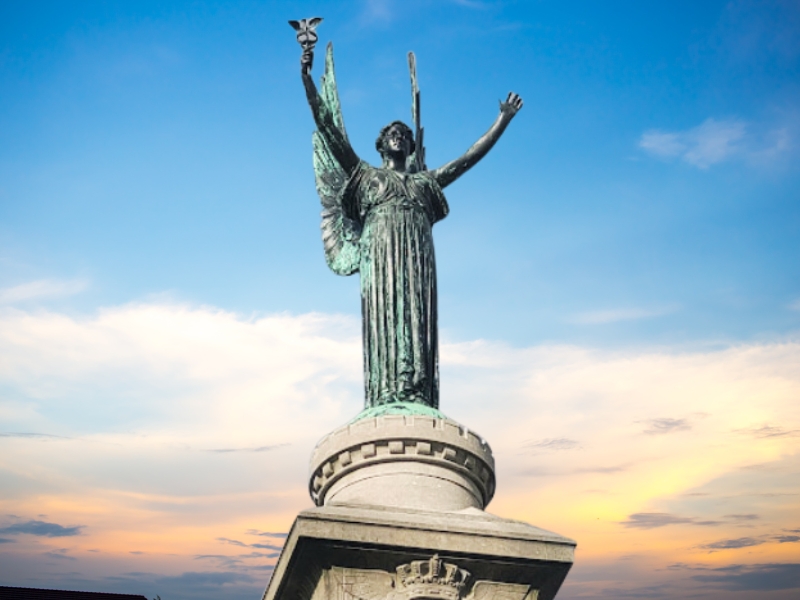
Most of central Rotterdam was rebuilt after the German bombing of 14 May 1940, so the few older places that remain stand out. This guide covers four of them: the medieval Laurenskerk, the Witte Huis of 1898, the old yacht club on the Willemskade that is now the Wereldmuseum, and the Calandmonument by the Veerhaven. Together they tell the story of the city and its port before the modern skyline.
Grote of Sint-Laurenskerk
The Laurenskerk, named after Saint Lawrence, the patron saint of Rotterdam, was built between 1449 and around 1525 in the late Gothic style. It was the first building in the city made entirely of stone, and it is the only medieval building left in the city centre. Built as a Catholic church, it became Protestant in 1572. Its tower has a story of its own: a wooden spire by Hendrick de Keyser was added in 1621 and taken down again in 1645 because the wood was poor, and a heavier stone top later made the tower lean until new piles were driven under it.
The bombing of 1940 left only the tower and the outer walls standing. There were proposals to clear the ruin, but Queen Wilhelmina opposed them, Queen Juliana laid the first stone of the restoration in 1952, and the church was finished again in 1968. Today it is a Protestant church that also hosts concerts and exhibitions, and it is one of the stops on our scavenger hunt.
- The bronze doors of the main entrance by the Italian sculptor Giacomo Manzù, on the theme of war and peace.
- The main organ by the Danish builder Marcussen & Søn, inaugurated in 1973 and often described as the largest mechanical organ in the Netherlands.
- The tombs of the naval heroes Witte de With, Egbert Kortenaer and Johan van Brakel, and outside on the square the 17th-century statue of Erasmus by Hendrick de Keyser.
Witte Huis
The Witte Huis (White House) on the Wijnhaven was finished in 1898 to a design by Willem Molenbroek. With ten floors and a height of 43 metres, it is counted as the first high-rise office building in Europe, an unheard-of height on the continent at the time. Many people doubted that the soft, wet ground of Rotterdam could carry it, so around a thousand piles were driven in before building began.
The structure uses iron, steel and concrete, and wood was largely avoided to reduce the risk of fire. The building came through the 1940 bombing, one of the few in the centre to do so, and it is now a national monument (rijksmonument). It is one of the stops on our scavenger hunt.
- The white glazed facade in Art Nouveau style, which still looks bright among the brick and glass around it.
- The view of the building from across the Oude Haven, the old harbour, where it rises above the boats and the terraces.
Wereldmuseum
The Wereldmuseum (World Museum) stands on the Willemskade, the quay along the Nieuwe Maas. The building went up between 1849 and 1851 as the clubhouse of the Royal Netherlands Yacht Club, to a design by A. N. Godefroy, and from the 1880s it housed the city's ethnographic museum, long known as the Museum voor Land- en Volkenkunde. In 2000 it was enlarged with two neighbouring buildings on the quay.
Since 2023 the museum shares the name Wereldmuseum with its partner museums in Amsterdam, Leiden and Berg en Dal, and they work with one joint collection. In Rotterdam the displays and temporary exhibitions deal with objects and cultures from Asia, Oceania, Africa and the Americas, and with the stories of the many communities that live in the port city. The museum is one of the stops on our scavenger hunt.
- The classical white facade on the waterfront, which shows its past as a 19th-century clubhouse.
- The view from the quay in front of the museum over the river to the Kop van Zuid and the Erasmusbrug.
Calandmonument
The Calandmonument honours Pieter Caland (1826–1902), the engineer who planned and built the Nieuwe Waterweg, the canal dug between 1864 and 1872 that gave Rotterdam a direct, deep route to the North Sea. That waterway let the port grow strongly in the late 19th and early 20th centuries. The monument was finished in 1907, designed by Henri Evers, the architect of Rotterdam's city hall, with sculpture by Arend Odé. It was paid for by the citizens of Rotterdam, as a gift marking the departure of mayor s'Jacob.
The monument first stood on the Coolsingel, in the middle of the city. In 1939 it was moved to the Veerkade by the Veerhaven for technical reasons, and that move probably saved it from the bombing a year later. It is the last of the ten stops on our scavenger hunt.
- The stone obelisk, about ten metres high, topped by a winged woman who stands for the genius of Rotterdam.
- The three bronze lion heads that spout water into the basins, and the two nude figures in the curved basin at the front.
- The stone panels with inscriptions, one of them a map of the region showing the planned waterway.
How to see them in one walk
Start at the Laurenskerk and walk around the church to see the bronze doors and the statue of Erasmus. Head south-east past the Markthal and the Cube Houses to the Oude Haven, where the Witte Huis stands on the corner of the Wijnhaven. From there follow the river west along the Boompjes and the Willemskade to the Wereldmuseum, and finish a little further on at the Calandmonument by the Veerhaven, a small harbour where historic sailing ships are often moored.
See Rotterdam with World City Trail
Our Rotterdam scavenger hunt turns the city centre into a game you play on your phone. The route links 10 stops, from the Stadhuis to the Calandmonument, and the Laurenskerk, the Witte Huis, the Wereldmuseum and the Calandmonument are all stops, along with the Cube Houses, the Maritime Museum and the Erasmusbrug.
There is also a self-guided walking tour and an outdoor escape game in Rotterdam, for people who prefer a different format.
Play the Rotterdam scavenger hunt →
Take the self-guided walking tour of Rotterdam →
Play the outdoor escape game in Rotterdam →
Facts checked in October 2026.