
Savannah's historic district is built around a grid of squares laid out from 1733 onwards, and most of its sights sit on or next to one of them. This guide follows seven places from the riverside end of the district southwards: City Market, Reynolds Square, the Kennedy Pharmacy, the Owens-Thomas House, Colonial Park Cemetery, the Sorrel-Weed House and Monterey Square. Together they cover the colonial town, the cotton-era mansions and the fight to save old Savannah in the 1950s.
City Market
Savannah's market stood on what is now Ellis Square from 1733, the year the town was founded, and for two centuries people came here for groceries and services. In 1954 the city leased the site so that the market house could be replaced by a parking garage. The demolition caused such anger that it helped start the city's preservation movement and the Historic Savannah Foundation. The garage itself was pulled down in 2006, Ellis Square became a public square again, and the old warehouses west of it, along West St. Julian Street, now form City Market, with restaurants, art galleries and shops. It is one of the stops on our scavenger hunt.
- The old brick market buildings along West St. Julian Street, and Ellis Square at its eastern end, where the market house once stood.
Reynolds Square
Reynolds Square was laid out in 1734 as Lower New Square, the first square after the original four. It was later renamed after John Reynolds, governor of the colony in the mid-1750s, who was so unpopular that his departure was celebrated about as much as his arrival. The silk filature, where the colonists tried and failed to build a silk industry, once stood on the square. It is one of the stops on our scavenger hunt.
- The bronze statue of John Wesley by Marshall Daugherty, put up in 1969 on what is believed to be the site of his house. Wesley, the founder of Methodism, led a mission to Savannah from 1735 to 1738.
- The Olde Pink House, built in 1771 as the Habersham House and the oldest building on the square, next to the Oliver Sturges House of 1813; the Lucas Theatre of 1921 is also on the square.
Kennedy Pharmacy
The two-storey red-brick building at 323 East Broughton Street was built in 1890 by Robert Kennedy, then the harbour master, as an investment. Around 1900 it held a pharmacy, a tax office and a Chinese laundry, and it served as a drugstore into the 1940s before decades as offices and storage. Today it belongs to the Historic Savannah Foundation, was restored with the help of preservation students from SCAD, and serves as the shop and entrance of the Davenport House Museum, with workshops and pop-up shops for local artisans. It is not on our scavenger hunt route.
- The cast-iron balcony across the upper floor, the plate-glass shop windows with transoms on two sides and the brass rails on ornate brackets at street level.
Owens-Thomas House
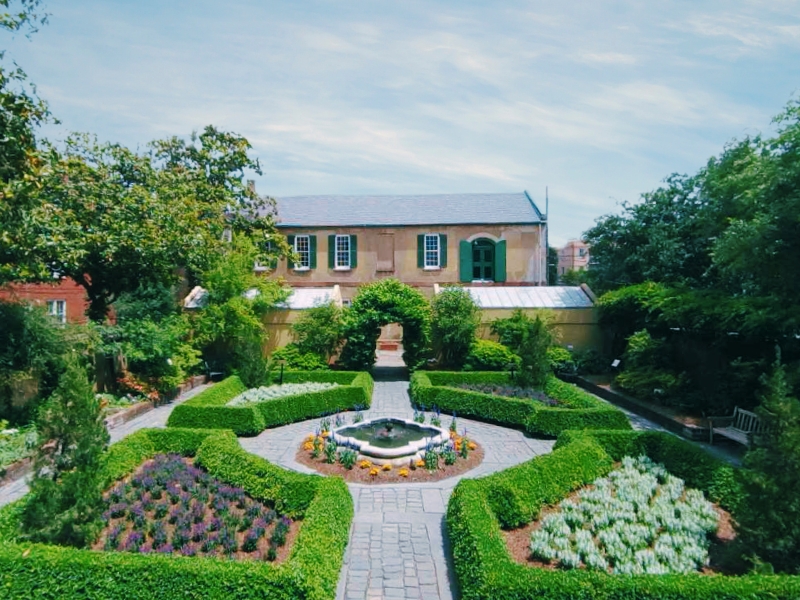
The Owens-Thomas House on Oglethorpe Square was designed by the English architect William Jay and built between 1816 and 1819 for Richard Richardson, its first owner. It is often described as the leading example of English Regency architecture in North America. In 1825 the Marquis de Lafayette spoke to the people of Savannah from its side veranda. Margaret Thomas left the house to the Telfair Academy in 1951, and it is now a house museum run by Telfair Museums and a National Historic Landmark.
During work in the 1990s the slave quarters in the carriage house were uncovered. They are among the oldest and best-preserved urban slave quarters in the American South, and the tour now tells the story of the enslaved people who lived and worked here. The house is one of the stops on our scavenger hunt.
- The ceiling of the slave quarters, painted in haint blue, the colour once believed to keep spirits away, and the cast-iron veranda with its acanthus scroll supports.
Colonial Park Cemetery
Colonial Park Cemetery was opened in 1750 and closed to burials in 1853. It covers about six acres and holds an estimated 9,000 graves. Among those buried here are Button Gwinnett, one of the signers of the Declaration of Independence, Archibald Bulloch and Lachlan McIntosh. More than 700 victims of the yellow fever epidemic of 1820 were also laid to rest here. It is one of the stops on our scavenger hunt.
- The resting places of the Habersham family: James Habersham and his sons John and Joseph.
- The story that Union soldiers who camped here after taking the city in December 1864 changed the dates and ages on some gravestones; it is often told on tours, but it cannot be checked stone by stone.
Sorrel-Weed House
This house on Madison Square was designed by Charles Cluskey and completed around 1840 for Francis Sorrel, a wealthy shipping merchant. It is Greek Revival with strong English Regency touches, and in 1954 it became one of the first two houses in Georgia named a State Landmark. Henry D. Weed agreed to buy it in 1859 and his family kept it until 1914. Robert E. Lee visited the Sorrels here in the early 1860s and again in 1870. It is one of the stops on our scavenger hunt.
The house is now a museum with daytime history tours and evening ghost tours. The best-known ghost stories are legends: they involve Matilda Sorrel, Francis's wife, who died by suicide, and an enslaved servant called Molly, but historians have found no record that a Molly ever lived here.
Monterey Square
Monterey Square was laid out in 1847 and named after the Battle of Monterrey of 1846 in the Mexican-American War. Most of the buildings around it are original, which makes it one of the most complete of all the squares. In the centre stands the Pulaski Monument, designed by Robert Launitz and dedicated in the mid-1850s, for Casimir Pulaski, the Polish general who was mortally wounded fighting for American independence at the siege of Savannah in 1779. Remains believed to be his lie beneath it. It is one of the stops on our scavenger hunt.
The square became world-famous through John Berendt's book Midnight in the Garden of Good and Evil (1994) and the 1997 film, which centre on the Mercer House on its western side.
- The Mercer Williams House, finished in 1868, later the home of the antiques dealer Jim Williams.
- Congregation Mickve Israel's synagogue of 1878 facing the square, one of the few Gothic-style synagogues in America, and the statue of Liberty on top of the Pulaski Monument.
How to see them in one walk
Start at City Market and walk east along St. Julian Street to Reynolds Square. Continue south-east to the Kennedy Pharmacy on East Broughton Street, then head back towards Abercorn Street for the Owens-Thomas House on Oglethorpe Square. Colonial Park Cemetery lies just south of it. From there go west to Bull Street and walk south through the squares to the Sorrel-Weed House on Madison Square, and finish at Monterey Square.
See Savannah with World City Trail
Our Savannah scavenger hunt turns the historic district into a game you play on your phone. The route links 10 stops, from the fountain in Forsyth Park to East River Street, and Monterey Square, the Sorrel-Weed House, Colonial Park Cemetery, the Owens-Thomas House, Reynolds Square and City Market are all stops, along with the Cathedral of St. John the Baptist and Chippewa Square.
There is also a self-guided walking tour and an outdoor escape game in Savannah, for people who prefer a different format.
Play the Savannah scavenger hunt →
Take the self-guided walking tour of Savannah →
Play the outdoor escape game in Savannah →
Facts checked in October 2026.