
This guide covers four places in St. Gallen that tell the story of the town itself rather than of its famous abbey: the Textile Museum, which recalls the embroidery trade that made the town rich, the Stadthaus of the Ortsbürgergemeinde, the citizens' corporation that still looks after much of the old city's property, and the two Protestant town churches, St. Laurenzen and St. Mangen. All four stand inside or just outside the old town, close enough to visit on one walk.
Textile Museum (Textilmuseum St. Gallen)
For centuries St. Gallen lived from cloth, first linen and later machine embroidery, which the town exported all over the world in the late 19th and early 20th centuries. The Textile Museum on Vadianstrasse tells that story. Its building, completed in 1886 and nicknamed the Palazzo Rosso for its red brick facades, was built to hold the pattern collection and textile library of the town's merchants' association, and it also housed a drawing school and later an embroidery school where designers for the industry were trained.
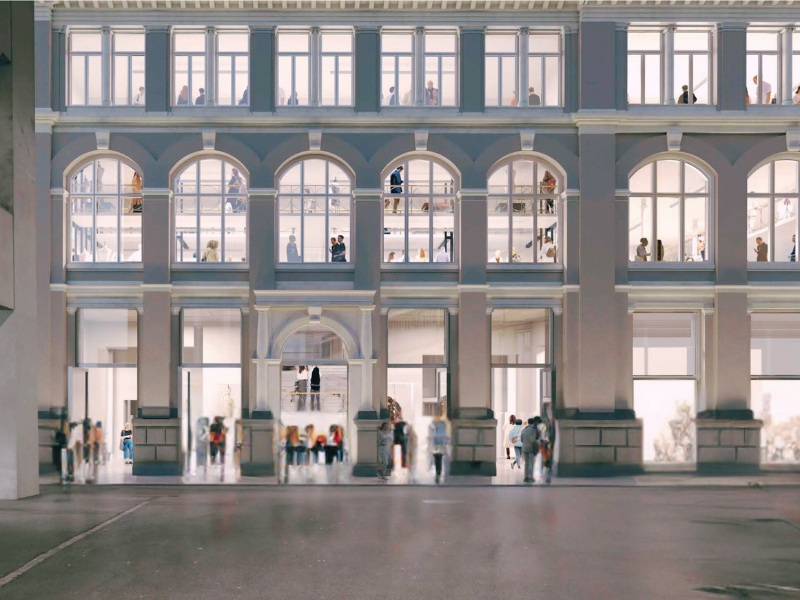
Today the collection covers fabrics, lace and embroidery from many countries, together with pattern books, design drawings and photographs of the Swiss textile industry, and the textile library is still in the house. A full renovation is planned, with a design by the architect Christian Kerez that won a competition in 2019; the museum expects to reopen in 2030 after the works, so check whether it is open before you go.
- The red brick facades that gave the building its nickname, unusual among the plastered houses of the town.
- The location just outside the old town, in a quarter of large commercial buildings from the embroidery era.
- If the exhibitions are open, the pattern books, where you can see how St. Gallen designs were presented to buyers.
St. Mangen Church
St. Mangen stands on a small rise at the north-eastern edge of the old town. The first church on the site was built by Salomo, bishop of Konstanz and abbot of St. Gallen, and was confirmed by Emperor Arnulf in 898; it was dedicated to St. Magnus and received a relic of his arm. The present church is early Romanesque, probably from around 1100, and its nave was extended westwards in 1657. The tower was built between 1505 and 1508 after lightning had destroyed the earlier roof turret, and it was given its upper storey and spire in 1568.
The church is closely linked to Wiborada, who had herself walled into a cell attached to it around 916. According to the account of her life, she foresaw the Hungarian raid of 926, so that the clergy could hide the books and escape; she refused to leave and was killed when the raiders came. In 1047 Pope Clement II canonized her, and she is often called the first woman to be formally canonized by a pope. Her relics were destroyed in 1528, when the church was stripped of its images during the Reformation; it has been Reformed ever since.
- The wooden replica of Wiborada's cell, built against the church in 2021, which modern anchorites have used for short periods in spring.
- The tower from the early 16th century, which you can see from the lanes of the old town below.
- The setting just inside the line of the old city walls, a quieter corner of the old town.
Stadthaus of the Ortsbürgergemeinde
The Ortsbürgergemeinde St. Gallen is a corporation of the town's citizens, separate from the political municipality. Its story begins with the end of the old city republic in 1798, and it was formally separated from the political municipality after the cantonal constitution of 1831. It took over much of the common property of the former republic: over time it ran welfare, schools, church property and the fountains, and today it manages forests, farms, a vineyard, real estate and the City Archive with the Vadian Collection, named after the reformer Vadian.
Since 1867 its seat has been the Stadthaus on Gallusstrasse, a Renaissance house built around 1589 for Hans Schlumpf, a canvas merchant who was among the richest men in the town and traded with Nuremberg and Lyon. It stands on the site of an older chapel and hermitage. Because of its size it was called the Grosse Haus or Hohe Haus, the big or tall house, and it later also served as a post office.
- The tall facade of the merchant's house, which shows how much wealth the linen trade brought in the 16th century.
- The vaulted rooms on either side of the entrance hall, once used for business; a vaulted room upstairs holds a small exhibition on local history, shown on guided tours.
St. Laurenzen Church
St. Laurenzen was the parish church of the town's citizens, standing right next to the abbey but separate from it. The first church on the site probably dates from the 12th century, and the tower was begun in 1305 and finished in 1423. In the 1520s, under the humanist and mayor Vadian, it became the centre of the Reformation in St. Gallen, and in 1526 the town council ordered the images to be removed from the church. From then on the Protestant town and the Catholic abbey lived side by side, with a wall between them.
What you see today is largely the result of a neo-Gothic rebuilding from 1851 to 1854, carried out by Johann Christoph Kunkler on the basis of plans by Johann Georg Müller; the upper part of the tower was rebuilt to plans by Ferdinand Stadler. In 2023 and 2024 a new organ complex was installed, with 76 stops. In 1995 the Catholic bishop of St. Gallen was consecrated here because the cathedral next door did not have enough space.
- The neo-Gothic tower with its pointed spire, which rises right next to the twin towers of the abbey cathedral.
- The contrast between the plain Protestant interior and the Baroque richness of the cathedral a few steps away.
How to see them in one walk
Start at the Textile Museum on Vadianstrasse, close to the station, and walk east into the old town. Head for the abbey district, where St. Laurenzen stands on the northern side of the cathedral, and then walk the short distance to the Stadthaus on Gallusstrasse. From there continue north-east through the lanes to St. Mangen on its rise at the edge of the old town. On the way you pass the Marktplatz and many of the oriel windows that St. Gallen is known for.
See St. Gallen with World City Trail
Our St. Gallen scavenger hunt turns the old town into a game you play on your phone. The route links 10 stops, from the railway station to St. Mangen Church, and all four places in this guide are stops: the Textile Museum, the Ortsbürgergemeinde, St. Laurenzen and St. Mangen, along with Red Square, the Broderbrunnen, the Gallus fountain, the abbey and the Marktplatz. At each stop you solve a riddle and learn a story, at your own pace.
There is also a self-guided walking tour and an outdoor escape game in St. Gallen, for people who prefer a different format.
Play the St. Gallen scavenger hunt →
Take the self-guided walking tour of St. Gallen →
Play the outdoor escape game in St. Gallen →
Facts checked in October 2026.