
This guide follows a line of five places through the centre of Sydney, from Sydney Square near the Town Hall up to Circular Quay: St Andrew's Cathedral School, St Mary's Cathedral, Queens Square, the Museum of Sydney and Customs House. Between them they cover the colony's first years, its churches and its port, and they sit along one walk from the south of the city centre to the harbour.
St Andrew's Cathedral School
St Andrew's Cathedral School began on 14 July 1885 as a schoolroom for the choirboys of St Andrew's Cathedral, founded by Alfred Barry, the third Anglican Bishop of Sydney. It has grown into a school from kindergarten to Year 12, coeducational throughout since 2008, and since 2007 it has also been home to Gawura, a school for Aboriginal and Torres Strait Islander children. Its main campus is unusual: it occupies upper floors and the rooftop of St Andrew's House, an office block completed in 1976 on Sydney Square.
The school is a working school and not open to visitors, but it stands right next to the cathedral it was founded for. St Andrew's Cathedral, designed in its present form by Edmund Blacket in the Gothic Revival style, was consecrated on St Andrew's Day, 30 November 1868, which makes it the oldest cathedral in Australia. Governor Lachlan Macquarie had already laid a foundation stone for a cathedral in 1819, though that first plan was abandoned.
- The pale sandstone cathedral beside the glass and concrete of St Andrew's House and the Town Hall, three very different buildings around one square.
St Mary's Cathedral
Across Hyde Park stands Sydney's Catholic cathedral, the seat of the Archbishop of Sydney. The first church on the site burned down on 29 June 1865, and the present building was designed by William Wardell, a pupil of Augustus Pugin. It was built in stages: the dedication Mass was held in 1882, the nave was completed in 1928, and the two spires on the south front were only added in 2000.
The cathedral is built of golden Sydney sandstone in a Gothic style closely based on Lincoln Cathedral. It is 107 metres long, and its heritage listing describes it as the largest 19th-century English Gothic church building in the world.
- The mosaic floor of the crypt by Peter Melocco and his firm, completed in 1961: a large cross decorated like an illuminated Celtic manuscript, with roundels of the Days of Creation.
- The view of the cathedral from Hyde Park, where its front rises behind the Archibald Fountain.
Queens Square
Queens Square sits at the northern end of Hyde Park, where King Street, Macquarie Street and Phillip Street meet. Governor Macquarie planned it in the early 19th century as Kings Square, and it was renamed in 1837, the year Victoria came to the throne. The statue of Queen Victoria on its south-western corner was unveiled in 1888, the centenary of the colony, and Prince Albert faces her from the other side of Macquarie Street.
Look around the square: St James' Church, the Hyde Park Barracks, now part of a UNESCO World Heritage site, and the old Sydney Mint all face it, so in one spot you see three buildings from Macquarie's time.
- Prince Albert's statue on the south-eastern corner, placed so that the couple look at each other across the street.
Museum of Sydney
The Museum of Sydney stands on the site of First Government House, which was built in 1788 for Governor Arthur Phillip and demolished in 1845 and 1846. The museum opened in 1995 in a building designed by Denton Corker Marshall, and it is run by Museums of History NSW. Its exhibitions are about Sydney's history, from the Eora people who lived around the harbour to the modern city.
Much of the most interesting material is outside, in the forecourt. The outline of Phillip's house is marked in the paving, and glass panels show drains from the late 1790s and the early 19th century, still in their original place. Next to them stands Edge of the Trees, made in 1995 by Janet Laurence with the Aboriginal artist Fiona Foley.
- The 29 pillars of Edge of the Trees, one for each of the Aboriginal clans of the Sydney area, made of sandstone, wood and steel and carrying names of plants, places and First Fleet arrivals, with recorded voices speaking place names.
- The outline of First Government House in the paving of the forecourt.
Customs House
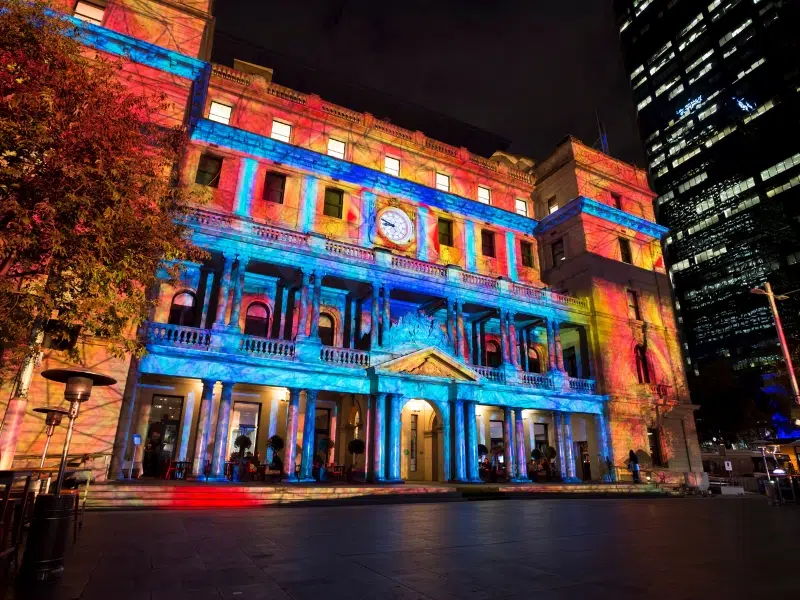
Customs House stands on Alfred Street, facing Circular Quay, close to where the First Fleet is presumed to have landed and raised the flag in 1788. The first sandstone building was designed by Mortimer Lewis and opened in 1845. It was then rebuilt and enlarged several times: by James Barnet in the 1880s, by Walter Liberty Vernon around 1900, and again during the First World War, which explains its size.
Customs moved out in 1990, the City of Sydney took over the building in 1994, and since 2003 it has housed a City of Sydney library. As a public library, it is a grand building of the old port that you can simply walk into.
- The scale model of the city centre under the glass floor of the ground floor, built in 1998, where you can walk over the city's streets.
- The view from the forecourt across Circular Quay to the ferries and the harbour.
How to see them in one walk
Start at Sydney Square beside the Town Hall, with St Andrew's Cathedral and its school. Walk east to Hyde Park and cross it to St Mary's Cathedral, then follow the edge of the park north to Queens Square. From there walk down Macquarie Street and turn left towards Bridge Street and Phillip Street to reach the Museum of Sydney, and finish at Customs House on Circular Quay, a short walk from the Opera House.
See Sydney with World City Trail
Our Sydney scavenger hunt turns the city centre into a game you play on your phone. The route links 10 stops, from Darling Harbour to the Bridge Stairs, and all five places in this guide are stops: St Andrew's Cathedral School, St Mary's Cathedral, Queens Square, the Museum of Sydney and Customs House, along with the Town Hall, the Queen Victoria Building and the Sydney Opera House. At each stop you solve a riddle and learn a story, at your own pace.
There is also a self-guided walking tour and an outdoor escape game in Sydney, for people who prefer a different format.
Play the Sydney scavenger hunt →
Take the self-guided walking tour of Sydney →
Play the outdoor escape game in Sydney →
Facts checked in October 2026.