
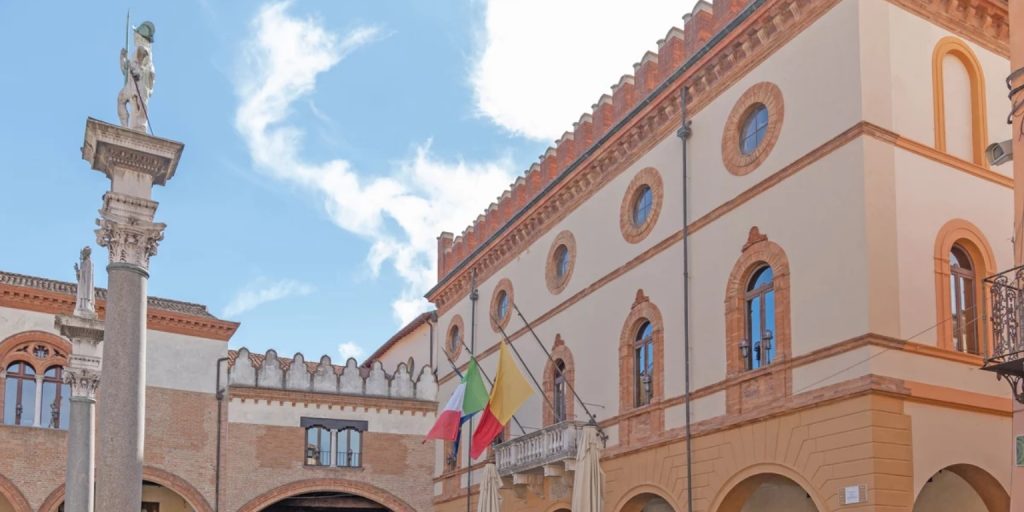
In the bustling center of Ravenna, the vibrant Piazza del Popolo serves as the city’s social and historical heart. Dominating one side of this grand square is a majestic building that stands as a silent witness to centuries of history: the Palazzo Merlato. Though it is formally known as the Palazzo Comunale (City Hall), its traditional name—meaning “crenellated palace”—speaks to its medieval origins and its enduring role as the seat of Ravenna’s civic power. A visit to the palace is to step into a living history book, where the stories of rulers, poets, and citizens have unfolded for more than 700 years.
A Palatial History in Stone
The origins of the Palazzo Merlato in Ravenna trace back to the late 13th century, when construction began on a building intended to house the city’s government. Its strategic location in the main square was a clear statement of its political importance. The palace gained a particular historical prominence as the residence of the Da Polenta family, who governed Ravenna from 1275 until the early 15th century. This powerful family, famously the patrons of Dante Alighieri, transformed the palace into a center of political power and culture.
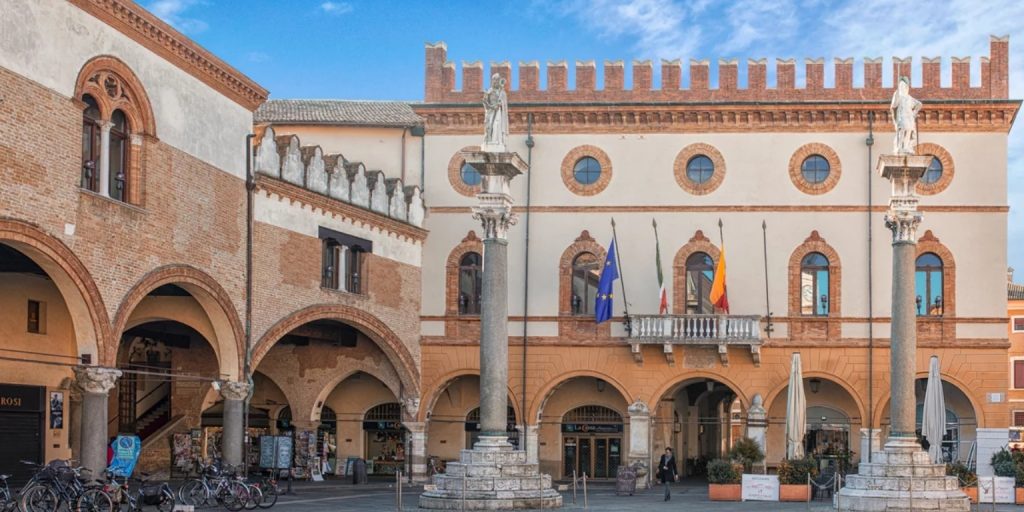
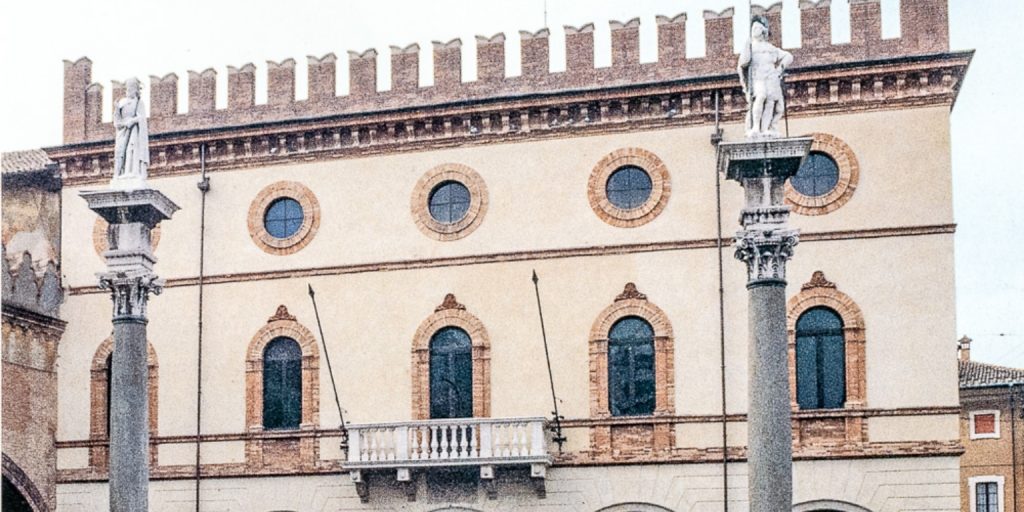
Over the centuries, the palace has undergone numerous transformations. While its initial structure was medieval, its current elegant appearance is largely the result of significant renovations in the 16th century. The medieval battlements that give the palace its distinctive name were likely a part of its original design, and their presence serves as a reminder of an age of city-states and fortifications.
Architectural Elegance and Enduring Symbols
The most striking feature of the Palazzo Merlato is its beautiful, open loggia that spans the length of the building on the ground floor. This feature, added in the 16th century, provides a graceful series of arches that offer a pleasant shaded walkway for citizens and visitors alike. Above the arches, the palace’s facade is decorated with two majestic bronze eagles, a long-standing symbol of the city and its rulers. These eagles stand as a symbol of Ravenna’s strength and resilience through centuries of change.
Within the palace, a number of other details speak to its rich history. Visitors can often catch a glimpse of the grand internal staircase, known as the Scala dell’Orologio, which leads to the main halls and offices of the City Council. While the palace is not a traditional museum, its publicly accessible areas, including the loggia and courtyard, provide a powerful sense of its historical gravitas.
The Heart of Ravenna’s Civic Soul
Today, the Palazzo Merlato continues its original function as the seat of the city’s government, a testament to the continuity of civic tradition in Ravenna. It is the place where mayors and councils meet, and where the decisions that shape the city’s future are made. This modern function, combined with its profound historical significance, makes it a unique landmark. It is a place where Dante’s legacy is discussed, where medieval conflicts are remembered, and where contemporary urban life thrives.
The Palazzo Merlato in Ravenna stands not only as a monument to the past but as a symbol of the city’s enduring civic pride. Its location at the center of the bustling Piazza del Popolo makes it an unmissable part of any visit. It invites visitors to contemplate the city’s journey from a powerful city-state to a modern, cultural hub. In a city celebrated for its mosaics and ancient history, the Palazzo Merlato is a reminder that Ravenna’s living, political, and social history is just as compelling as its artistic heritage.