
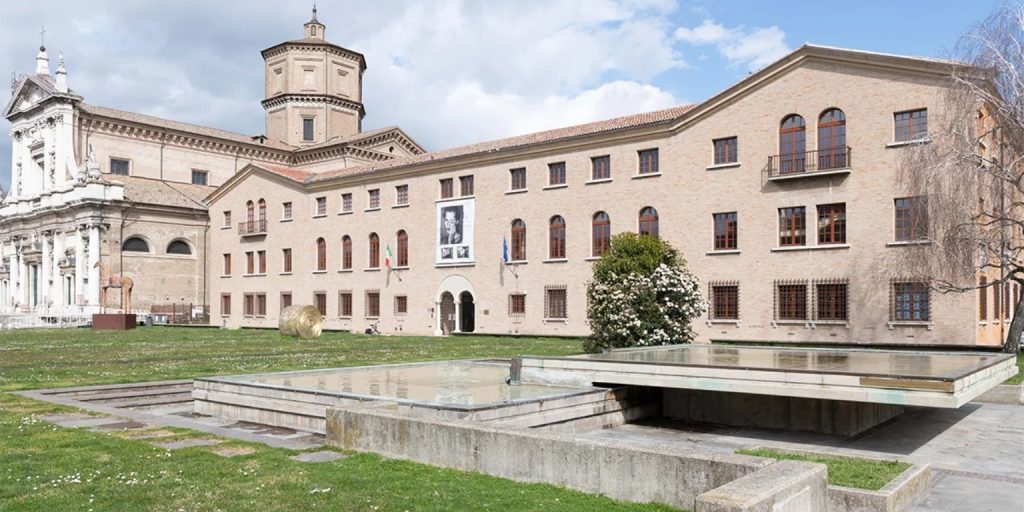
This guide covers three buildings that show a side of Ravenna beyond its early Christian mosaics: the city art museum, MAR, in a Renaissance monastery, the Teatro Alighieri opera house, and Palazzo Merlato, the town hall on Piazza del Popolo. All three stand close together in the old centre, and between them they tell the story of the city from Venetian rule to the 19th century, when Ravenna built a theatre and named it after Dante, who spent his last years here.
MAR, the Ravenna Art Museum
MAR (Museo d'Arte della città di Ravenna) occupies the former monastery of Santa Maria in Porto on Via di Roma. The monks of Porto built it between 1496 and 1525, after the Venetian authorities who then ruled Ravenna required them to move inside the town. Only the larger of its two cloisters survives, with three storeys of arches and columns in pale Istrian stone; the smaller one, facing the street, was pulled down in 1885 to make room for military barracks. The best-known part is the Loggetta Lombardesca, a white marble loggia at the back of the complex that opens onto the public gardens and is attributed to the sculptor and architect Tullio Lombardo.
The collection runs from the 14th century to today. The picture gallery has works by Antonio Vivarini, Marco Palmezzano, Nicolò Rondinelli, Giorgio Vasari and Guercino, but the museum's special subject is mosaic. It keeps the contemporary mosaics made for a 1959 exhibition curated by Giuseppe Bovini, for which designs by twenty modern artists, among them Marc Chagall, Renato Guttuso, Emilio Vedova and Massimo Campigli, were turned into mosaic. Later pieces after artists such as Mimmo Paladino and Balthus joined them, and the museum hosts the Biennale of Contemporary Mosaics. MAR is not one of our scavenger hunt stops, but it stands on the same street as the Basilica di Sant'Apollinare Nuovo, which is.
The museum's most famous piece comes with a story. The marble effigy of Guidarello Guidarelli, a knight from Ravenna, was carved by Tullio Lombardo and lent to an exhibition of Italian Renaissance art in Paris in the 1930s. It came back stained, and to calm the row that followed, the marks were said to be lipstick from Parisian women who had kissed it. Journalists then spread the legend that anyone who kissed Guidarello would marry within a year, and magazines kept the tale alive in the 1950s and 1960s. So many people kissed the statue that for some years a replica stood in its place. Since its restoration, touching it is not allowed.
- The effigy of Guidarello Guidarelli: the knight lies in full armour, and his face may have been modelled on a death mask.
- The Loggetta Lombardesca, best seen from the public gardens behind the museum.
- The surviving cloister, with arches and pillars on the ground floor and columns on the floors above.
Teatro Alighieri
Ravenna's opera house is named after Dante Alighieri, who is buried a few streets away. In 1838 the city chose the Venetian brothers Tomaso and Giovanni Battista Meduna as architects. Tomaso had supervised the restoration of La Fenice in Venice after a fire, and the neoclassical theatre the brothers designed for Ravenna is close in style to the Venetian house. Building began in 1840, and the theatre opened on 15 May 1852 with Giacomo Meyerbeer's opera Robert le diable.
Inside is a horseshoe-shaped auditorium with four tiers of boxes and a gallery above them. The theatre closed in 1959 for a long restoration and reopened in 1967. Today it hosts an opera season in the colder months and many performances of the Ravenna Festival, held every summer since 1990. In 2004, on the 350th anniversary of the composer's birth, its Ridotto, the foyer hall, was named Sala Corelli after Arcangelo Corelli, who was born in the province of Ravenna. The Teatro Alighieri is one of our scavenger hunt stops.
- The neoclassical front on Via Mariani, a short walk from Piazza del Popolo.
- The horseshoe auditorium and its tiers of boxes, which you see best by going to a performance.
Palazzo Merlato and Piazza del Popolo
Palazzo Merlato is Ravenna's town hall, and its name comes from the battlements (merli) along the top of its front. They look medieval but are not: the building was begun in 1681 on the site of older civic buildings, raised by a further floor from 1761, and only received its battlements in 1857. Inside, the Council Hall has a ceiling decorated by the painter Gaetano Savini in 1882, and the vaulted passage that links Piazza del Popolo to Piazza XX Settembre was painted by him in 1873.
The square in front, Piazza del Popolo, took its present form when Venice ruled Ravenna, between 1441 and 1509. The Venetians paved it and set up two granite columns on bases carved by Pietro Lombardo in 1483. One carried the lion of Saint Mark, which came down when Venetian rule ended; today the columns hold statues of Saint Apollinaris and Saint Vitalis, two saints closely tied to the city. Next to the town hall stands the Palazzetto Veneziano, built in 1461 to 1463 as the seat of the Venetian government. Piazza del Popolo is one of our scavenger hunt stops.
- The capitals of the Palazzetto Veneziano's portico: four of them carry the monogram of the Gothic king Theodoric, reused from a church of his time that was demolished in the 15th century.
- The column bases, signed with Pietro Lombardo's name and the date 1483.
- The battlements of the town hall, added in 1857 to give a 17th-century building a medieval look.
How to see them in one walk
Start at MAR on Via di Roma and, if you have time, step into the public gardens behind it to see the Loggetta from outside. Walk along Via di Roma past the Basilica di Sant'Apollinare Nuovo, then turn west into the old centre to Piazza del Popolo, where Palazzo Merlato, the two columns and the Palazzetto Veneziano stand together. From the square it is only a few minutes to the Teatro Alighieri on Via Mariani. Dante's Tomb is close by, so you can easily end the walk there.
See Ravenna with World City Trail
Our Ravenna scavenger hunt turns the old town into a game you play on your phone. The route links 10 stops, from the Giardini Pubblici to the Mausoleum of Galla Placidia, and two of the places in this guide are stops: the Teatro Alighieri and Piazza del Popolo, with Palazzo Merlato. On the way you also visit the Basilica di Sant'Apollinare Nuovo, Dante's Tomb, the Neonian Baptistery, the covered market, Porta Adriana and the Basilica of San Vitale. At each stop you solve a puzzle and learn a story, at your own pace.
There is also a self-guided walking tour and an outdoor escape game in Ravenna, for people who prefer a different format.
Play the Ravenna scavenger hunt →
Take the self-guided walking tour of Ravenna →
Play the outdoor escape game in Ravenna →
Facts checked in October 2026.