
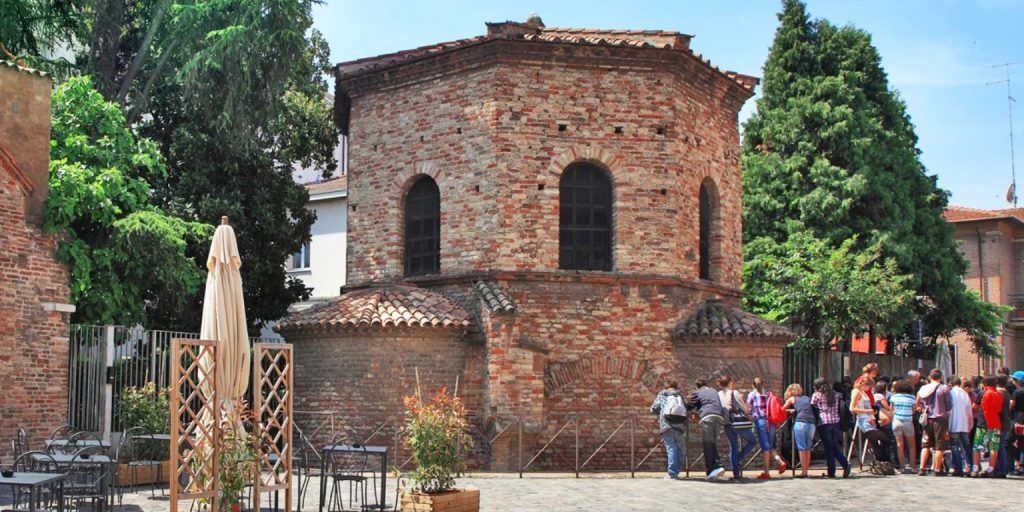
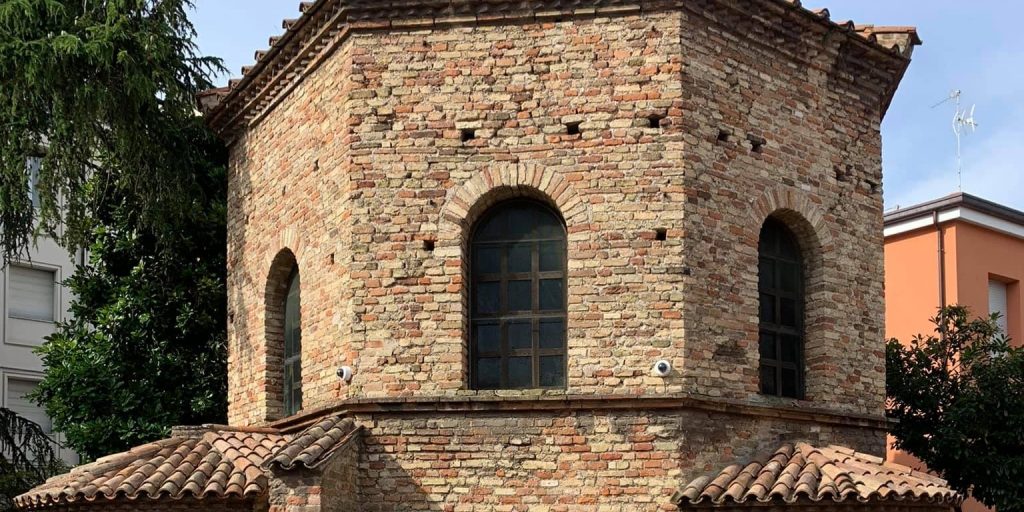
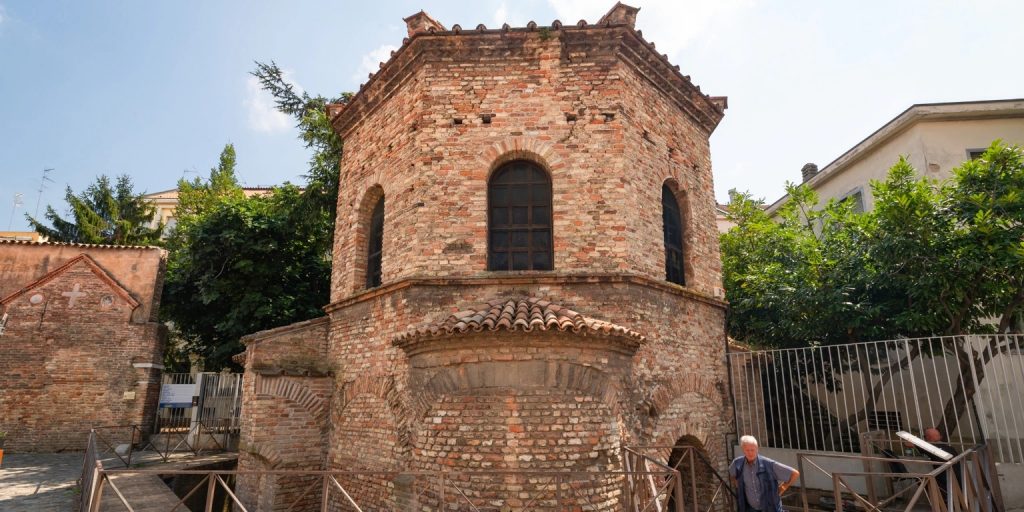
In the city of Ravenna, a city of mosaics and emperors, every building tells a story. But few are as unique and historically significant as the Arian Baptistry. Tucked away on a quiet street, this modest-looking octagonal brick structure holds a breathtaking secret: a dazzling mosaic that serves as a physical testament to a long-forgotten chapter of religious history. As a key part of Ravenna’s UNESCO World Heritage sites, the Arian Baptistry is an unmissable stop for anyone who wishes to understand the deep and complex layers of this extraordinary city.
The King, the City, and a Different Faith
The history of the Arian Baptistry in Ravenna is intrinsically linked to the powerful Ostrogothic king, Theodoric the Great. In the late 5th century, Theodoric made Ravenna the capital of his kingdom and, as a follower of the Arian branch of Christianity, he built monuments that reflected his faith. Arianism was a Christian doctrine that held a different view on the Holy Trinity than mainstream Nicene Christianity, believing that Jesus was a separate being and subordinate to God the Father. This theological difference led to a religious and political schism between the Ostrogothic rulers and the local, orthodox Roman population.
The baptistry was built for the Ostrogothic community, while the Orthodox population used the nearby Neonian Baptistry. This duplication of key religious buildings underscores the religious divide that existed in Ravenna under Theodoric’s rule. Though the architecture of the Arian Baptistry is simple on the outside, its interior was designed to reflect the glory of its patron and the piety of its community, even if their beliefs were considered heretical by the majority.
A Mosaic Masterpiece: A Story in Stone and Gold
The true marvel of the Arian Baptistry is its dome, which is covered in a brilliant mosaic dating back to the late 5th century. This dazzling work is a masterpiece of early Byzantine art, with a central medallion depicting the Baptism of Christ. Jesus stands waist-deep in the River Jordan, a detail that is uniquely represented by the personification of the river god: an old, bearded man holding a reed. This inclusion of a pagan figure is a fascinating detail that shows the cultural fusion of the time.
Surrounding the central scene, a magnificent procession of the twelve apostles, led by Saint Peter and Saint Paul, circles the dome. They are all dressed in pristine white robes and carry crowns, representing their martyrdom. The apostles are separated by elegant palm trees, which symbolize the martyrs’ victory. The figures are rendered with a dynamic sense of movement and emotion, a striking contrast to the more static figures in the Neonian Baptistry’s dome.
A UNESCO Site with Enduring Significance
After the Byzantine emperor Justinian’s reconquest of Ravenna in the mid-6th century, the Arian faith was suppressed. The Arian Baptistry was stripped of its original purpose and converted into an Orthodox Christian church. However, its historical and artistic importance was recognized much later. Today, as a protected UNESCO World Heritage site, the baptistry stands as a vital record of a crucial period in European history.
The Arian Baptistry in Ravenna is a powerful testament to the city’s role as a meeting point of cultures and ideas. It is a place where Roman, Gothic, and early Byzantine traditions converged and where religious beliefs were debated with profound consequences. A visit to the baptistry offers not just a chance to see a breathtaking mosaic but an opportunity to reflect on a past that was far more complex than a simple narrative of good versus evil. The Arian Baptistry stands as a unique and beautiful relic, a quiet but powerful symbol of a time of division and a city that found a way to endure.