
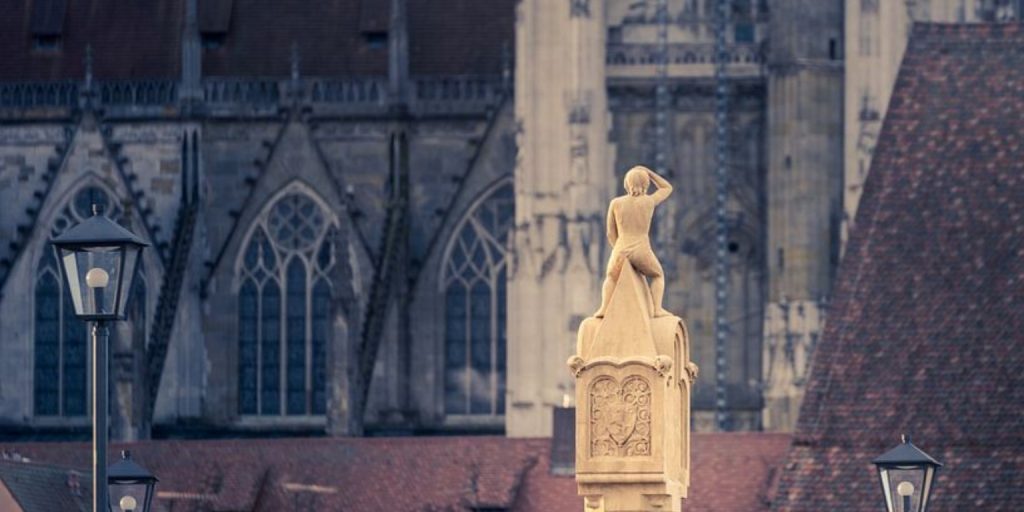
In the heart of Regensburg, a city celebrated for its medieval architecture and vibrant history, two colossal landmarks stand as symbols of a timeless rivalry. The majestic Regensburg Cathedral reaches for the heavens, while the ancient Stone Bridge gracefully spans the mighty Danube River. Yet, it is a small, seemingly insignificant statue on the bridge that holds the key to the city’s most enduring legend.
The Bruckmandl, or “Bridge Man,” is more than a statue; he is a silent observer, a storyteller, and a beloved icon whose gaze connects the two greatest engineering feats of medieval Regensburg. The story of the Bruckmandl has captivated locals and visitors alike, weaving a rich tapestry of history and folklore. The Bruckmandl, standing proudly, continues to inspire awe and curiosity in all who cross the bridge.
A Legend Born of Rivalry
The history of the Bruckmandl is woven into the very fabric of the city’s folklore. The legend begins with a heated bet between the master builder of the Stone Bridge and his rival, the master builder of the Cathedral of St. Peter. They challenged each other to see whose grand project would be completed first. As the cathedral’s construction appeared to be advancing at a much faster pace, the bridge builder grew desperate to win the wager.
According to the famous tale, the bridge builder made a pact with the devil. In exchange for the devil’s help to complete the bridge quickly, he promised him the souls of the first three beings to cross it. With unholy speed, the bridge was finished first. However, the clever builder outwitted the devil by sending a rooster, a hen, and a dog across the bridge as the first “souls.” Enraged at being tricked, the devil tried in vain to destroy the bridge, leaving only a permanent bump in its structure.
The Bruckmandl is said to be a depiction of the master builder, forever immortalized at the highest point of his completed bridge, shielding his eyes as he looks over to the cathedral to see if he has won the bet.
A Small Statue with Great Significance
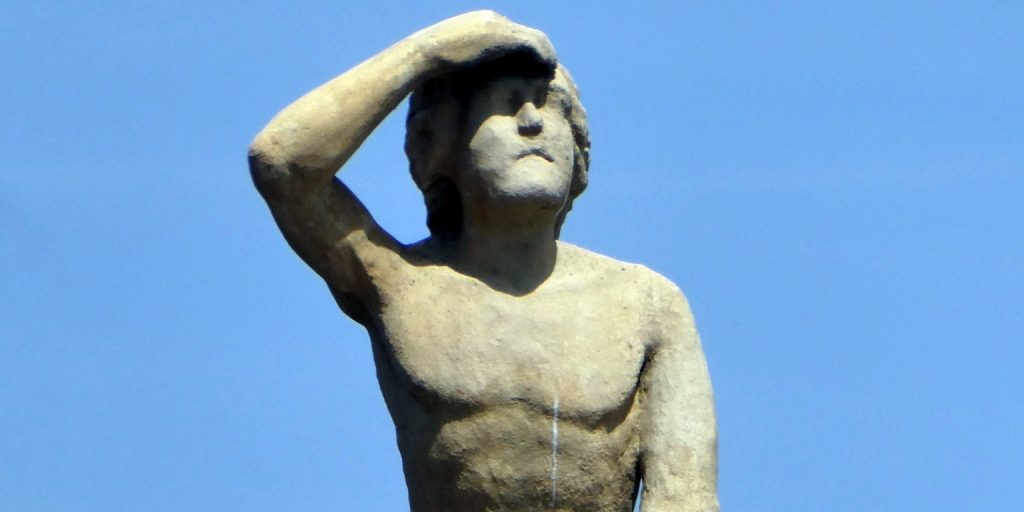
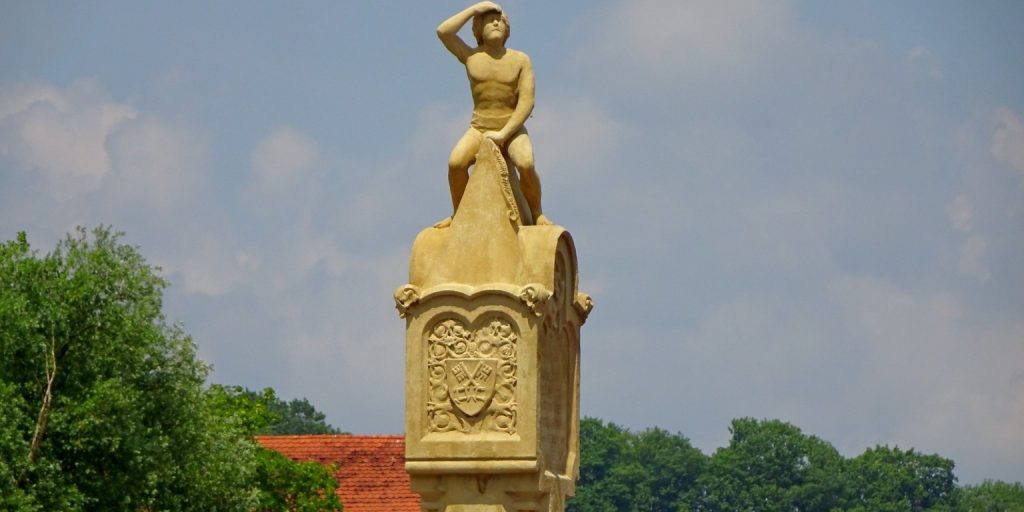
While the legend is a fantastical tale, its core speaks to a historical rivalry that shaped the city’s identity. The Bruckmandl statue itself is a powerful symbol of civic pride and the triumph of the city’s engineering over its ecclesiastical power. The current statue is a replica from 1854, replacing an earlier version from the 16th century. It depicts a young man, largely unclothed, with one hand shading his eyes from the sun as he looks intently toward the cathedral spires.
This simple pose captures the very essence of the legend. His gaze, directed at the cathedral, is not just a detail of the statue—it’s the core of its meaning. The Bruckmandl stands as a constant reminder of the rivalry that defined Regensburg’s medieval landscape, a rivalry that fueled the creation of two of the most magnificent structures in all of Germany.
An Enduring Icon
Today, the Bruckmandl in Regensburg is one of the most beloved and instantly recognizable symbols of the city. He stands guard over the Stone Bridge, a UNESCO World Heritage site and a living testament to medieval engineering. For both locals and tourists, the statue is a central part of the Regensburg experience. It is a place for a photo, a point of reference, and a trigger for one of the city’s most enduring and cherished stories.
Whether you choose to believe the legend or not, the Bruckmandl encapsulates the spirit of Regensburg. He represents the ingenuity and ambition of a city that dared to build a bridge across the powerful Danube that would last for a millennium. A visit to the Stone Bridge is incomplete without a moment to pause and reflect on the story of the Bruckmandl, a small statue with a grand tale, forever watching over the heart of this ancient city.