
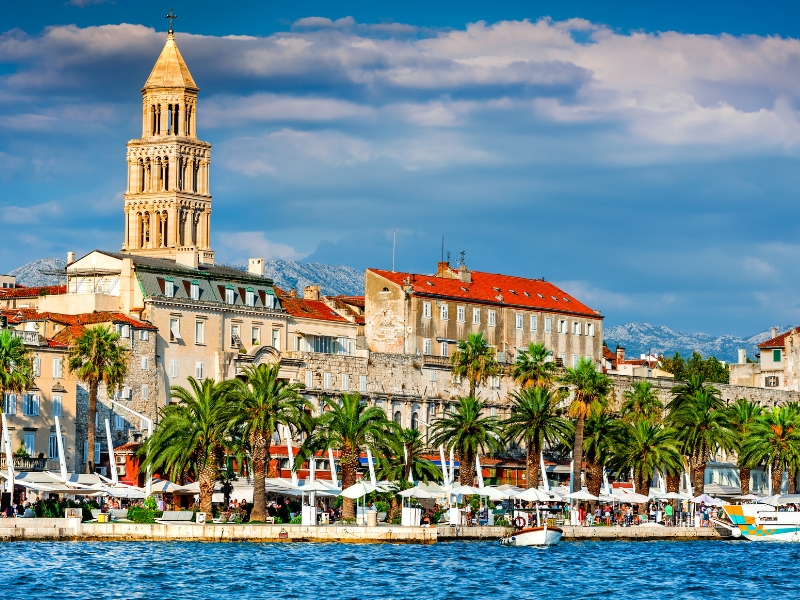
Split grew up inside a Roman emperor's retirement home, and most of what is worth seeing lies within a few minutes of its walls. This guide follows eight places in the order of our scavenger hunt: the Croatian National Theatre, the Golden Gate, Diocletian's Palace with the Peristyle, the Cathedral of Saint Domnius, Jupiter's Temple, People's Square, the Riva and the Prokurative. Together they cover seventeen centuries, from the Roman emperor to the 19th-century mayors who reshaped the town.
Croatian National Theatre
Just north of the old town stands the Croatian National Theatre, which opened in 1893 as the Split Municipal Theatre. It was designed by Emilio Vecchietti and Ante Bezić, and with about 1,000 seats it was described at the time as the largest theatre in Southeast Europe. In February 1970 a fire gutted it; the company played elsewhere for a decade, and the restored house reopened in May 1980. Today it stages opera, ballet and drama, and it is a home of the Split Summer Festival, founded in 1954, which also uses the Peristyle and other old town spaces as stages. The theatre is the first stop of our scavenger hunt.
- The main facade on the square in front of the building, the side that has greeted Split's audiences since 1893.
The Golden Gate
From the theatre, a short walk east brings you to the Golden Gate, the northern gate of Diocletian's Palace and once its main entrance. It faced the road to Salona, the Roman capital of the province, and you can still see the niches in its stone facade where statues once stood. Just outside it towers Ivan Meštrović's bronze statue of Gregory of Nin, the 10th-century bishop, which has its own guide on our blog. Both the statue and the gate are stops on our scavenger hunt.
Diocletian's Palace and the Peristyle
The palace was built for the Emperor Diocletian, who gave up power in 305; work is assumed to have started around 295. It was laid out like a Roman fort, with four gates, the Golden, Silver, Iron and Bronze Gates, the last one opening onto the sea. The southern half held the emperor's apartments, the northern half the garrison. When Salona was largely destroyed in the 7th century, its people took refuge inside the walls, and the palace has been lived in ever since. It has been a UNESCO World Heritage Site since 1979.
The Peristyle, the colonnaded court at the centre, led to the imperial apartments and is still the old town's main meeting point. Walk down from it into the palace's substructures: the barrel-vaulted cellars under the former apartments are among the best-preserved ancient structures of their kind, and they were used as a filming location for the fourth season of Game of Thrones. The palace and the Peristyle are both scavenger hunt stops.
- The Egyptian sphinx that still stands in the Peristyle, one of the originals brought for Diocletian.
- The cellars below the Peristyle, which show the plan of the rooms that once stood above them.
The Cathedral of Saint Domnius
The octagonal building on the east side of the Peristyle was built around 305 as Diocletian's own mausoleum. Early Christians later turned it into a church, and it is regarded as the oldest Catholic cathedral still in use in its original structure. There is an irony in its name: Saint Domnius, patron saint of Split, was a bishop of Salona executed in 304 during Diocletian's persecution of Christians. Strictly speaking the church itself is dedicated to the Virgin Mary, and the bell tower to Saint Domnius.
The bell tower, about 57 metres tall, mixes Romanesque and Gothic styles; it was built over several centuries and heavily restored between 1890 and 1908. The cathedral is one of the stops on our scavenger hunt.
- The walnut doors carved by Andrija Buvina in 1214, with 28 scenes from the life of Christ.
- The altar of Saint Anastasius on the left side, made by Juraj Dalmatinac in 1448.
Jupiter's Temple
West of the Peristyle, down a narrow lane, stands the small Temple of Jupiter, built along with the palace. It was later converted into a baptistery dedicated to Saint John the Baptist, probably in the 6th century. Its coffered stone barrel vault influenced early Renaissance art in Dalmatia. A sphinx brought from Egypt guards the entrance. The temple is a scavenger hunt stop.
- Inside: the large bronze statue of Saint John the Baptist by Ivan Meštrović, under the coffered vault.
People's Square
Leave the palace through the Iron Gate, on its west side, and you are on People's Square (Narodni trg), known locally as the Pjaca. It grew up when the town spread west beyond the palace walls, and has had several names, among them Lovrin Trg and Gospodski trg, before getting its present one at the start of the 20th century. It is a stop on our scavenger hunt.
- The Old Town Hall, the Romanesque tower with its bell and clock, and the Morpurgo bookshop, open since 1861 and the oldest in Split.
The Riva
The Riva runs along the harbour below the palace's south wall. Its official name is Obala hrvatskog narodnog preporoda, the Croatian National Revival waterfront. It took its present shape under French rule: in 1807 Marshal Marmont ordered buildings along the shore pulled down, including part of a Venetian sea castle, for fear of an attack from the sea. It carried traffic until the 1990s, when it became a pedestrian zone, and has had palm trees since the early 20th century. The Riva is a stop on our scavenger hunt.
- The south facade of Diocletian's Palace, with the Bronze Gate leading straight into the cellars.
The Prokurative
At the western end of the Riva opens the Prokurative, officially Republic Square (Trg Republike), a large square framed by arcaded buildings on three sides and open to the sea on the fourth. It is the 19th-century counterpart to the old town: the mayor Antonio Bajamonti, who also built a public theatre in 1859, built the west wing of its representative building and pushed for a square surrounded by galleries. It is the last stop of our scavenger hunt.
How to see them in one walk
Start at the Croatian National Theatre and walk east to the statue of Gregory of Nin and the Golden Gate. Enter the palace through the gate and follow the main street south to the Peristyle, with the cathedral on one side and the lane to Jupiter's Temple on the other. Go down into the cellars, then leave by the Iron Gate for People's Square. From there walk down to the Riva, follow it west along the harbour and finish at the Prokurative. Come back to the Riva in the evening, when the whole town seems to stroll along it.
See Split with World City Trail
Our Split scavenger hunt turns the old town into a game you play on your phone. The route links 10 stops, from the Croatian National Theatre to the Prokurative: the theatre, the statue of Gregory of Nin, the Golden Gate, the Cathedral of Saint Domnius, the Peristyle, Diocletian's Palace, Jupiter's Temple, People's Square, the Riva and the Prokurative on Republic Square. All eight places in this guide are among them. At each stop you solve a puzzle and learn a story, at your own pace.
There is also a self-guided walking tour and an outdoor escape game in Split, for people who prefer a different format.
Play the Split scavenger hunt →
Take the self-guided walking tour of Split →
Play the outdoor escape game in Split →
Facts checked in October 2026.