What is the Split outdoor escape game?
The Split outdoor escape game turns an escape room into a stroll through a Roman palace district: you play on your smartphone, and at each of the 10 stops a puzzle waits that you solve by studying the surroundings and reasoning it through. In about 2 hours you walk 1.5 km, roughly 20 minutes of it on the move, starting whenever you like.
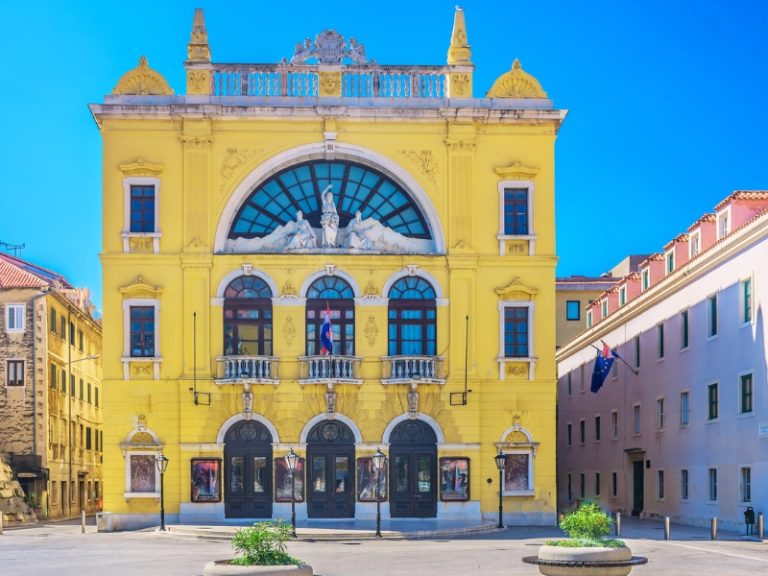
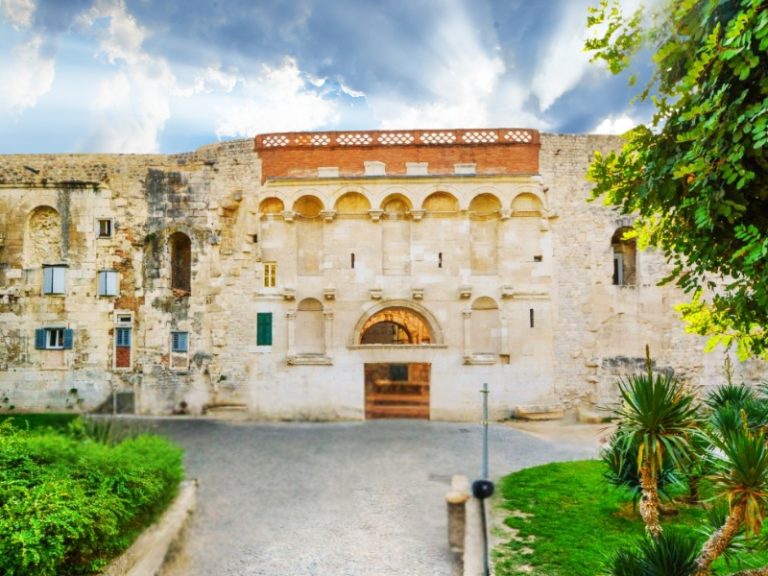
The puzzles are tied to the Croatian National Theatre, the Golden Gate, the Peristyle, the Temple of Jupiter and the Riva, and each one stands on its own, so no storyline is needed. Three tiers of help at most wait behind every puzzle. The route fits this format well, because the old town grew inside the palace walls and the stops are only a few minutes apart.
- Durationabout 2 hours
- Walkingabout 20 min · 1.5 km
- Stops10
- LanguagesEnglish, German, French, Italian, Spanish, Dutch
What you do during the escape game
Solve
Work out the puzzle at each stop from what you see and from logic. You need no prior knowledge of Split.
Read the stones
Clues hide in carvings, columns, doorways and empty niches, so look closely at the stonework around you.
Stroll
Follow Google Maps from one stop to the next, roughly 20 minutes of walking across about 1.5 km.
Take your time
There is no countdown. Use a hint when you need one, stop for a coffee on the Riva and carry on later or on another day.
See the route and attractions →
How it works
- Book online Choose the number of players. Your booking reference arrives by email straight away.
- Get the app Download the World City Trail app from the App Store or Google Play and enter your booking reference.
- Play when you like Start whenever you are ready, walk at your own pace and pause any time. No guide, no fixed schedule.
Who it is for
Friends on a short break
The puzzles give the group something to argue over at every stop, and nobody has to know Split in advance.
Couples
A shared challenge that keeps you talking as you pass through ancient gates and along the waterfront, with no clock ticking.
Team building
Teams of up to 5 each play on their own phone, so colleagues can share the reasoning as they move through the old town.
Good to know
- Bring a charged smartphone with mobile data; a power bank helps.
- Best started in daylight, so you can see the details the puzzles ask about.
- No entry tickets needed: everything happens outside the buildings. Going inside is optional and paid separately.
- Family friendly; children must be accompanied by an adult.
- Not suitable for wheelchair users and difficult with strollers.
- Teams of up to 5 work best; bigger groups split into several teams, one ticket per player.
- Every purchase helps support stray cats and dogs in Greece.
The puzzle trail: from the Croatian National Theatre to Republic Square
10 stops · about 20 min walking · start: Croatian National Theatre · finish: Prokurative (Republic Square)
The first puzzle waits at the Croatian National Theatre and the last on Republic Square, the Prokurative. Between them come the statue of Gregory of Nin, the Golden Gate, the Cathedral of Saint Domnius, the Peristyle and the Temple of Jupiter inside the palace, then People's Square and the Riva. Daylight makes the best start, since the puzzles are solved outdoors and rain slows the game down. Google Maps guides you between stops, you can reorder them in the app, and no entry tickets are needed.
Open the route map ↗
1Croatian National TheatreStart
Split's Croatian National Theatre opened in 1893 and stands on Gaje Bulata Square, just north of the old town. Its large 19th-century building hosts drama, opera and ballet, and it was restored after a fire in the 1970s. In summer it is one of the stages of the Split Summer Festival.
2Gregory of Nin statue (Grgur Ninski)
Ivan Meštrović created this huge bronze of Gregory, a 10th-century bishop of Nin who defended the use of the Croatian language in church services instead of Latin. Made in 1929, it first stood in the Peristyle and was moved to the Golden Gate in 1954. Rubbing his big toe is said to bring luck.
Read the full story →
3Golden Gate
The Golden Gate was the northern main entrance of Diocletian's Palace, facing the road to Salona, then the capital of the Roman province of Dalmatia. It was the most richly decorated of the palace gates. Look at the empty niches in its façade, which once held statues.
Read the full story →
4Cathedral of Saint Domnius
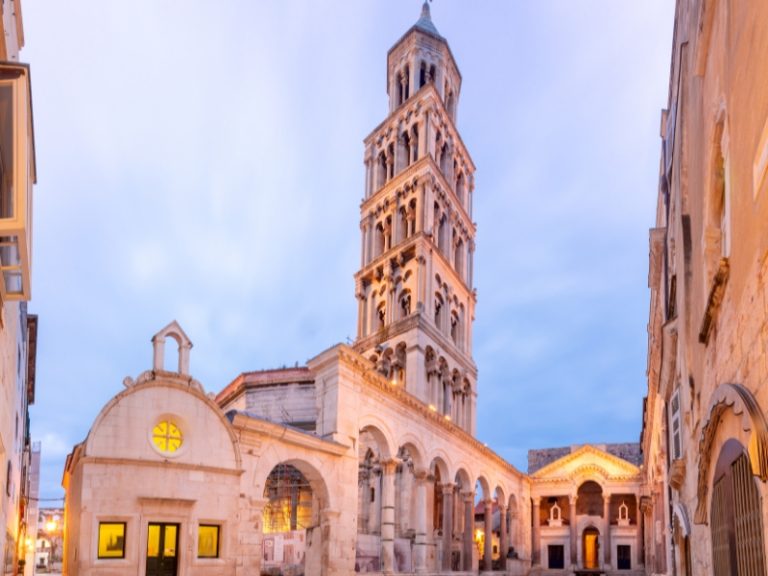
The cathedral was originally the octagonal mausoleum of Emperor Diocletian, built around 300 AD, and became a church in the 7th century. Ironically it is dedicated to Domnius, a bishop of Salona martyred under Diocletian. Look at the carved wooden doors by Andrija Buvina from 1214 and the tall Romanesque bell tower.
Read the full story →
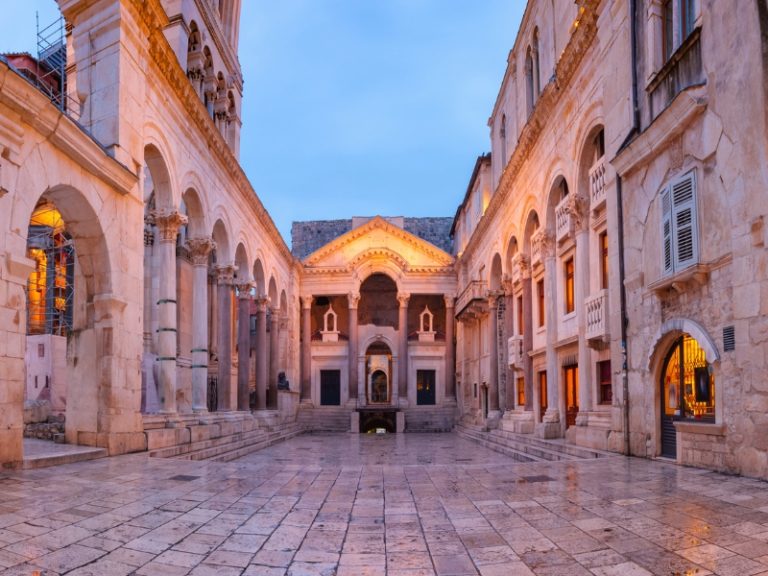
5Peristyle
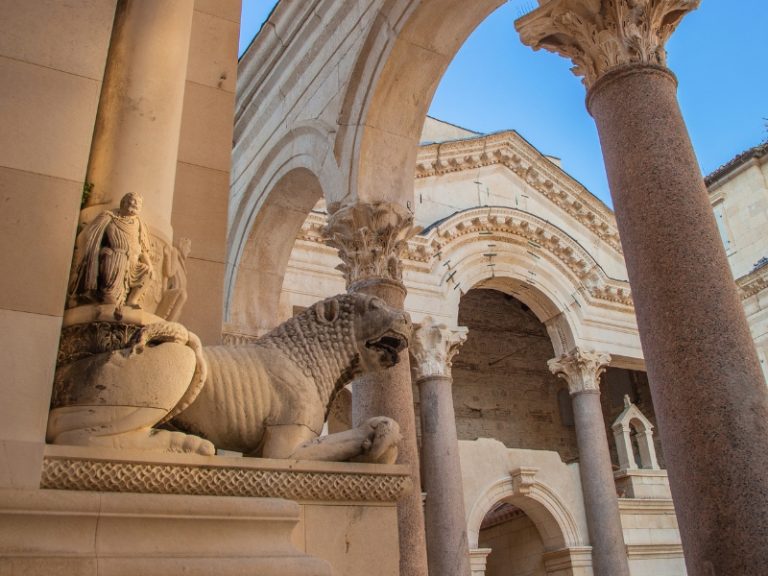
The Peristyle was the ceremonial courtyard of Diocletian's Palace, lined with granite columns and arches that lead to the emperor's former residence. Here the emperor showed himself to his subjects. Look for the black granite sphinx, one of several that Diocletian brought from Egypt.
Read the full story →
6Diocletian's Palace
Emperor Diocletian built this fortified palace around 300 AD as the place where he retired after giving up power in 305. In the 7th century refugees from nearby Salona settled inside its walls, and the palace slowly turned into a town that is still lived in today. It has been a UNESCO World Heritage Site since 1979.
Read the full story →
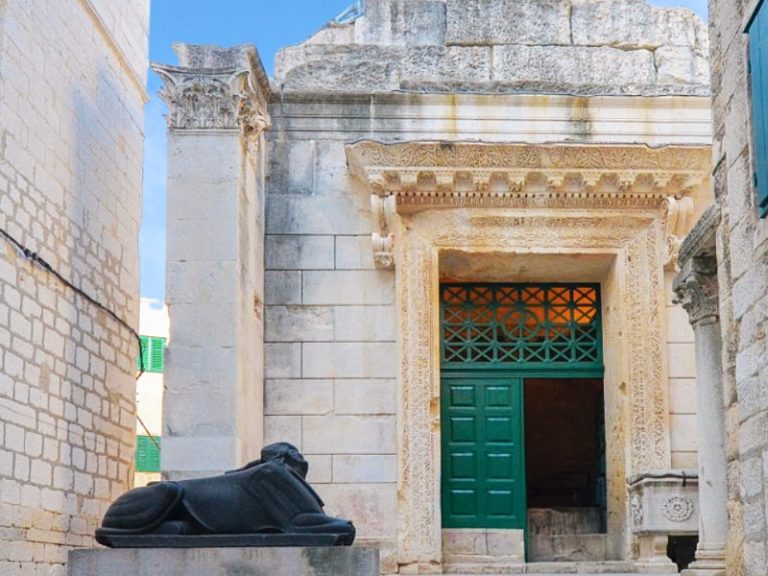
7Temple of Jupiter
This small Roman temple stood next to Diocletian's mausoleum and was dedicated to Jupiter, the god the emperor saw as his protector. In the Middle Ages it was turned into a baptistery of St John the Baptist. Look up at its stone barrel vault with carved coffers and at the headless sphinx outside.
Read the full story →
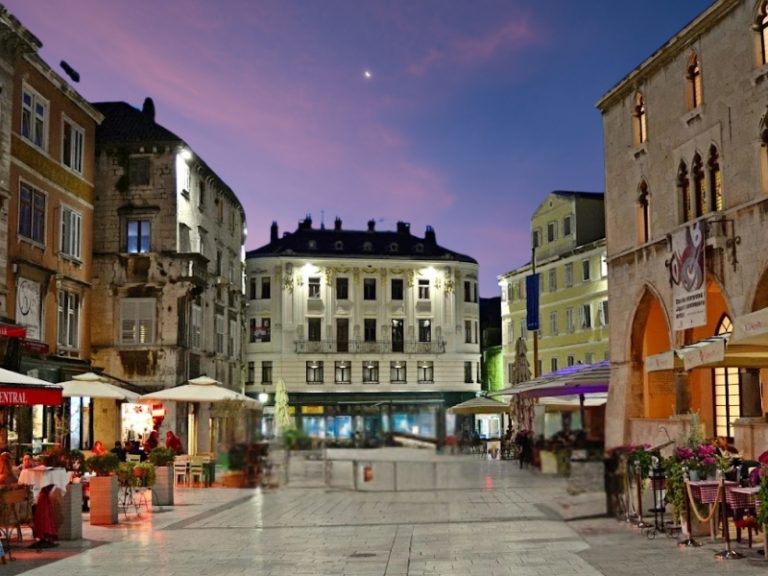
8People's Square (Pjaca)
Narodni trg, called Pjaca by locals, was the main square of the medieval town that grew west of the palace walls. Its oldest building is the Gothic Old Town Hall from the 15th century, with three wide arches on the ground floor. You reach it from the palace through the Iron Gate.
Read the full story →
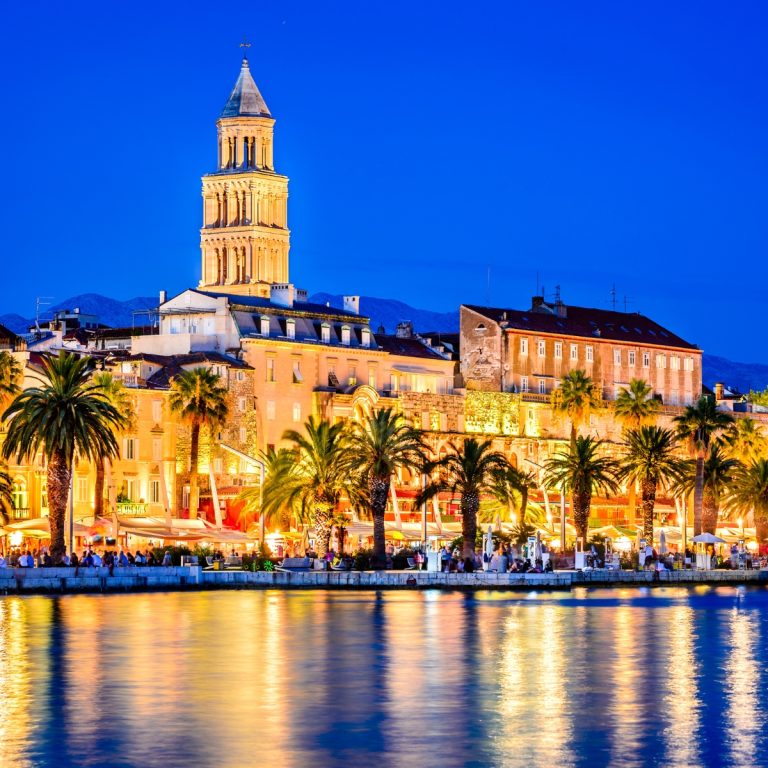
9Riva
The Riva is Split's palm-lined waterfront promenade, running along the southern façade of Diocletian's Palace. In Roman times the sea came right up to these walls, and the Bronze Gate opened directly onto the water. Today cafés line the promenade, with views of the harbour and the islands.
10Prokurative (Republic Square)Finish
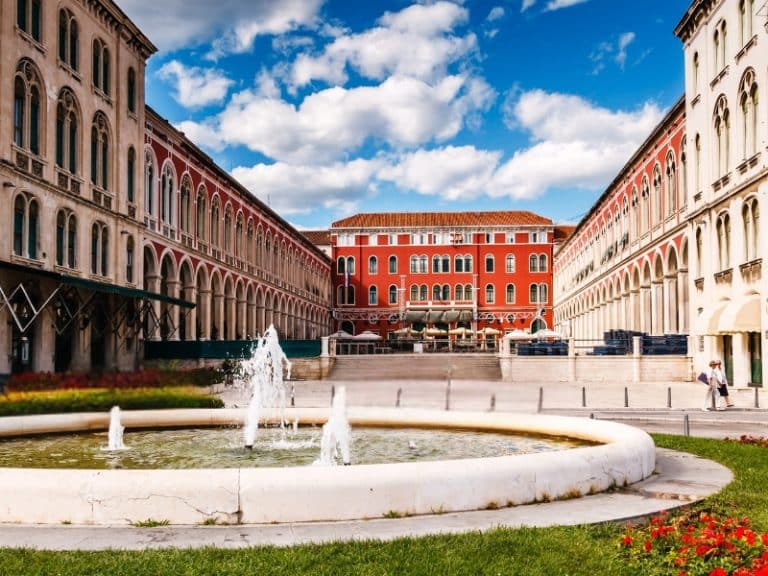
Republic Square, known as the Prokurative, was built in the second half of the 19th century on the initiative of mayor Antonio Bajamonti. Its neo-Renaissance buildings with arcades frame the square on three sides and were modelled on the Procuratie of St Mark's Square in Venice. The fourth side opens to the sea.
Read the full story →
Only logged in customers who have purchased this product may leave a review.






France –
Collected on GetYourGuide
Très bien pour découvrir la ville
France –
Collected on GetYourGuide
Très bien pour découvrir la ville