
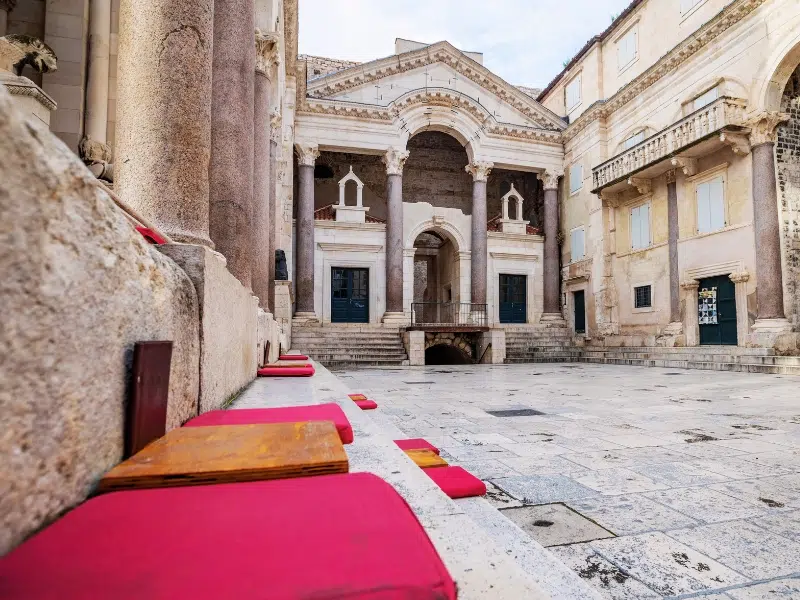
Diocletian's Palace is the Roman emperor's retirement residence on the seafront of Split, and it is not a ruin you visit but the old town itself. Built around 295 AD, it was taken over by refugees in the 7th century, and about 3,000 people still live inside its walls today, among cafés, shops and a cathedral that was once the emperor's tomb.
Diocletian's Palace at a glance
- Where: the core of Split's old town, between the Riva seafront promenade and the Golden Gate on the north side.
- Built: begun around 295 AD; Diocletian moved in after giving up the throne in 305.
- What it is today: a lived-in old town and, with the historic centre of Split, a UNESCO World Heritage Site since 1979.
- Time needed: 1–2 hours to walk through it; half a day if you also visit the cathedral, the bell tower and the cellars.
From an emperor's villa to a town
Diocletian, who reorganised the Roman Empire and is remembered for the last great persecution of Christians, did something almost no emperor did: he retired. Work on his palace on the Dalmatian coast began around 295, and after he abdicated in 305 he lived here until his death a few years later. The palace was laid out like a Roman military camp, with walls and towers; half of it was for the emperor, the other half for his garrison. It was built of local white limestone, stone from the island of Brač and tuff, with granite columns and sphinxes brought from Egypt.
In the 7th century, when Avars and Slavs destroyed the nearby Roman city of Salona, its inhabitants took refuge inside the palace walls. They built houses into the Roman structures, churches above the gates and, over the centuries, medieval and Renaissance houses on top of the old rooms, and the town of Split grew out of the palace. In 1764 the Scottish architect Robert Adam published drawings of the ruins, which helped shape Neoclassical architecture in Britain. In 1979 the palace became a UNESCO World Heritage Site, and more recently its cellars were a filming location for season 4 of Game of Thrones.
What to look for
- The Peristyle: the colonnaded central square, framed by granite columns, where you can still see one of the palace's Egyptian sphinxes. Of the original sphinxes, three survive: one here, one by the Temple of Jupiter and one in the city museum.
- The Vestibule: the round, domed entrance hall to the imperial apartments, now open to the sky at the top; klapa groups often sing here because of its acoustics.
- Cathedral of St Domnius: Diocletian's octagonal mausoleum turned into a Christian cathedral, dedicated to a bishop of Salona who was martyred under the emperor who was buried here.
- The cellars (substructures): the vaulted halls under the southern half of the palace, which follow the plan of the lost imperial rooms above them. You can enter them from the Riva through the Bronze Gate.
- The four gates: the Golden Gate (north), the Silver Gate (east), the Iron Gate (west, the only one that has been in use without interruption) and the Bronze Gate (south, the old sea gate).
The emperor and his cabbages
An ancient story says that a few years after his retirement, when Diocletian was invited to return to power, he refused and replied that if his visitors could see the cabbages he had grown with his own hands, they would never ask him to give that up. It is told by later Roman writers and may be embellished, but it fits a palace built for an emperor who chose to stop ruling.
Tips for your visit
- Come early in the morning or in the evening, when the lanes are quieter and the cruise-ship groups have left.
- The old stone paving is polished smooth and can be slippery, especially after rain: wear shoes with some grip.
- Climb the cathedral bell tower for a view over the rooftops of the palace and the harbour.
- Stop in the Vestibule for a few minutes: if a klapa group is singing, you will hear why they choose that room.
Nearby
- Gregory of Nin: Ivan Meštrović's giant bronze bishop outside the Golden Gate; rubbing his big toe is said to bring luck.
- The Riva: the palm-lined seafront promenade along the south wall of the palace, the place for an evening walk.
- Croatian National Theatre: the theatre building from 1893, a few minutes' walk north of the old town.
- Marjan Hill: the forested hill west of the centre, with viewpoints over the city and the islands.
See Split with World City Trail
Our Split scavenger hunt turns the old town into a game you play on your phone. The route links 10 stops and takes around 2 hours, with about 20 minutes of walking. One of the stops is the palace's Golden Gate, and the route also includes the Gregory of Nin statue and the Croatian National Theatre.
If you prefer a different format, there is also a self-guided walking tour and an outdoor escape game in Split.
Play the Split scavenger hunt →
Take the self-guided walking tour of Split →
Play the outdoor escape game in Split →
Facts checked in October 2026.