
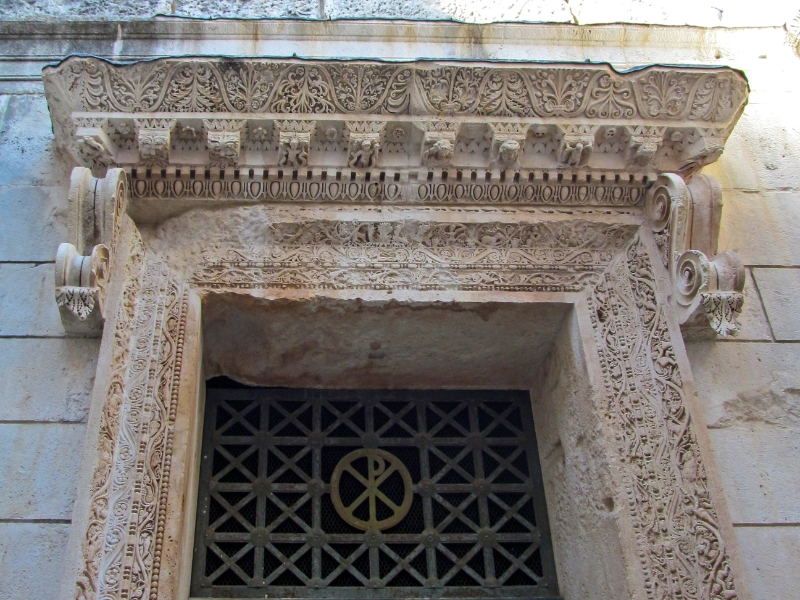
The Temple of Jupiter is the small Roman temple at the end of a narrow lane just west of the Peristyle, inside Diocletian's Palace in Split. It was built around 300 AD for the god the emperor presented as his divine protector, and in the early Middle Ages it became a Christian baptistery dedicated to St John the Baptist. Its carved stone vault has survived almost intact, and a headless granite sphinx from Egypt still sits by the door.
The Temple of Jupiter at a glance
- Where: in the western half of Diocletian's Palace, at the end of a narrow lane that leads west from the Peristyle, facing the cathedral.
- Built: between about 295 and 305 AD as part of Emperor Diocletian's retirement palace; converted into a baptistery in the early Middle Ages, possibly as early as the 6th century.
- What it is today: the Baptistery of St John, part of Split's cathedral complex and visited with a ticket. It lies within the UNESCO World Heritage site of Diocletian's Palace.
- Time needed: 15–20 minutes.
From Jupiter's temple to John's baptistery
Diocletian, who ruled the Roman Empire from 284, took the name Jovius to present himself as the chosen one of Jupiter, the chief Roman god. He built his palace on the Adriatic coast to live in after he gave up power in 305. West of the Peristyle he laid out a sacred precinct, and the temple stood there on a high podium with a porch of columns at the front, a vaulted room for the cult statue and a crypt underneath. Building work stopped when the emperor abdicated, so parts of the decoration were never finished. The dedication to Jupiter is the traditional one; some scholars have suggested other gods.
Diocletian is also remembered for the last great persecution of Christians, in which Domnius, bishop of nearby Salona, was executed in 304. In the early Middle Ages, as people from Salona settled inside the palace walls, the emperor's mausoleum became the cathedral of St Domnius and the temple became a baptistery for St John the Baptist, with the crypt below dedicated to St Thomas.
What to look for
- The sphinx: the headless granite sphinx by the steps is one of the sphinxes Diocletian brought from Egypt. It was found in 1928 in the foundations of a demolished Romanesque house and later set up in front of the temple.
- The doorway: a richly carved stone frame around the entrance, with Roman reliefs above it showing gods and heroes, among them Jupiter, Apollo and Hercules.
- The vault: a barrel vault of heavy stone blocks carved into deep coffers. In the 15th century it inspired the early Renaissance baptistery that Andrija Aleši (Andrea Alessi) built for the cathedral of Trogir.
- The font: it was put together in the 13th century from carved panels of an 11th-century altar screen that once stood in the cathedral. One panel shows a Croatian king on his throne with his subjects, usually identified as Petar Krešimir IV or Dmitar Zvonimir. Other panels carry the interlace pattern typical of early Croatian stone carving.
- St John the Baptist: the tall bronze statue by Ivan Meštrović. He designed it in 1953 while living in the United States; it was cast in 1959 and set up here in 1960.
- The tombs: the stone sarcophagi of two medieval archbishops of Split, John and Lawrence; Lawrence died in 1099. In front of the building stands the 16th-century Renaissance sarcophagus of Jakov Selembrije.
Sphinxes from Egypt and a Scottish architect
Diocletian had a series of granite sphinxes shipped from Egypt to decorate his palace; tradition puts their number at twelve. The best preserved one, with its head, still lies on the Peristyle beside the cathedral. Many centuries later, in 1757, the Scottish architect Robert Adam spent weeks measuring and drawing the palace. His volume of engravings, published in 1764, made Split's Roman buildings known across Europe and fed the neoclassical style he brought to Britain.
Tips for your visit
- The lane to the temple is barely wide enough for two people to pass, and the room fills quickly. Come early in the morning or late in the afternoon, when the tour groups have thinned out.
- Look up first: the coffered vault is the reason to step inside, and it is easy to miss while you queue at the door.
- This is a church space: dress modestly and keep your voice down. If you also want to see the cathedral and climb the bell tower, ask about a combined ticket for the cathedral complex.
Nearby
- Peristyle: the colonnaded courtyard at the centre of the palace, with the complete Egyptian sphinx, a minute's walk east.
- Cathedral of St Domnius: Split's cathedral, set inside Diocletian's octagonal mausoleum, with a Romanesque bell tower you can climb.
- Vestibule: the round, domed hall just south of the Peristyle that once led to the emperor's private rooms.
- Golden Gate and the Gregory of Nin statue: the palace's north gate and Meštrović's giant bronze bishop, a few minutes' walk north.
See Split with World City Trail
Our Split scavenger hunt turns the old town into a game you play on your phone. The route links 10 stops and takes around 2 hours, with about 20 minutes of walking. Along the way it includes the Golden Gate, the Gregory of Nin statue and the Croatian National Theatre.
If you prefer a different format, there is also a self-guided walking tour and an outdoor escape game in Split.
Play the Split scavenger hunt →
Take the self-guided walking tour of Split →
Play the outdoor escape game in Split →
Facts checked in October 2026.