
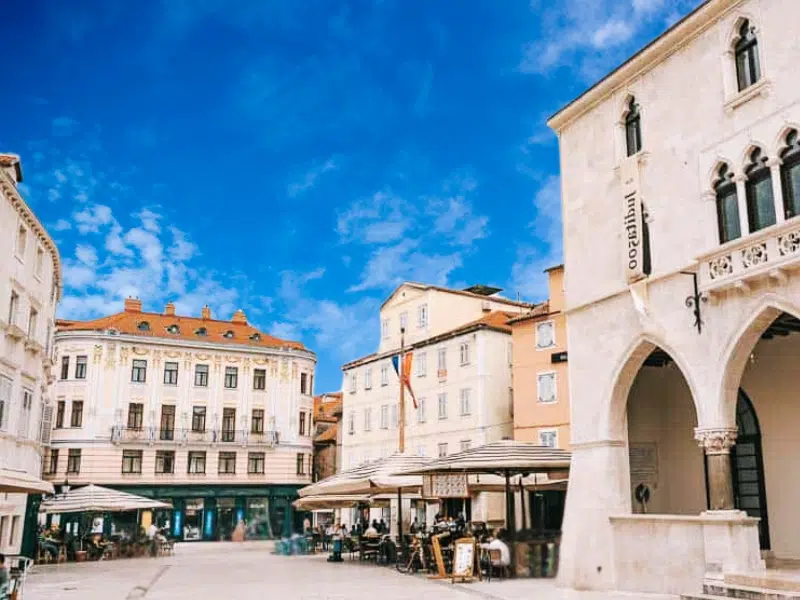
People's Square (Narodni trg) is the main square of Split's old town, just outside the western wall of Diocletian's Palace. Everyone in Split calls it Pjaca, the local form of the Italian piazza. It was the first part of the city to grow outside the Roman walls, and for centuries it was where Split was governed, traded and gossiped: the Gothic town hall, the 24-hour clock above the Iron Gate and the café tables are all still there.
People's Square at a glance
- Where: on the west side of Diocletian's Palace, through the Iron Gate from the palace streets, a short walk from the Riva.
- Built: laid out from the 14th century, when the city spread beyond the palace walls; the old town hall dates from the 15th century and the buildings around the square range from the Middle Ages to 1902.
- What it is today: a pedestrian square paved in pale, polished stone, lined with cafés and shops, and still the city's favourite meeting point.
- Time needed: 10–15 minutes to look around, longer if you stop for a coffee.
The first square outside the palace
When the Roman emperor Diocletian built his retirement palace here around 300 AD, the whole town that later grew up lived inside its walls for centuries. As the population grew, the palace became too small, and from the 14th century houses and streets spread to the west, outside the palace's western gate. The open space in front of that gate became the new centre. It was once known as the Square of St Lawrence (Trg svetog Lovre), and the city's government, its notaries and its merchants gathered around it.
In the 15th century, while Split was under Venetian rule, the town hall was built on the north side of the square in Venetian Gothic style, with an open loggia of three pointed arches at street level. Over the following centuries noble families built their palaces around the square, from the late Romanesque and Gothic to the Renaissance. The last major addition came in 1902: the Nakić house at the western end, with rounded corners and floral decoration in the style of the Viennese Secession. The town hall is no longer the seat of government and is now used for exhibitions and events.
What to look for
- The old town hall: the three Gothic arches on columns at ground level, the clearest Venetian touch on the square.
- The Iron Gate (Željezna vrata) at the east end, the western gate of Diocletian's Palace. A relief of Nike, the goddess of victory, once stood on its lintel; by the 5th century Christians had replaced it with a cross.
- The city clock on the tower beside the Iron Gate, with a dial divided into 24 hours instead of the usual 12.
- The Nakić house of 1902, with its curved corners and plant ornaments, a piece of Vienna in a medieval square.
- The Standarac, the stone flagpole monument on the square.
Pjaca and the Split way of life
In Split you do not 'go to the square', you go to Pjaca. The word is Italian in origin, a reminder of the centuries when Italian was widely spoken along the Dalmatian coast. The Gradska kavana, the city café on the square, is known as a place where older men meet for their morning coffee, and the slow, sociable coffee that can last an hour is a local habit worth copying.
Tips for your visit
- Come in the morning to see the square in everyday use, or in the evening when the stone is warm and the cafés are full.
- Stand at the western end of the square for a view of the town hall, the clock tower and the Iron Gate together.
- Walk through the Iron Gate into the palace: the passage leads straight towards the Peristyle and the cathedral.
Nearby
- Iron Gate and the Church of Our Lady of the Belfry: the small church built above the gate in the 11th century, with an early Romanesque bell tower.
- Fruit Square (Voćni trg): the next square towards the sea, with a Venetian tower and Ivan Meštrović's statue of Marko Marulić, the father of Croatian literature.
- Peristyle: the colonnaded central square of Diocletian's Palace, a few minutes' walk through the palace streets.
- Republic Square (Prokurative): the arcaded 19th-century square at the western end of the Riva.
See Split with World City Trail
Our Split scavenger hunt turns the old town into a game you play on your phone. The route links 10 stops and takes around 2 hours, with about 20 minutes of walking. Along the way it includes the Croatian National Theatre, the Gregory of Nin statue and the Golden Gate of Diocletian's Palace.
If you prefer a different format, there is also a self-guided walking tour and an outdoor escape game in Split.
Play the Split scavenger hunt →
Take the self-guided walking tour of Split →
Play the outdoor escape game in Split →
Facts checked in October 2026.