
Table of Contents
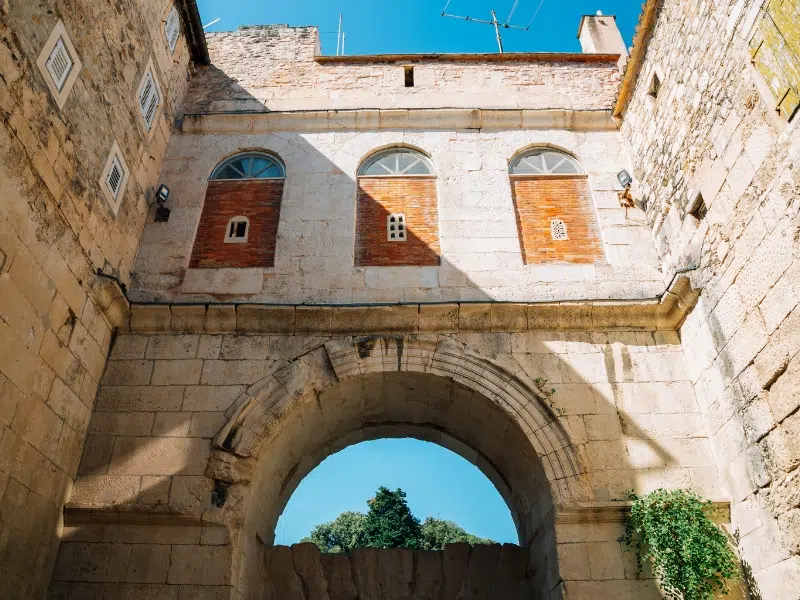
The Golden Gate (Zlatna Vrata) in Split is more than just an entrance—it is a monument to the city’s imperial past, a portal into the heart of Diocletian’s Palace, and a testament to the enduring grandeur of Roman engineering. As the northernmost and most important gate of the palace, it was once exclusively reserved for Emperor Diocletian and his closest retinue, symbolizing power, prestige, and the might of the Roman Empire. Today, the Golden Gate stands as a majestic relic of antiquity, welcoming visitors into a UNESCO World Heritage Site and one of the best-preserved Roman structures in the world.
A Gateway to Imperial Splendor
Built in the late 3rd and early 4th centuries AD, the Golden Gate was designed as the primary entrance to Diocletian’s lavish retirement palace. Unlike the other gates—Silver, Iron, and Bronze—the Golden Gate held the highest ceremonial significance, as it was the passage through which the emperor himself would enter his palace after traveling from Salona, the capital of the Roman province of Dalmatia.
The gate’s strategic placement along the main road (Via Egnatia) ensured that it was both a functional entrance and a grand statement of imperial power. Through its arch, emperors, dignitaries, and soldiers passed, bringing with them the wealth and influence of Rome. It was designed to be both awe-inspiring and impenetrable, reinforcing the emperor’s dominion over his palace and the surrounding lands.
Architectural Majesty
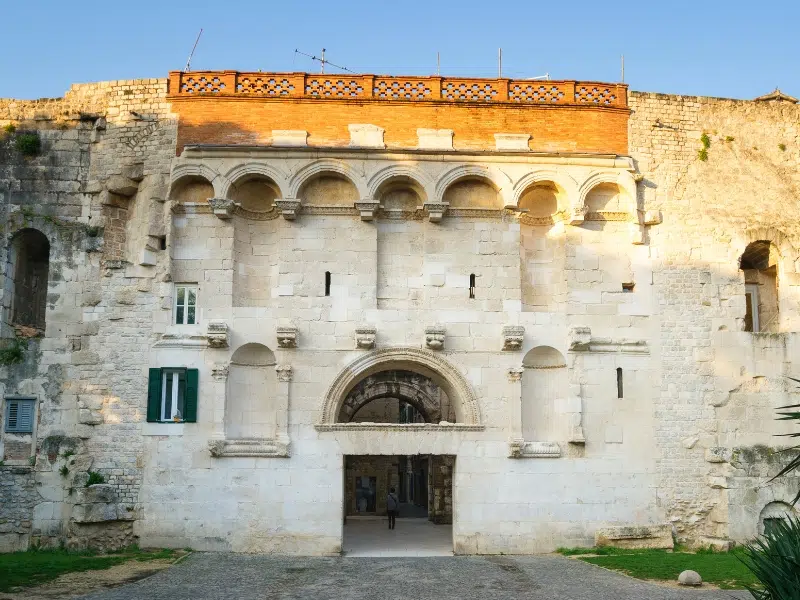
The Golden Gate is a masterpiece of Roman engineering, showcasing the meticulous craftsmanship and durability of Roman construction. Its massive stone blocks, arranged with precision, have stood the test of time, remaining remarkably well-preserved despite centuries of war, conquest, and urban transformation. The design reflects the grandeur of Roman military architecture, featuring high defensive walls, flanking octagonal towers, and ornate detailing, which once included statues and elaborate carvings.
Originally, the gate was adorned with statues of Diocletian and the four tetrarchs, underscoring the ruler’s dominance and the political order of the time. While these embellishments have since disappeared, the structure still exudes a sense of imperial power and artistic brilliance, making it a striking landmark in Split’s historic core.
A Symbol of Continuity
Throughout the centuries, the Golden Gate has witnessed the transformation of Split, evolving from a Roman imperial residence into a thriving medieval city. Following the fall of the Western Roman Empire, Diocletian’s Palace became a fortified settlement, with refugees from nearby Salona taking shelter within its walls. Over time, homes, churches, and marketplaces sprang up within the palace, and the Golden Gate remained a vital point of entry, adapting to the city’s shifting identity.
The gate’s historical significance extends beyond its Roman origins. During the medieval period, it was integrated into the city’s fortifications, and under Venetian rule, its defensive importance was reinforced. Even today, it continues to stand as a bridge between the past and present, embodying Split’s unbroken connection to its ancient heritage.
A Hub of Activity
The Golden Gate is not just a historical relic—it is a living part of Split’s daily life. The area around the gate is always bustling, with tourists, performers, and vendors creating a vibrant atmosphere that blends ancient history with modern culture. Just outside the gate, visitors are greeted by the towering statue of Gregory of Nin, a 10th-century bishop known for advocating the use of the Croatian language in religious services. The statue, sculpted by Ivan Meštrović, is now one of the most recognizable symbols of Split, and its shining toe—rubbed for good luck by countless visitors—adds a touch of legend to the site.
Walking through the arched entrance of the Golden Gate is like stepping into a portal through time. Once inside, visitors are immediately immersed in the maze-like streets of Diocletian’s Palace, where Roman, medieval, and modern influences seamlessly intertwine.
Golden Gate is part of Split scavenger hunt and walking tour!
Embark on an unforgettable journey through the enchanting city of Split with World City Trail. Our interactive walking tour combines the thrill of exploration with the rich history and culture of this beautiful city.
Key Features:
Interactive gameplay: Solve engaging puzzles and challenges as you explore the city.
Hidden gems: Uncover lesser-known spots.
Cultural insights: Learn about the city’s fascinating history.
Flexibility: Explore at your own pace and create your own itinerary.
Family friendly activity and a great way to explore the city!
Further reading on Wikipedia: Split, Croatia