
Bergamo's upper town, Città Alta, packs eight centuries of building into a few streets on a hill. This guide covers four places there: the Basilica of Santa Maria Maggiore, the medieval Palazzo della Ragione on Piazza Vecchia, the Piazza della Cittadella inside the old Visconti fortress, and Palazzo Terzi, the city's grandest Baroque palace. Three of them are stops on our Bergamo scavenger hunt, and all four can be seen in one unhurried walk.
Basilica di Santa Maria Maggiore
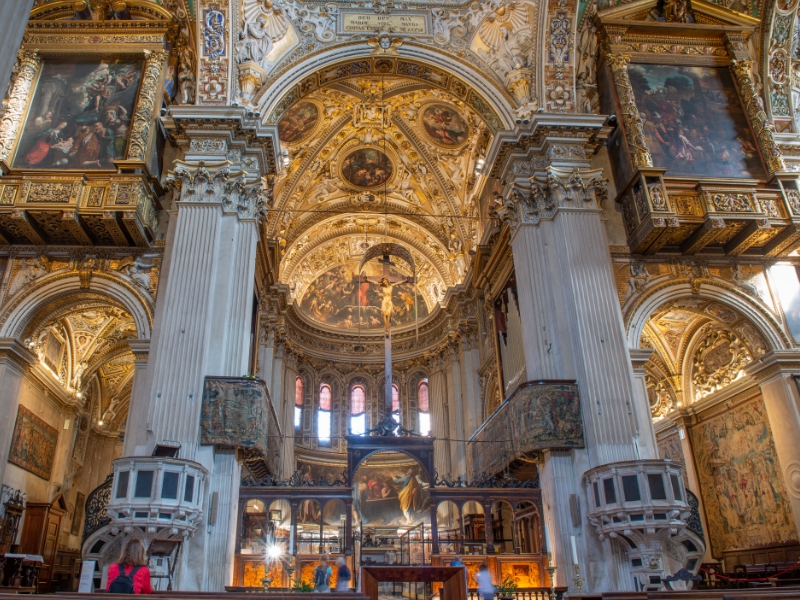
An inscription on the southern portal gives the founding date of Bergamo's great Romanesque church as 1137, on the site of an older church from the 8th century; the high altar was consecrated in 1185. Popular tradition says the citizens had vowed a church to the Virgin in 1133 to save the city from plague, a story that the documents partly support. It is not the cathedral, which stands right next to it, but the city's own church, and its plan is still the Romanesque Greek cross. You will notice that the main facade has no door: the basilica is entered from the side, through porches on Piazza Duomo and the Porta della Fontana.
Inside, the plain medieval shell was covered with Baroque decoration in the 17th century. The walls are hung with large tapestries of the Life of Mary, some woven in Florence between 1583 and 1586 to designs by Alessandro Allori and others in Flemish workshops, with a huge Crucifixion woven in Antwerp in 1698. The wooden choir has inlaid panels designed by Lorenzo Lotto and made between 1524 and 1555, using woods of different colours to paint pictures. The composer Gaetano Donizetti, born in Bergamo, is buried here, in a tomb by Vincenzo Vela from 1855, near that of his teacher Simone Mayr.
- The porch by Giovanni da Campione from 1353, its columns resting on lions of Verona marble, with a frieze of hunting scenes on the arch.
- The second porch on the other side, with white marble lions, and the Porta della Fontana finished by Pietro Isabello in 1521.
- The Colleoni Chapel beside the basilica, built from 1481 to 1491 as the tomb of the mercenary captain Bartolomeo Colleoni, who had the church's old sacristy pulled down to make room for it.
Palazzo della Ragione
The Palazzo della Ragione, on the south side of Piazza Vecchia, was built between 1182 and 1198 as the seat of the medieval commune, which makes it one of the oldest town halls in Italy. It burned in 1296 and again in 1513, and much of what you see dates from the restoration led by Pietro Isabello from 1538, when the open arcade on the ground floor was rebuilt. A covered stone staircase from 1457 climbs the outside of the building to the upper floor.
Above the central window sits the winged lion of Saint Mark, sign of the Republic of Venice, which ruled Bergamo from 1428. The first lion was put up in 1464; the one there now is a restoration of 1933, given by the city of Venice after the original was destroyed when the French arrived at the end of the 18th century. Upstairs, the great Sala delle Capriate, named after its timber roof trusses, holds frescoes moved here from other buildings, including works by Bramante from the Palazzo del Podestà next door. Its opening depends on the exhibitions on show. The palace is one of the stops on our scavenger hunt.
- The sundial set into the pavement under the arcade, made in the late 18th century by the abbot Giovanni Albrici; around solar noon the sun marks the hour on its line.
- The lion of Saint Mark above the balcony on the Piazza Vecchia side.
- The view through the arcade from Piazza Vecchia to the white facade of the Colleoni Chapel and the cathedral behind it.
Piazza della Cittadella
At the western end of Via Colleoni, a gate tower leads into a quiet square that was once the parade ground of a fortress. In 1355 Bernabò Visconti, lord of Milan, took over this part of the hill, expelled the family who lived there and built a ring of tower houses around the open space; his son Rodolfo was given the job of building the large residence, the Hospitium Magnum. The Visconti ruled Bergamo from 1331 until Venice took over in 1428, and the citadel housed customs offices, a prison and even a torture chamber.
Under Venice the citadel lost its purpose, and in 1520 it was auctioned off in twelve lots, with buyers free to raise, lower or pull down the towers as they wished. Since the 20th century the Hospitium Magnum has housed two museums, the Civic Archaeological Museum and the Enrico Caffi Natural Science Museum. The square is a stop on our scavenger hunt, and the pastry shop La Marianna, the last stop, is just beyond it at Colle Aperto.
- The Torre della Campanella, the much-altered gate tower you walk through from Piazza Mascheroni.
- The cobbled surface of the square, crossed by an old Roman road, and the pointed arches of the 18th-century facade, restored between 1958 and 1960 by the architect Sandro Angelini.
Palazzo Terzi
Palazzo Terzi stands on a small square of its own, Piazzetta Terzi, at the edge of the Rocca in the upper town, and it is considered Bergamo's most important Baroque palace. The Terzi were an old noble family, and the palace grew around two marriages: that of Marquis Luigi Terzi and Paola Roncalli in 1631, which produced the facade and the south wing, and that of Gerolamo Terzi and Giulia Alessandri about a century later, which enlarged the terrace below. The piazzetta itself was created by widening a lane, to a design by Filippo Alessandri dated 1747. The writer Hermann Hesse admired it when he visited Bergamo.
Inside, the rooms are decorated by some of the best artists of the 17th and 18th centuries: a room with frescoes by Giambattista Tiepolo, a red room hung with vermilion damask, a small mirror cabinet with mirrors brought from Venice and a multicoloured wooden floor by Giovan Battista Caniana, and a ceiling of Dawn chasing away Sleep painted by Carpoforo Tencalla in 1664. The palace is not one of our scavenger hunt stops, and the rooms can be seen only on guided tours.
- The statue of Architecture by Giovanni Antonio Sanz in a niche opposite the entrance, with putti representing the seasons.
- The terrace between the two wings, which looks over the garden to the lower town.
How to see them in one walk
Start where the funicular from the lower town arrives, at Piazza Mercato delle Scarpe, which is also the first stop of our scavenger hunt. Palazzo Terzi and its piazzetta are close by, near the Rocca, so see them first. Then walk up Via Gombito to Piazza Vecchia, where the Palazzo della Ragione and the Campanone tower face the square; pass under the arcade to Piazza Duomo for Santa Maria Maggiore, the Colleoni Chapel and the cathedral. Follow Via Colleoni west to the Piazza della Cittadella, and end with a stop at La Marianna at Colle Aperto.
See Bergamo with World City Trail
Our Bergamo scavenger hunt turns the old town into a game you play on your phone. The route links 10 stops, from Piazza Mercato delle Scarpe to La Marianna, and the Basilica of Santa Maria Maggiore, the Palazzo della Ragione and the Piazza della Cittadella are all stops, along with Porta San Giacomo, the cathedral, the Campanone, Piazza Vecchia and the University of Bergamo. At each stop you solve a puzzle and learn a story, at your own pace.
There is also a self-guided walking tour and an outdoor escape game in Bergamo, for people who prefer a different format.
Play the Bergamo scavenger hunt →
Take the self-guided walking tour of Bergamo →
Play the outdoor escape game in Bergamo →
Facts checked in October 2026.