
This guide follows six places on the hill of Castello, Cagliari's walled old town, and on its northern slope: the Giardini Pubblici, the Roman amphitheatre, Porta Cristina, the National Archaeological Museum, the cathedral and the Bastion of Saint Remy. They run from Roman Carales to the 20th century, and they are all stops on our scavenger hunt, so one walk links them from the gardens down to the great staircase above the modern city.
Giardini Pubblici
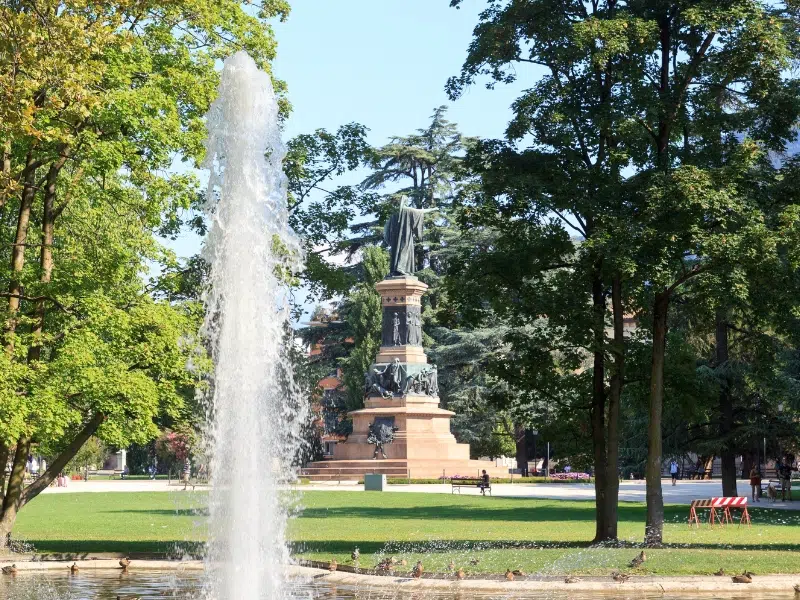
The Giardini Pubblici, the public gardens, lie just outside the walls of Castello, at the start of the Buon Cammino avenue. The city bought the land in 1840 and laid it out as a 19th-century garden for walking, with a long avenue of trees, fountains and flower beds. It is one of the shadiest places in the old town on a hot day.
At the end of the main avenue stands the Galleria Comunale d'Arte, the city art gallery. The building was the royal gunpowder magazine of the Savoy arsenal, with a Neoclassical front from 1828; it became an art gallery in 1933, the first civic museum in Sardinia. It holds the Ingrao collection of Italian art and a room of works by the Sardinian sculptor Francesco Ciusa. The gardens are the first stop of our scavenger hunt.
- The old jacaranda trees, which turn the avenue purple in late spring, and two huge Moreton Bay fig trees.
- The plaster of Ciusa's La madre dell'ucciso (The Mother of the Slain), a grieving mother from 1907, inside the gallery.
Roman Amphitheatre of Cagliari
The amphitheatre was built in the 1st to 2nd century AD, when Cagliari was the Roman town of Carales. Half of it is carved out of the rock of the hillside and the rest was built of white limestone; it held around 8,000 to 10,000 spectators, a large share of the town's people. It hosted gladiator fights, shows with animals and public executions.
After it fell out of use in the 5th century, later rulers, from the Byzantines to Pisa and Aragon, used it as a quarry, which is why so much of the upper seating is gone. It was excavated in the 19th century under the archaeologist Giovanni Spano. In the early 2000s a metal and wood structure covered it for summer concerts; it was later removed to give the site back to archaeology. The amphitheatre is one of our scavenger hunt stops, next to the university's botanical garden.
- The rows of seats cut straight into the living rock of the hill.
- The corridors around the arena floor, which were buried when excavation began.
Porta Cristina
Porta Cristina is the northern gate of Castello, between the Buon Cammino avenue and Piazza Arsenale. It was built in 1825 in Neoclassical style, to a design by Count Carlo Pilo Boyl approved by King Charles Felix of Savoy, and it replaced an older 17th-century gate called the Porta del Soccorso.
The gate is named after Queen Maria Cristina, Charles Felix's wife. Its lines are modelled on the inner face of Porta Pia in Rome. It is one of the stops on our scavenger hunt, and walking through it is the classic way into the upper town from the gardens.
- The Latin inscription in the lunette, which says that King Charles Felix opened an easier and shorter road from the castle and that Queen Maria Cristina gave it her name, dated 1825.
- The pilasters on each side of the arch and the two projecting cornices above it.
National Archaeological Museum
Cagliari's National Archaeological Museum began in 1800, when the viceroy Charles Felix set up a cabinet of archaeology and natural history in the viceroy's palace; it opened to the public in 1802. Since 1993 it has been in the Cittadella dei Musei on Piazza Arsenale, a complex built in the former royal arsenal and rebuilt by the architect Libero Cecchini.
It is the best place in Sardinia to understand the island's past, from the pre-Nuragic and Nuragic ages to the Byzantine period. The highlights are the Nuragic bronze figurines of warriors, archers and chieftains, the Nora Stone with one of the oldest Phoenician inscriptions in the western Mediterranean, and Carthaginian gold jewellery. The museum is one of the scavenger hunt stops.
- The statues of Mont'e Prama, large stone figures of warriors and boxers, in a section dedicated to them.
- The Nuragic bronze boat models (navicelle), such as the one found at Orroli.
Cagliari Cathedral
The cathedral, dedicated to Our Lady of the Assumption and Saint Cecilia, stands on Piazza Palazzo in the middle of Castello. It was built in the 13th century, when Pisa ruled the town, in Pisan Romanesque style, and became a cathedral in 1258. The striped front you see today is much younger: a Neo-Romanesque facade from the 1930s, inspired by the cathedral of Pisa.
Inside, the church is largely Baroque, but its oldest treasure is Pisan. Master Guglielmo carved a marble pulpit for Pisa Cathedral in the 12th century, and in 1312 it was sent to Cagliari; it was later split into two ambos, now by the main door. In the left transept is the 17th-century mausoleum of King Martin I of Sicily, who died in Cagliari in 1409. The cathedral is one of our scavenger hunt stops.
- Guglielmo's carved panels with scenes from the life of Christ on the two ambos by the entrance.
- The crypt, the Sanctuary of the Martyrs, with 179 niches holding relics of Cagliari's early martyrs.
Bastion of Saint Remy
The Bastion of Saint Remy is a grand terrace and staircase that links Castello with the modern city below. It stands on Spanish bastions from the 1530s, but its present form was built between 1899 and 1903 to a design by Giuseppe Costa, and it is named after the first Savoyard viceroy of Sardinia, Filippo Guglielmo Pallavicino, baron of Saint-Rhémy.
The upper terrace and the covered walk below it are named after King Umberto I. On 17 February 1943 bombs destroyed the triumphal arch and part of the staircase, and the bastion then sheltered people who had lost their homes; it was rebuilt and reopened in 1958. Today the terrace is the city's favourite viewpoint and one of the stops on our scavenger hunt.
- The double staircase rising from Piazza Costituzione to the triumphal arch.
- The Passeggiata Coperta, the covered walk with three naves, now used for art exhibitions, and the view over the harbour and the lagoons from the Terrazza Umberto I.
How to see them in one walk
This order roughly follows the scavenger hunt. Start in the Giardini Pubblici and see the art gallery, then walk down to the Roman amphitheatre. Come back up to the Buon Cammino avenue and enter Castello through Porta Cristina. Piazza Arsenale is right behind the gate, with the Archaeological Museum in the Cittadella dei Musei. From there walk south along the spine of Castello to Piazza Palazzo and the cathedral, and finish on the Bastion of Saint Remy, ideally at sunset, before going down the staircase to Piazza Costituzione.
See Cagliari with World City Trail
Our Cagliari scavenger hunt turns the old town into a game you play on your phone. The route links 10 stops, from the Giardini Pubblici to Piazza Giacomo Matteotti, and all six places in this guide are stops, along with the Bastion of Santa Croce, the Elephant Tower, Piazza Yenne and Piazza Giacomo Matteotti. At each stop you solve a puzzle and learn a story, at your own pace.
There is also a self-guided walking tour and an outdoor escape game in Cagliari, for people who prefer a different format.
Play the Cagliari scavenger hunt →
Take the self-guided walking tour of Cagliari →
Play the outdoor escape game in Cagliari →
Facts checked in October 2026.