
This guide covers six places in the medieval centre of Ghent that sit within sight of one another: the City Hall on the Botermarkt, the Belfry with its Cloth Hall, the modern Stadshal next to it, Saint Nicholas' Church, the Korenmarkt and Saint Michael's Bridge over the Leie. Together they tell the story of a rich trading city, from its 13th-century churches to a market hall finished in 2012, and you can walk between them in a single morning.
Stadshal (City Pavilion)
The Stadshal is the open market hall on the square between the Belfry and Saint Nicholas' Church. It was designed by Robbrecht en Daem architecten (Paul Robbrecht and Hilde Daem) together with Marie-José Van Hee, and completed in 2012. Its story goes back decades: buildings around the three medieval towers were cleared for the 1913 World Exhibition, a block of houses was demolished in the 1960s, and for years the empty space served largely as an open-air car park. An underground car park was rejected in a referendum, a first design for the hall from a 1996 competition was disqualified, and a second competition was won by the same team about ten years later.
Few new buildings in Ghent have caused as much argument. Politicians, residents, architects and the press disagreed over putting such a modern structure among Gothic towers, and some objected to losing the parking. Today it works as a covered public room: people meet under it, markets and events use it, and below it there is a brasserie, public toilets and a bicycle park.
- The two steep, parallel pitched roofs, which echo the gables of the old houses around the square. They are wooden panels covered with glass, pierced by about 1,600 small skylights, so the roof glows like a lantern after dark.
- The four solid corner piers: two hold fireplaces where fires can be lit at ground level, and two contain the lifts and stairs down to the lower level.
Belfry and Cloth Hall
The Belfry (Belfort) is the city's watchtower and the symbol of its freedom. Work began in 1313 to a design by the master mason Jan van Haelst, and the tower was finished in 1380 after many interruptions. At 91 metres it is the tallest belfry in Belgium. It held the town's charters and its alarm bell, Roeland, installed in 1325, which rang to warn of enemies and announce victories. After Charles V crushed a revolt in Ghent in 1540, he had the bell removed.
The present stone spire dates from 1911 to 1913, replacing a cast-iron one from 1851. At its base stands the Cloth Hall, begun in 1425; only seven of the eleven planned bays were built at first, and four more were added in 1903. The Belfry has been part of the UNESCO World Heritage site Belfries of Belgium and France since 1999, and you can climb it to see the bell rooms and the view.
- The gilded dragon on top of the spire. The first one was placed there in 1377. A popular story says it was brought from Bruges, but historians say it was made in Ghent.
- The carillon, first built in the 17th century by the Hemony brothers and enlarged to 53 bells after a restoration in 1982.
- The Mammelokker, the small annex from 1741 on the west side, once the entrance to the city jail. Above its door is a relief of Roman Charity, a daughter feeding her imprisoned father, which gave the building its name.
Ghent City Hall
Ghent City Hall shows two centuries in one building. The corner of the Botermarkt and Hoogpoort is late Gothic, with lacy flamboyant decoration, built between 1519 and 1539 to designs linked to Domien de Waghemakere and Rombout Keldermans. The long front on the Botermarkt, built from 1595 to 1618, is Renaissance, with rows of Doric, Ionic and Corinthian columns. The Pacification of Ghent, an alliance of the Dutch provinces against Spanish rule, was proclaimed in 1576, and one of the halls inside is named after it.
- On the Gothic corner, look for the empty niches: they were meant to hold statues of the Counts of Flanders.
- Walk round the building from the Hoogpoort to the Botermarkt to see where the Gothic part stops and the strict Renaissance facade begins.
Saint Nicholas' Church
Saint Nicholas' Church (Sint-Niklaaskerk) was begun in the early 13th century and is one of the best examples of Scheldt Gothic, a local style named after the river. It was built of blue-grey stone brought from the Tournai area. Its large tower above the crossing was partly paid for by the city and served as a lookout and carried the town bells until the Belfry was built. Over the centuries shops and small houses were built against its walls; these were later cleared during long restoration work.
- The slender corner turrets around the central tower, typical of Scheldt Gothic.
- Inside, the organ by Aristide Cavaillé-Coll, inaugurated in 1856 and considered one of the most important Romantic organs in Belgium.
Korenmarkt
The Korenmarkt (Corn Market) was where grain arriving on the Leie was traded, and it is still the busy square where trams, cafés and the old centre meet. The large building on its west side is the former post office, built between 1898 and 1910 by Louis Cloquet with Stéphane Mortier and planned with the 1913 World Exhibition in mind. Belgian Post sold it in 1998, and it now holds a hotel and shops.
- The facades of the old post office are covered with around a hundred statues and coats of arms, including Belgium, its provinces and 23 European heads of state of the time. Its clock tower is about 51 metres high.
Saint Michael's Bridge
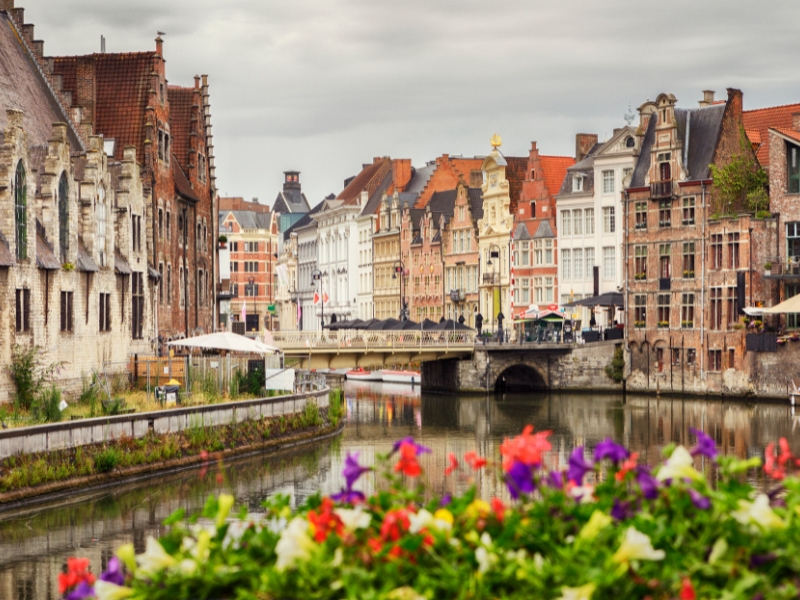
Saint Michael's Bridge (Sint-Michielsbrug) crosses the Leie between the Korenmarkt and Saint Michael's Church. A flat movable bridge once stood here; it was replaced at the beginning of the 20th century by the present stone arch bridge designed by Louis Cloquet, the same architect as the post office. It is best known for its view: it is the one place where you can see all three of Ghent's towers, Saint Bavo's, the Belfry and Saint Nicholas', lined up in a single view.
- The lantern in the middle of the bridge, topped by a bronze statue of Saint Michael standing over a dragon.
- The view down the river: the Graslei and Korenlei quays with their guild houses on both sides, and the Castle of the Counts in the distance.
How to see them in one walk
Start at the City Hall on the Botermarkt and walk round it to compare its two facades. The Belfry is just across the street; climb it if you want the view from the top, then step out onto the square with the Stadshal. Saint Nicholas' Church closes the square on the west side, and directly behind it lies the Korenmarkt with the old post office. From there it is a short walk to Saint Michael's Bridge. Stand in the middle of the bridge for the view of the three towers, then go down to the Graslei for a seat by the water.
See Ghent with World City Trail
Our Ghent scavenger hunt turns the old town into a game you play on your phone. The route links 10 stops, from Saint Michael's Church to the Gravensteen, and the Belfry, the City Hall, Saint Nicholas' Church, the Korenmarkt and Saint Michael's Bridge are all stops, along with Saint Bavo's Cathedral, Sint-Jacobskerk and the Vrijdagmarkt. At each stop you solve a puzzle and hear a story, at your own pace.
There is also a self-guided walking tour and an outdoor escape game in Ghent, for people who prefer a different format.
Play the Ghent scavenger hunt →
Take the self-guided walking tour of Ghent →
Play the outdoor escape game in Ghent →
Facts checked in October 2026.