
Corfu Town was ruled in turn by Venice, France and Britain before it became Greek, and each left a building you can still walk past. This guide covers five places in the old town that tell that story: the Ionian Parliament, where the vote for union with Greece was taken, the church of Saint Spyridon, the arcades of the Liston, the Spianada and the Old Fortress. They lie close together, from the narrow lanes of the old town to the sea.
Ionian Parliament
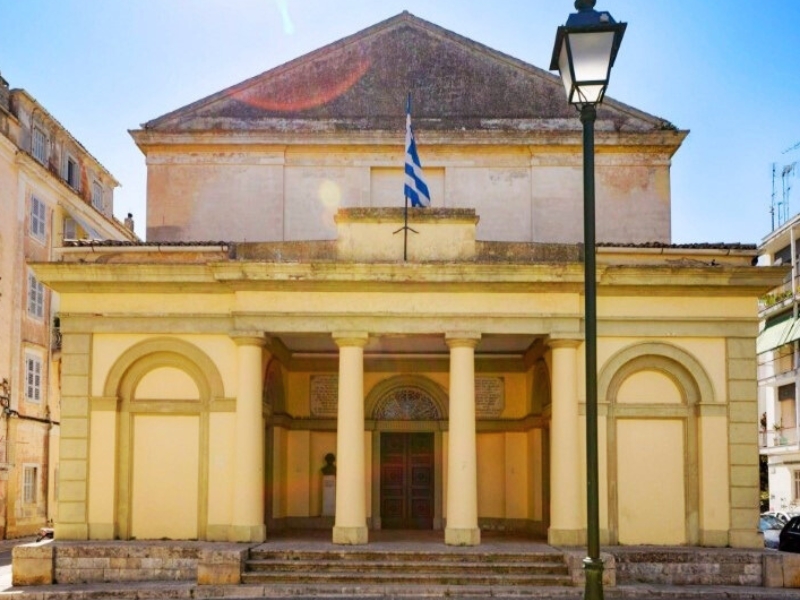
The Ionian Parliament is a neoclassical building at the top of Moustoxydi Street, a short walk from the Spianada. It was designed by the Corfiot architect Ioannis Chronis and completed in 1855 for the parliament of the United States of the Ionian Islands, then a British protectorate. In 1863 the members of the last Ionian Parliament voted here for union with Greece, and the islands joined the Greek state the following year. In 1869 the building was given to the British community as a church. It was largely destroyed in 1943, during the Second World War, and was restored in 1962. Today it also houses a museum about the Ionian Islands' struggle for freedom and union.
- The entrance with its marble columns, a calm, classical front among the Venetian houses of the old town.
Church of Saint Spyridon
Saint Spyridon is the patron saint of Corfu, and his church stands in the old town just behind the Liston. It was built in 1589, and its bell tower, completed in 1620, is the tallest in the Ionian Islands; it looks much like the tower of San Giorgio dei Greci, the Greek church in Venice. By tradition the saint's relics were brought to Corfu from Constantinople after the city fell to the Ottomans, carried by a Greek monk, Georgios Kalochairetis, in the late 15th century, and they stayed in the hands of his descendants for generations.
The relics lie in a chapel to the right of the iconostasis. Four times a year, including Palm Sunday and 11 August, they are carried in procession through the town, each time to remember a miracle attributed to the saint. His feast day is 12 December, and Spyros, short for Spyridon, is one of the most common men's names on the island.
- The ceiling with scenes from the saint's life. Panagiotis Doxaras painted the originals in 1727; they decayed and were replaced by copies by Nikolaos Aspiotis, and only Doxaras's gilded frame survives.
- The large silver lamp near the west end of the nave, given by the Venetian Senate in thanks for the saint's help during the Ottoman siege of 1716. It shows Saint Spyridon and the lion of Saint Mark.
- The double coffin of the saint: an outer one of wood trimmed with silver, and an inner one covered in red velvet.
Liston
The Liston is the long row of arcaded buildings on the western side of the Spianada. It was begun in 1807, during French rule, and was designed by the French imperial commissioner Mathieu de Lesseps on the model of the Rue de Rivoli in Paris. The usual explanation of its name is that it comes from the Venetian word for a list: the Libro d'Oro, the register of noble families, whose members alone were once allowed to walk here. Today the arcades are lined with cafés, and the promenade in front is where Corfiots and visitors stroll in the evening.
- The arches and the lamps hanging under them, which give the arcade its rhythm.
- On Holy Saturday, at 11 in the morning, people in the old town throw clay pots full of water from their balconies, the custom known as botides; the Liston is one of the busiest places to watch it.
Spianada
The Spianada, or Esplanade, is the open space between the old town and the Old Fortress, and it is often described as the largest square in Greece. Its name comes from a Venetian word for a flat, open area. It took its present form under the French, and the British, who governed the islands from 1814 to 1864, added their own landmarks. The lower part of the square is a grass cricket ground, a game Corfiots took up under British rule and still play today.
- The Maitland Rotunda, the small round temple with columns in the upper square, named after Sir Thomas Maitland, the first British Lord High Commissioner of the islands.
- The bandstand in the upper square, where the town's philharmonic societies give concerts.
- The cricket pitch on the lower square, with the Liston arcades along one side.
Old Fortress
The Old Fortress stands on a rocky headland east of the Spianada, cut off from the town by a sea channel, the Contrafossa, which the Venetians dug to turn it into an island. People settled on the headland in Byzantine times, and the first walls date from around the 6th century. The Venetians rebuilt the defences from the 15th century, and after the Ottoman siege of 1537 the engineers Savorgnan and Martinengo added new bastions. The fortress held out against Ottoman sieges in 1537, 1571 and 1716; the last one lasted seven weeks, and the defence was led by Count Schulenburg.
The headland has two peaks, and the Greek word for peaks, koryfi, is the origin of the name Corfu. Today the fortress is home to the Public Library of Corfu, housed in former British barracks, and to a music research lab of the Ionian University, and it hosts exhibitions.
- The Church of Saint George, built in 1840 for the British garrison in the form of a Doric Greek temple. It became an Orthodox church in 1865. A fire caused by lightning damaged part of its roof in 2023.
- The climb to the higher peak, which has a lighthouse and a view over the town, the Spianada and the sea towards the mainland.
How to see them in one walk
Start at the Ionian Parliament at the top of Moustoxydi Street, then wind down through the lanes of the old town to the church of Saint Spyridon. From the church it is only a few steps to the Liston, where you can take a seat under the arches. Cross the Spianada past the cricket ground, the bandstand and the Maitland Rotunda, and finish at the Old Fortress, crossing the bridge over the Contrafossa and climbing to the top for the view.
See Corfu with World City Trail
Our Corfu scavenger hunt turns the old town into a game you play on your phone. The route links 10 stops, from the statue of Ioannis Kapodistrias to the Old Fortress, and the Ionian Parliament, the church of Saint Spyridon, the Liston, the Spianada and the Old Fortress are all stops, along with the Old Town Hall, the bell tower of the Annunziata, the Casa Parlante and the Museum of Asian Art. At each stop you solve a puzzle and hear a story, at your own pace.
There is also a self-guided walking tour and an outdoor escape game in Corfu, for people who prefer a different format.
Play the Corfu scavenger hunt →
Take the self-guided walking tour of Corfu →
Play the outdoor escape game in Corfu →
Facts checked in October 2026.