
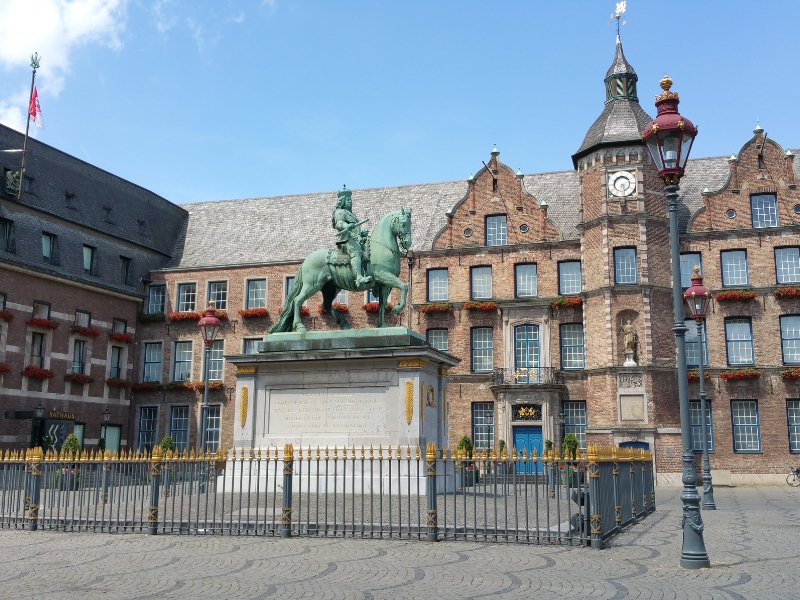
Düsseldorf began as a small village where the Düssel stream runs into the Rhine, and this guide stays close to that spot. It covers the castle square and its last tower, the church with the twisted spire, the bronze monument to the town charter of 1288, the riverside promenade, the art space hidden inside a road tunnel and, as a detour, a wartime bunker that became a church. Together they tell the story of the city from its founding to the post-war years.
Burgplatz and the Schlossturm
Burgplatz, the castle square, sits on the site of the palace of the Counts and later Dukes of Berg, who ruled from here for centuries. The palace was badly damaged by a fire on the night of 19 to 20 March 1872, and the ruins were cleared in the following decades. Only one piece survived: the Schlossturm, the round white tower at the edge of the square. Its three lower floors go back to the 13th century; a fourth floor was added in 1552 and the lantern on top in 1845.
Since 1984 the tower has housed the Schifffahrtsmuseum, a museum about shipping on the Rhine, and there is a café in the lantern with views over the river and the old town. A wide flight of steps leads from the square down to the riverbank, and on a sunny day it fills with people sitting and watching the boats. Burgplatz is one of the stops on our scavenger hunt.
- The lines of differently coloured stones in the paving, which trace the outline of the old palace.
- The Radschlägerbrunnen, a fountain with two bronze boys turning cartwheels, by Alfred Zschorsch, on the square since 1954. Cartwheeling children are a symbol of Düsseldorf; one popular story, more legend than history, says that children turned cartwheels in the streets to celebrate the victory of 1288.
Basilika St. Lambertus
The tall brick church just behind Burgplatz is the oldest parish church of the old town. Work on the present Gothic hall church began in 1370, and it was consecrated in 1394. In 1815 a fire destroyed the spire, and the new timber, probably too fresh and damp, warped as it dried: since then the spire has been twisted. When the roof was rebuilt after the Second World War, it was given the same twist on purpose. Pope Paul VI made the church a minor basilica in 1974.
Inside, the relics of St Apollinaris, the city's patron, rest in a silver-gilt shrine given by Duke Philipp Wilhelm in 1665. His feast is the old reason for the big summer fair on the Rhine meadows across the river. The church is one of the stops on our scavenger hunt. A local legend says the spire will only straighten when a true virgin gets married in the church; so far, it is still crooked.
- The tomb of Duke Wilhelm V of Jülich-Cleves-Berg in the choir, the most important Renaissance work of art in the city.
- The late Gothic sacrament house from the end of the 15th century, and the west portal by the sculptor Ewald Mataré from the 1950s.
Stadterhebungsmonument
On 14 August 1288, after the Battle of Worringen, Count Adolf V of Berg granted the village of Düsseldorf the rights of a town. To mark the 700th anniversary, the sculptor Bert Gerresheim created this bronze monument, unveiled in 1988. It stands in the lanes between Burgplatz and the river, at the corner of Müller-Schlösser-Gasse, and it is one of the stops on our scavenger hunt.
- Battle scenes from Worringen, with a jumble of fighting figures, horses and fallen soldiers.
- The seal of the town charter, and the scene in which St. Lambertus was raised to a collegiate church in the same year.
Rheinuferpromenade
Until 1990 a busy road ran along the riverbank and cut the old town off from the Rhine. Between 1990 and 1993 the traffic was moved into the Rheinufertunnel, and on its roof the architect Niklaus Fritschi and his partners designed the promenade that opened up the whole riverfront. Today it runs from the old town past the Rheinturm and the state parliament towards the Medienhafen, and it is the last stop of our scavenger hunt.
- The casemates, a row of low arches under the promenade that now hold restaurants and bars.
- The view across the Rhine to the Oberkassel bank, best in the late afternoon.
KIT – Kunst im Tunnel
When the Rheinufertunnel was built, a long, empty cavity was left over between the road tubes under the promenade. Artists and theatre groups used it informally in the 1990s, and after a conversion by the same architects who planned the promenade, it opened in 2007 as KIT, short for Kunst im Tunnel, Art in the Tunnel. The entrance is a small pavilion with a café on the Mannesmannufer.
KIT shows contemporary art, and one of its founding aims was to give young graduates of the Düsseldorf Kunstakademie a place to exhibit. The bare concrete space is part of the experience: you walk under the promenade, with the traffic rumbling somewhere beyond the walls. It is not one of our scavenger hunt stops, but it is close to the riverside part of the route.
Bunkerkirche St. Sakrament
This detour takes you across the Rhine to the district of Heerdt. Between 1940 and 1942 the architect Philipp Stang built a concrete air-raid shelter here, a tall block with walls more than a metre thick. After the war, on the initiative of the parish priest Carl Klinkhammer, Stang and Willy Weyres turned it into a church between 1947 and 1949, blasting openings for windows and doors through the concrete.
The result is a rare thing, a church that was once a bunker: a heavy grey building that still looks like what it was. A bell tower was added in the early 1950s. Its motto, a line from the prophet Isaiah about turning swords into ploughshares, sums up the idea behind it. In recent years a Coptic congregation has also worshipped here, and the building hosts events and exhibitions. It is far from the old town and not on our scavenger hunt route; reach it by tram or bike.
How to see them in one walk
Start on Burgplatz, at the Schlossturm, and look for the outline of the palace in the paving. Walk round the back of the square to St. Lambertus, then into the narrow lanes towards the river to find the Stadterhebungsmonument. Go down the steps to the Rheinuferpromenade and follow the river south, past the casemates, to the Mannesmannufer and the pavilion of KIT. Keep the Bunkerkirche in Heerdt for another day, or take the tram across the Rhine after your walk.
See Düsseldorf with World City Trail
Our Düsseldorf scavenger hunt turns the old town into a game you play on your phone. The route links 10 stops, from Martin-Luther-Platz to the Rheinpromenade, and Burgplatz, St. Lambertus, the Stadterhebungsmonument and the Rhine promenade are all stops, along with the Tritonenbrunnen, the Kunsthalle, St. Andreas, the Marktplatz and the old town hall. At each stop you solve a puzzle and learn a story, at your own pace.
There is also a self-guided walking tour and an outdoor escape game in Düsseldorf, for people who prefer a different format.
Play the Düsseldorf scavenger hunt →
Take the self-guided walking tour of Düsseldorf →
Play the outdoor escape game in Düsseldorf →
Facts checked in October 2026.