
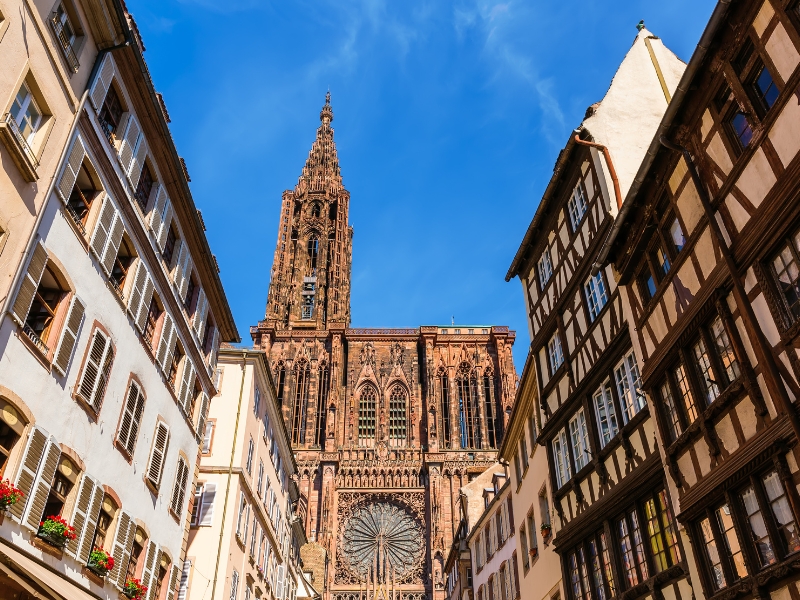
Strasbourg's old town sits on the Grande Île, an island ringed by the river Ill, and the whole island has been a UNESCO World Heritage Site since 1988. This guide covers five places on it: the cathedral, the Ponts Couverts at the edge of Petite France, St. Thomas Church, Place Gutenberg and Place Kléber. All five are stops on our scavenger hunt, and together they show the city's story from medieval Free City to French and German rule.
Strasbourg Cathedral
The Cathédrale Notre-Dame was begun in 1015 and finished in 1439. Its Gothic west front was started in 1277, and the master builder Erwin von Steinbach is credited with much of it; his son and grandson carried on after his death in 1318. Only the north tower was ever built, which gives the cathedral its lopsided outline. With a spire 142 metres high, it was the tallest building in the world from 1647 to 1874. The red-pink colour comes from sandstone quarried in the Vosges mountains.
Goethe, who studied in Strasbourg, wrote that the building rose like a sublime tree of God. Inside, the astronomical clock in the south transept was built by Jean-Baptiste Schwilgué between 1837 and 1842, inside an older case; at half past twelve the figures of the apostles file past Christ. The cathedral is one of the stops on our scavenger hunt.
- The rose window on the west front, about 14 metres across and finished in 1345.
- The Pillar of the Angels in the south transept, carved in the mid-13th century with statues of angels sounding trumpets for the Last Judgement.
- The asymmetrical facade itself: stand on the square and compare the finished north tower with the flat platform on the south side.
Ponts Couverts and the Barrage Vauban
Where the Ill splits into channels at the western tip of the island, the citizens built four bridges between about 1230 and 1250 to close the river to attackers. They were guarded by towers, and four of these survive. The bridges had wooden roofs, hence the name covered bridges, but the roofs were taken off in 1784 and the bridges were rebuilt in stone in 1865. Several towers served as prisons until a new jail opened in 1823. The Ponts Couverts are one of the stops on our scavenger hunt.
Just upstream stands the Barrage Vauban, a lock and dam built between 1681 and 1688 by the engineer Jacques Tarade to plans by Vauban, after the city became French. It could flood the land south of Strasbourg to stop an attack, and it was used that way in the siege of 1870. Inside, a public passage displays statues and plaster casts from the cathedral, and the roof terrace looks straight down on the bridges and towers, with the cathedral spire behind them.
- Petite France next door, the old quarter of tanners, millers and fishermen. Its name comes from a hospice founded in 1503 for soldiers with syphilis, then called the French disease.
- The Maison des Tanneurs on rue du Bain-aux-Plantes, a half-timbered guild house from 1572.
St. Thomas Church
A short walk east along the river stands St. Thomas, built from 1196 in the Romanesque style and completed in 1521 in late Gothic. It has five naves of the same height, a layout found nowhere else in Alsace. The church became Lutheran in 1524 and has stayed so, and since the cathedral was returned to the Catholics after 1681, people call St. Thomas the Protestant cathedral. Mozart played its Silbermann organ of 1741 in 1778, and Albert Schweitzer was organist here. It is one of the stops on our scavenger hunt.
- The tomb of Marshal Maurice de Saxe by Jean-Baptiste Pigalle, finished in 1777, a large marble group in which the marshal steps towards an open coffin held by Death.
- The sarcophagus of Bishop Adeloch from around 1130, one of the oldest pieces in the church.
Place Gutenberg
Johannes Gutenberg lived in Strasbourg in the 1430s and 1440s, and his first experiments with printing took place here, before he went back to Mainz. In the middle of the square, formerly Place Saint-Martin, stands his bronze statue by David d'Angers, set up in 1840. He holds a sheet with the words Et la lumière fut, And there was light. Behind it rises the Neue Bau, the former town hall from the late 16th century, now home to the chamber of commerce. The square is one of the stops on our scavenger hunt.
- The reliefs on the pedestal, which show the spread of printing across the world, and the merry-go-round that usually turns in front of the statue.
Place Kléber
Place Kléber is the city's main square. It took its name in 1840 from General Jean-Baptiste Kléber, a Strasbourg man who fought in the French Revolutionary Wars and was assassinated in Cairo in 1800. His remains have lain in a vault under the square since 1838, and his statue by Philippe Grass stands on top. During the Nazi occupation, from 1940 to 1944, the square was renamed after the Alsatian autonomist Karl Roos.
On the north side is the Aubette, a long classical building from the 18th century that was first a guardhouse. In 1928 Theo van Doesburg, Hans Arp and Sophie Taeuber-Arp designed its interiors as an avant-garde entertainment complex, and parts of their interiors have since been restored. In December a huge fir tree from the Vosges stands in the square for the Christmas market. Place Kléber is one of the stops on our scavenger hunt.
- The statue of Kléber above his burial vault, and the Aubette's long facade across the square.
How to see them in one walk
Start at the western tip of the island with the roof terrace of the Barrage Vauban and the Ponts Couverts, then walk through Petite France along the water. Follow the river to St. Thomas Church, then head up into the old streets to Place Gutenberg. From there the cathedral is only a few steps away. Finish by walking north to Place Kléber, and on the way look up at the cathedral spire, which you can see from almost everywhere on the island.
See Strasbourg with World City Trail
Our Strasbourg scavenger hunt turns the old town into a game you play on your phone. The route links 10 stops, from the Ponts Couverts to the Église réformée Saint-Paul, and the Ponts Couverts, St. Thomas, Place Gutenberg, the cathedral and Place Kléber are all stops, along with the Alsatian Museum, the Palais Rohan, the Opéra national du Rhin and Place de la République. At each stop you solve a puzzle and learn a story, at your own pace.
There is also a self-guided walking tour and an outdoor escape game in Strasbourg, for people who prefer a different format.
Play the Strasbourg scavenger hunt →
Take the self-guided walking tour of Strasbourg →
Play the outdoor escape game in Strasbourg →
Facts checked in October 2026.