
This guide covers four places in the northern half of Lübeck's old town island: the Town Hall on the market square, the Art Nouveau theatre on the Beckergrube, the medieval Hospital of the Holy Spirit on the Koberg, and the Museum of Nature and Environment beside the cathedral. Together they show how the Hanseatic city governed itself, entertained itself and looked after its poor and sick, and three of them are stops on our scavenger hunt.
Lübeck Town Hall (Rathaus)
Lübeck's Town Hall is one of the largest medieval town halls in Germany, and it is still where the city is run: the mayor's office is here and the city parliament, the Bürgerschaft, meets inside. Building on the site began around 1240, and after a fire in 1251 the main wing was rebuilt; most of what stands today dates from the 14th century. In the Hansesaal, the hall that gave the building much of its fame, delegates of the Hanseatic towns gathered for their assemblies when Lübeck was the leading city of the League.
The building is a patchwork of six centuries. Around 1435 the old gables facing the market were joined into one tall decorative wall with slender towers, pierced by round holes so the wind would not push it over. In 1570 to 1572 a sandstone Renaissance arcade by the Flemish sculptors Hans Fleminck and Hercules Midow was added in front of the Gothic wing, and in 1594 Robert Coppens built an elaborate outdoor staircase on the Breite Straße side; what you see there now is a copy made in the 1880s.
- The shield wall above the market square, with its round wind holes, best seen from the middle of the square.
- The white Renaissance arcade (Laube) on the market side, a sharp contrast with the dark brick behind it.
- The Audienzsaal inside, a late Baroque and Rococo courtroom with ten allegorical paintings by Stefano Torelli from 1754 to 1761. Its two doors are of different heights: the story goes that the acquitted left through the tall one and the convicted had to stoop through the low one. Guided tours take you in.
Theater Lübeck
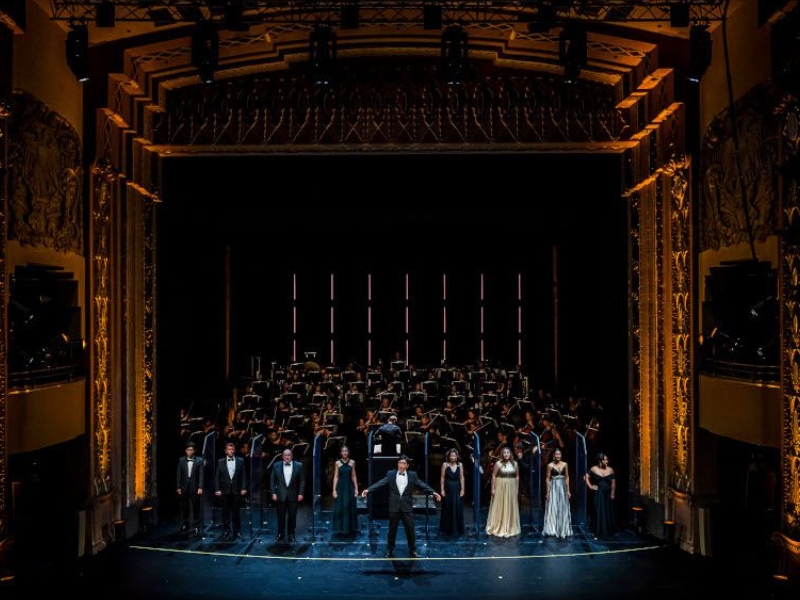
The city theatre stands on the Beckergrube, one of the streets that run down from the old town's ridge to the river Trave. It was designed by the Dresden architect Martin Dülfer, built in 1907 and 1908 with money from the Lübeck businessman Emil Possehl, and opened on 1 October 1908 with a programme of Wagner, Goethe and Schiller. It replaced an older theatre on the same street, and Lübeck's theatre tradition goes back much further: the city's first opera performance is recorded in 1746.
It is one of the finest Art Nouveau theatres in Germany. By 1992 the building had grown so run-down that it was closed for safety reasons; after a full restoration it reopened in 1996. Today it is home to opera, drama, ballet and the concerts of the Lübeck Philharmonic Orchestra, with a main house of around 900 seats and the smaller Kammerspiele.
- The sandstone facade with reliefs by Georg Roemer and the carved caryatids and Atlas figures by Karl Weinberger.
- The curving Art Nouveau details around the entrance, best seen from across the narrow street.
Hospital of the Holy Spirit (Heiligen-Geist-Hospital)
At the northern end of the Breite Straße, on the square called the Koberg, the Hospital of the Holy Spirit shows its gables and slender towers to the street. The foundation was set up by wealthy citizens in 1227 and the building was finished in 1286, which makes it one of the oldest social institutions in the world that is still in operation. For centuries it took in old, poor and sick people, and parts of it are still a home for elderly people today.
You enter through the church hall, where two large wall paintings from around 1320 to 1325 survive on the north side: one shows the Throne of Solomon, the other Christ in majesty surrounded by the symbols of the four evangelists. Behind it lies the long hall where the residents lived. In 1820 it was divided into small wooden chambers, so each person had a room of their own under the great roof.
- The rows of tiny wooden chambers in the long hall, an early idea of privacy in a care home.
- The late medieval altars in the church hall, including the Marienaltar with the Virgin sheltering people under her cloak. In Advent the hall hosts a well-known crafts Christmas market, held since 1958.
Museum of Nature and Environment
Lübeck's natural history museum stands right next to the cathedral, on the Musterbahn. It traces its roots to 1799, when the collection of the Lübeck physician Johann Julius Walbaum became the basis of a natural history collection, and it claims the longest history of any museum in the city. Its first building, the Museum am Dom, was destroyed in the air raid of March 1942; rebuilding began in 1951, and the present building, linked to the cathedral by a cloister, dates from the 1960s.
The museum is about the nature of Lübeck and Schleswig-Holstein rather than exotic animals. Its permanent exhibition on local waters looks at the river Wakenitz, the Trave and the Bay of Lübeck, and its best-known pieces are whales: fossil skeletons of baleen whales found in a gravel pit near Groß Pampau and the skeleton of a sperm whale that stranded off the Danish island of Rømø in 1997. It is not on the scavenger hunt route, but it is next door to the final stop, the cathedral.
- The sperm whale skeleton in the glass extension facing the cathedral courtyard, visible even before you go in.
- The fossil whales from Groß Pampau, millions of years old, which show that this part of northern Germany was once under the sea.
How to see them in one walk
Start on the market square in front of the Town Hall and walk round it to see the arcade and the staircase on the Breite Straße. Follow the Breite Straße north, past St Mary's Church, and turn left into the Beckergrube to see the theatre. Back on the Breite Straße, carry on north to the Koberg and the Hospital of the Holy Spirit; the Burgtor, the old northern city gate, is just beyond. To finish, cross the old town southwards through its quiet lanes to the cathedral and the Museum of Nature and Environment beside it.
See Lübeck with World City Trail
Our Lübeck scavenger hunt turns the old town into a game you play on your phone. The route links 10 stops, from the Burgtor to Lübeck Cathedral, and Theater Lübeck, the Town Hall and the Hospital of the Holy Spirit are all stops, along with St Mary's Church, the Buddenbrookhaus, the Holstentor, St Peter's Church and the St Annen museum quarter. At each stop you solve a puzzle and learn something about the place, at your own pace.
There is also a self-guided walking tour and an outdoor escape game in Lübeck, for people who prefer a different format.
Play the Lübeck scavenger hunt →
Take the self-guided walking tour of Lübeck →
Play the outdoor escape game in Lübeck →
Facts checked in October 2026.