
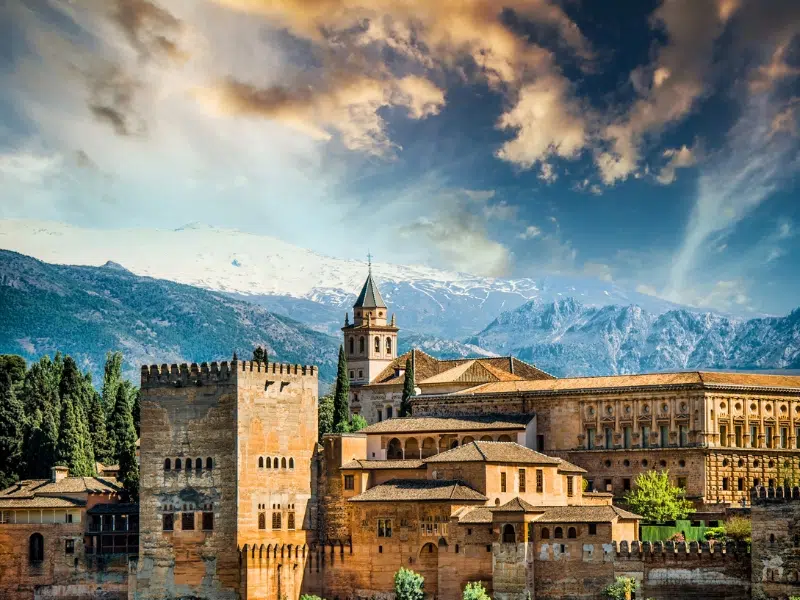
This guide covers six places in the lower town of Granada and on the climb to the Alhambra: Plaza de Bib-Rambla, the Palacio de la Madraza, the cathedral with the Royal Chapel, Plaza Nueva and its fountain, the Puerta de las Granadas and the Pilar de Carlos V. They follow the story of the city in the decades after the Christian conquest of 1492, when the Nasrid town was rebuilt as a Renaissance capital, and they lie on one walk from the market streets up into the Alhambra woods.
Plaza de Bib-Rambla
Bib-Rambla (also written Bibarrambla) is one of the oldest squares in Granada. It goes back to the Nasrid period, when it lay next to the commercial core of the city, the silk market of the Alcaicería and the street of the Zacatín. In the centuries after the conquest it was the stage for jousts, bullfights and festivals, and it got roughly its present size in a remodelling at the end of the 16th century. It also saw one of the darkest moments of those years: after the conquest the library of the Madraza, the Nasrid university, was burned here. Today it is a square of cafés under lime trees, a few steps from the cathedral.
- The Fuente de los Gigantes in the middle, a fountain with pagan figures and pastoral details.
- The flower stalls around the fountain, which change with the season: Christmas trees in winter, bouquets in spring.
Palacio de la Madraza
Across the street from the Royal Chapel stands the building that was the Nasrid madrasa, founded by Sultan Yusuf I and opened in 1349. It was the first public university in al-Andalus and taught law, medicine and mathematics until around 1500. After the conquest it was closed, and in 1500 King Ferdinand gave it to the city council, which met here for centuries, so for a long time the building served as Granada's town hall.
Between 1722 and 1729 José de Bada y Navajas largely rebuilt it in Baroque style, with the painted facade and carved window frames you see from the street. The 14th-century prayer hall survived inside and was turned into a chapel. The building now belongs to the University of Granada and reopened to the public in 2011 after restoration.
- Inside, the 14th-century oratory, the main surviving part of the Nasrid madrasa.
Catedral de Granada and the Royal Chapel
The first stone of Granada's cathedral was laid on 25 March 1523 to a Gothic plan drawn by Enrique Egas, but in 1528 Diego de Siloé took over and steered the design towards the Renaissance, and his ideas shape the building you see today. Inside there are five naves, and the main chapel is a round, domed space surrounded by an ambulatory. The main facade was designed by the painter and sculptor Alonso Cano, who was made master of works in 1667. The bell tower was never finished.
Next to it, the Royal Chapel (Capilla Real), built from 1505 by Enrique Egas, holds the tombs of the Catholic Monarchs, Isabella and Ferdinand, who wanted to be buried in the city they had conquered. Their daughter Joanna of Castile and her husband Philip the Handsome lie beside them.
- Alonso Cano's main facade, best seen from the far side of the square in front of it.
- In the Royal Chapel, the marble tombs of the Catholic Monarchs and of Joanna and Philip.
Plaza Nueva and its fountain
Plaza Nueva is called new because it was made after the conquest by covering the River Darro. The first stretch of vault, 72 metres long, was built between 1506 and 1515, and more was added from 1531, so much of the square stands on top of the river. On its east side rises the Real Chancillería, the royal court of appeal, ordered in 1531 and finished in 1587, the only building on the square that has not been heavily altered. Beyond it is the church of San Gil y Santa Ana. A fountain once marked the line between Plaza Nueva and Plaza de Santa Ana, but a flood of the Darro destroyed it in 1835; the fountain in the square today is a stop on our scavenger hunt.
- The mannerist stone front of the Real Chancillería, little altered since it was finished in 1587.
- The Darro coming out from under the square near the church of Santa Ana, the start of the Carrera del Darro.
Puerta de las Granadas
From Plaza Nueva the steep Cuesta de Gomérez leads up to the Puerta de las Granadas, the gate that opens into the Alhambra woods. It was built for Charles V after his visit to Granada in 1526, the year he married Isabella of Portugal in Seville, and the work was directed by Pedro Machuca, the architect of the Palace of Charles V inside the Alhambra. It replaced an older Nasrid gate called Bib al-Buxar.
- The three stone pomegranates on top of the pediment, which give the gate its name and are the symbol of the city.
- The imperial coat of arms of Charles V on the tympanum, with figures of Peace and Abundance beside it.
Pilar de Carlos V
Higher up, against the walls of the Alhambra next to the Puerta de la Justicia, stands the Pilar de Carlos V, a Renaissance wall fountain of 1545. Pedro Machuca designed it and the Italian sculptor Niccolò da Corte carried it out. Placed on the approach to the Puerta de la Justicia, one of the main gates of the Alhambra, it greeted visitors with the emperor's name.
- The cartouche with the inscription in honour of Charles, set among the Renaissance carving of the fountain.
How to see them in one walk
Start in the lower town in Plaza de Bib-Rambla, then walk through the narrow streets of the Alcaicería to the cathedral and the Royal Chapel, with the Madraza right opposite. Continue to Plaza Isabel la Católica and along Calle Reyes Católicos to Plaza Nueva. From there climb the Cuesta de Gomérez to the Puerta de las Granadas and follow the path through the woods to the Pilar de Carlos V by the Puerta de la Justicia. The climb is steep, so take it slowly; if you have tickets for the Nasrid Palaces, check your entry time before you set off.
See Granada with World City Trail
Our Granada scavenger hunt turns the city into a game you play on your phone. The route links 10 stops, from the Fuente de las Granadas to the Pilar de Carlos V, and Bib-Rambla, the cathedral, the Madraza, the fountain of Plaza Nueva, the Puerta de las Granadas and the Pilar de Carlos V are all stops, along with the Basílica de las Angustias, the City Hall and Plaza Isabel la Católica. At each stop you solve a puzzle and learn a story, at your own pace.
There is also a self-guided walking tour and an outdoor escape game in Granada, for people who prefer a different format.
Play the Granada scavenger hunt →
Take the self-guided walking tour of Granada →
Play the outdoor escape game in Granada →
Facts checked in October 2026.