
Trieste climbs from its harbour up a single hill, and this guide follows that climb through six places: the Teatro Verdi opera house, the Leopold Column in Piazza della Borsa, the Roman theatre, and on top of San Giusto hill the cathedral, the castle and the Parco della Rimembranza. Together they tell the city's story from Roman Tergeste through Venetian and Habsburg rule to the 20th century, and all six are stops on our scavenger hunt.
Teatro Lirico Giuseppe Verdi
Trieste's opera house opened on 21 April 1801 as the Teatro Nuovo, with an opera by Johann Simon Mayr. Gian Antonio Selva, the architect of La Fenice in Venice, designed the horseshoe-shaped auditorium, and Matteo Pertsch reworked the exterior with ideas taken from La Scala in Milan. The theatre was renamed Teatro Grande in 1821, and under that name it gave the first performances of two Verdi operas, Il corsaro in 1848 and Stiffelio in 1850. When Verdi died in January 1901, the city renamed the theatre after him within hours.
- The classical front facing Piazza Verdi, with its columns and statues along the top, and the quieter side that faces the sea.
- The square in front, a good place to step back and see how the theatre sits between the old harbour front and the business district.
Piazza della Borsa and the Leopold Column
Piazza della Borsa is the square of Trieste's merchants. Its neoclassical Old Stock Exchange (Borsa Vecchia) was built in 1806 to a design by Antonio Mollari and is now the seat of the Chamber of Commerce; the exchange itself later moved to the Palazzo Tergesteo and then to the neighbouring building known as the New Stock Exchange. In the middle of the square stands a stone column carrying the statue of Emperor Leopold I. It was raised in 1660 in another square, Piazza Pozzo del Mare, and moved here in 1808. Leopold's son Charles VI made Trieste a free port, the decision that turned a small town into the main harbour of the Habsburg empire.
- The emperor on top of the column, in armour, looking out over the square.
- The columns and statues on the front of the Old Stock Exchange, and the mix of styles in the palaces around it, from neoclassical to early 20th century.
Roman Theatre of Trieste
At the foot of San Giusto hill, between Via Donota and Via del Teatro Romano, lie the remains of the theatre of Roman Tergeste. It was built in the late 1st century BC and enlarged in the early 2nd century AD, when it held somewhere between 3,500 and 6,000 people; sources disagree on the number. It may have been funded by Quintus Petronius Modestus, a man from Trieste who served Emperor Trajan, although some historians think he only paid for a renovation. The architect Pietro Nobile identified the site in 1814, but it was only fully uncovered in 1938, when part of the old town was demolished. The statues and inscriptions found here are now in the castle's Roman lapidarium.
- The curved rows of seats (cavea) set into the slope of the hill, which you can see from the street railings.
Cattedrale di San Giusto Martire
The cathedral on top of the hill is really two churches joined into one. Between the 9th and 11th centuries two basilicas were built side by side on the ruins of an older church, one dedicated to Our Lady of the Assumption and one to Saint Justus (San Giusto), the city's patron. In the 14th century one aisle of each was demolished and the two were joined under a single roof; the work ran from 1302 to 1320, and the cathedral was consecrated in 1385. That is why the plan inside is unusual and the facade is not symmetrical.
The two side apses keep their mosaics from the 12th and 13th centuries, made by craftsmen from the Veneto: one shows the Virgin, the other Christ between Saint Justus and Saint Servulus. The bell tower dates from the 14th century. In the Chapel of Saint Charles Borromeo are the tombs of the Carlist claimants to the Spanish throne, who lived in exile in Trieste in the 19th century.
- The Gothic rose window in the plain stone facade.
- The gold-ground mosaics in the side apses, and the stretch of old mosaic floor set into the present floor.
Castello di San Giusto
The castle stands on the highest point of the old town. The first records of a fortress here date from the 15th century; the Venetians added a high semicircular wall in the early 16th century, and the bastions followed in stages: the Lalio bastion between 1551 and 1561, the northern section by 1595 and the Pomis bastion in 1630. A plan to extend the fortress over the whole hilltop, which would have meant pulling down the cathedral, was never carried out. The castle saw real fighting only twice, during a two-week siege in 1813 and in 1945, when German troops surrendered here.
- Today it belongs to the city and is a civic museum. On the Lalio bastion, the Lapidario Tergestino, opened in 2001, shows Roman inscriptions, reliefs and sculptures from Trieste, including finds from the Roman theatre.
- The walk along the ramparts, which shows parts of the city and the gulf that you cannot see from the terrace.
Parco della Rimembranza
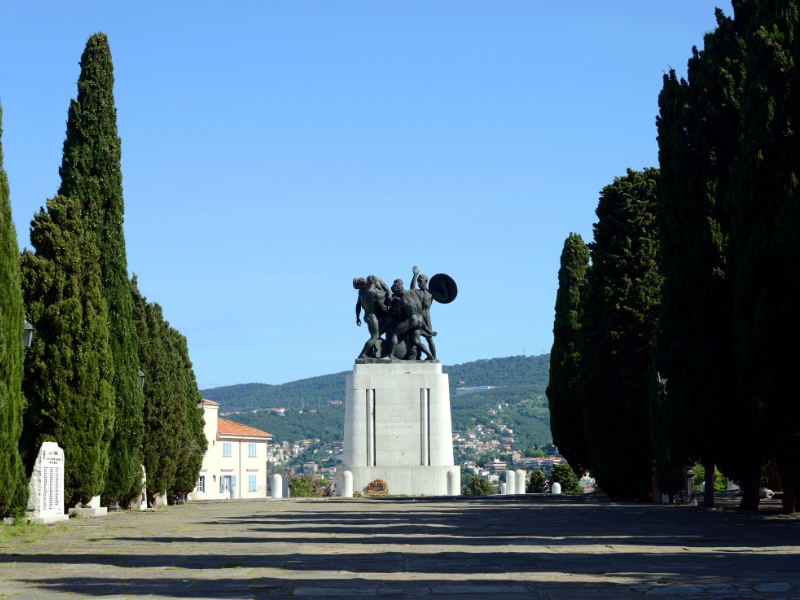
The memorial park covers the slope of San Giusto hill between the castle and Via Capitolina. It was designed by the engineer Vittorio Privileggi and laid out between 1933 and 1935, during the Fascist period, to honour the dead of the wars. The slope is dotted with rough blocks of Karst stone carved with the names of soldiers, known and unknown. At the top stands the Monument to the Fallen by Attilio Selva and Enrico Del Debbio, dedicated to the volunteers from Trieste who died in the First World War. A plaque also remembers the many men of Trieste who died in that war fighting for the Habsburg army, who were in fact the majority.
- The tall, obelisk-shaped fountain, also by Privileggi, added in 1938 for a visit by Mussolini. It was meant to be temporary, stayed, and has worked again since 2006 after two restorations.
- Below the park, the Scala dei Giganti, a double staircase of 1907 by Ruggero and Arduino Berlam that runs down to Piazza Goldoni, with a flower bed showing the city's red and white halberd coat of arms.
How to see them in one walk
Start by the sea at the Teatro Verdi, then walk past Piazza Unità d'Italia into Piazza della Borsa for the Leopold Column. From there head uphill towards Via del Teatro Romano to see the Roman theatre, and keep climbing San Giusto hill to the cathedral and the castle. Finish in the Parco della Rimembranza, then go down the Scala dei Giganti to Piazza Goldoni. If you start further north, the Ponte Rosso and the Grand Canal are only a few minutes from the theatre.
See Trieste with World City Trail
Our Trieste scavenger hunt turns the city into a game you play on your phone. The route links 10 stops, from the Ponte Rosso on the Grand Canal to the Cathedral of San Giusto, and all six places in this guide are stops: the Teatro Verdi, Piazza della Borsa, the Roman theatre, the Parco della Rimembranza, the castle and the cathedral, along with Piazza del Ponterosso, the wind rose and Piazza Unità d'Italia. At each stop you solve a puzzle and learn a story, at your own pace.
There is also a self-guided walking tour and an outdoor escape game in Trieste, for people who prefer a different format.
Play the Trieste scavenger hunt →
Take the self-guided walking tour of Trieste →
Play the outdoor escape game in Trieste →
Facts checked in October 2026.