
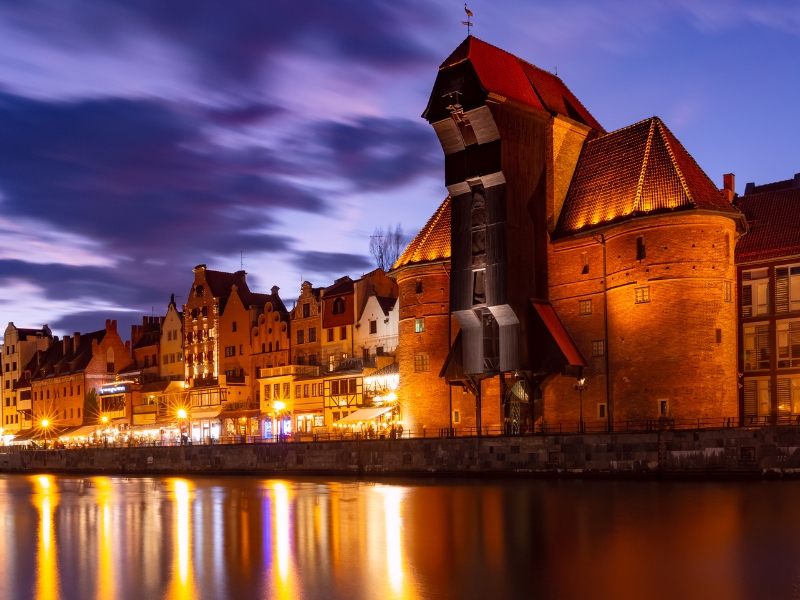
This guide covers six places in and around Gdańsk's Main Town: Long Market with Neptune's Fountain, the Artus Court, St Mary's Basilica, the medieval Crane, the National Maritime Museum and the Museum of the Second World War. Together they tell the city's story in two chapters: the rich Hanseatic port that traded across the Baltic, and the city where the Second World War began in 1939 and which was largely destroyed in 1945. All six lie within walking distance of each other along the Motława river.
Long Market and Neptune's Fountain
Long Market (Długi Targ) is the wide, open lower end of the Main Town's main street, lined with tall, narrow merchants' houses and running down to the Green Gate by the river. Most of what you see was rebuilt after 1945 from old drawings and photographs, which is why the facades look so complete. It is one of the stops on our scavenger hunt.
In front of the Artus Court stands Neptune's Fountain, the city's best-known symbol. It was designed by Abraham van den Blocke; the bronze sea god was made by the Flemish sculptor Peter Husen and cast in 1615 by Gerdt Benning. The fountain was finished in 1633 and first ran in March 1634. It was damaged during the war and taken out of the city, and returned to its place afterwards. The fountain is another scavenger hunt stop.
- Neptune's trident and twisting pose, a statement of the city's link with the sea.
- The richly decorated base of the statue and the ornamental railing around the basin.
- The Green Gate at the river end of the square and, looking the other way, the tall tower of the Main Town Hall.
Artus Court
The Artus Court (Dwór Artusa) was where Gdańsk's merchants and the town's elite met, ate and did business. The first building went up in 1348–1350; its present Dutch Mannerist facade dates from a rebuilding in 1617 by Abraham van den Blocke, the same man behind the fountain outside. In 1742 the building became the town's stock exchange. Today the great hall is a branch of the Gdańsk History Museum, and the Artus Court is a scavenger hunt stop.
- On the facade: statues of ancient heroes such as Scipio Africanus and Themistocles, with Fortuna on top of the gable.
- Inside: the tiled stove by Georg Stelzner from 1545–1546, about 11 metres tall and covered with 520 tiles that show European rulers.
St Mary's Basilica
A short walk north of Long Market, the Basilica of the Assumption of the Blessed Virgin Mary, usually called St Mary's, is often described as the largest brick church in the world. The present building was begun in 1379 and completed in 1502. It is about 105 metres long and can hold some 25,000 people.
The church was heavily damaged in March 1945, rebuilt and reconsecrated in 1955, and has been a basilica since 1965. Work on the interior is still going on, so parts may be screened off. St Mary's is one of the stops on our scavenger hunt, and so is the nearby Royal Chapel.
- The astronomical clock, built in 1464–1470 by Hans Düringer of Toruń and reconstructed after the war.
- The brick walls and the star and net vaults high above the nave, which make the building feel even bigger than it is.
The Crane
The Crane (Żuraw) on the Motława is the image of Gdańsk as a port. Built in 1442–1444, it loaded and unloaded ships' cargo and is described as the largest port crane of medieval Europe. A city official, the cranemaster, ran it and collected its fees.
In 1945 the wooden upper part burned along with much of the waterfront. The Crane was restored in 1956–1959 and its lifting machinery put back in 1966; it became the first site of the National Maritime Museum. After a long renovation it reopened on 30 April 2024. It is the last stop on our scavenger hunt route.
- The exhibition inside on the old port and the people who worked in it: dockers, merchants and sailmakers.
National Maritime Museum
The National Maritime Museum was founded on 1 January 1962 and started in the Crane. Its main site is now across the river on Ołowianka Island, where five restored granaries have housed galleries since 2000: Poles on the seas of the world, underwater archaeology and diving, and maritime art. The collection holds more than 28,000 objects.
- The Sołdek, moored by the granaries: a steam-powered coal and ore carrier built in 1949 and now a museum ship you can go aboard, from the engine room to the crew's cabins.
- The view back from Ołowianka to the Crane and the row of gabled houses along the waterfront.
Museum of the Second World War
The Museum of the Second World War opened to the public on 23 March 2017, on Wałowa Street by the Motława, close to the Polish Post Office, one of the sites attacked on the first day of the war in 1939. The building is by the Gdynia studio Kwadrat; its best-known feature is a leaning tower about 40 metres tall with a glass facade, which holds a library and cafés with views over the city.
The permanent exhibition follows the war from its origins to its aftermath. The museum also took over the museum at Westerplatte, where the German attack began. Plan for a long visit, and expect a museum that has been part of public debate: parts of its exhibition were changed several times after 2017.
- Large exhibits such as a Soviet T-34 tank, a German Ju 87 Stuka dive bomber and an Enigma cipher machine.
- The statue of Witold Pilecki in front of the building, put up in 2019.
How to see them in one walk
Start at the Golden Gate and walk down Long Lane to Long Market. Stop at Neptune's Fountain and the Artus Court, then head north to St Mary's Basilica. From the church, take one of the lanes east to the riverside, where the Crane stands on the Long Embankment. Cross to Ołowianka Island for the Maritime Museum's granaries and the Sołdek, then follow the river north to the Museum of the Second World War. The museums need time, so you may want to split the walk over two days.
See Gdańsk with World City Trail
Our Gdańsk scavenger hunt turns the Main Town into a game you play on your phone. The route links 10 stops, from the High Gate to the Crane: the High Gate, the Golden Gate, the Artus Court, Neptune's Fountain, Long Market, the Green Gate, St Mary's Gate, St Mary's Basilica, the Royal Chapel and the Crane. The two big museums in this guide are not on the route, but they are close to its end. At each stop you solve a puzzle and learn a story, at your own pace.
There is also a self-guided walking tour and an outdoor escape game in Gdańsk, for people who prefer a different format.
Play the Gdańsk scavenger hunt →
Take the self-guided walking tour of Gdańsk →
Play the outdoor escape game in Gdańsk →
Facts checked in October 2026.