
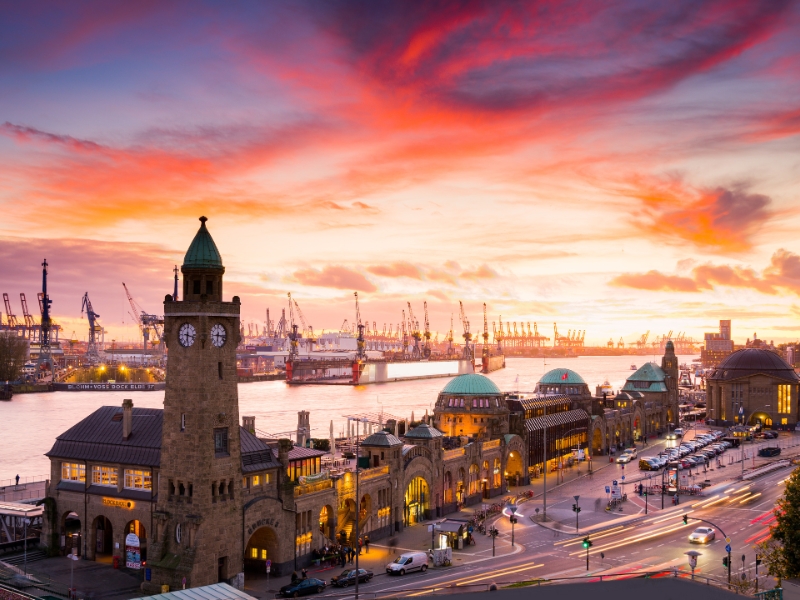
This guide follows seven places on one walk from Hamburg's City Hall through the old merchant quarter to the harbour: the Rathaus, the Chilehaus, the tower of St. Nikolai, St. Katharinen, the International Maritime Museum, the old boiler house (Kesselhaus) and the Hohe Brücke. Together they show two sides of the city: the brick of its offices, churches and warehouses, and the water and trade that paid for them.
Rathaus (City Hall)
Hamburg's City Hall was built between 1886 and 1897 in North German Neo-Renaissance style, designed by a group of local architects, the Rathausbaumeisterbund, led by Martin Haller. It houses both the city parliament, the Bürgerschaft, and the Senate, the government of the city-state. The building has 647 rooms and a tower 112 metres high, and because of the soft ground it stands on more than 4,000 oak piles. The entrance hall is open to the public, and guided tours show the state rooms when events allow. The Rathaus is the first stop of our scavenger hunt.
- The twenty bronze statues of German kings and emperors between the windows of the main façade on Rathausmarkt.
- The Hygieia Fountain in the inner courtyard, made in 1895–1896 by Joseph von Kramer: the goddess of health stands over a dragon that represents the cholera epidemic of 1892, and the fountain's base hides the air intakes for the building's ventilation.
Chilehaus
East of the centre, in the Kontorhaus district, stands the Chilehaus. It was built in 1922–1924 for Henry B. Sloman, who had made his fortune mining and trading Chilean saltpetre and named the building after his 32 years in South America. For the architect Fritz Höger it became his main work, and it set the model for the brick expressionism of the 1920s. Its sharp eastern point is often compared to the bow of a ship. Since 2015 the Kontorhaus district, together with the Speicherstadt, has been a UNESCO World Heritage Site. The Chilehaus is a stop on the scavenger hunt.
- The condor at the foot of the point, a symbol of Chile, and the ceramic decorations on the façades and in the staircases, much of them by the sculptor Richard Kuöhl.
- The stepped upper floors, the brick pilasters between some 2,800 almost identical windows, and the street Fischertwiete, which runs right under the building and joins its two halves.
St. Nikolai
The tall dark spire south of the Rathaus belongs to St. Nikolai. The neo-Gothic church was begun in 1846 to designs by the English architect George Gilbert Scott and consecrated in 1863, and its tower, finished in 1874, made it the tallest building in the world at about 147 metres until Rouen Cathedral overtook it in 1876. Allied bombing on 28 July 1943 left the church in ruins; the nave was demolished in 1951 and the tower was kept as a memorial. Since 2005 a lift has taken visitors up to a viewing platform at about 75 metres, and the crypt holds an information centre about the church. St. Nikolai is a stop on the scavenger hunt.
- The carillon of 51 bells, installed in the tower in 1993 as a memorial.
St. Katharinen
St. Katharinen, close to the Speicherstadt, is first recorded in 1256. The base of its tower dates from the 13th century and is described as the second-oldest surviving building in the city, after the lighthouse on the island of Neuwerk. A Baroque top was added in 1657, bringing the spire to 115 metres. An air raid on 30 July 1943 destroyed most of the church and left only the outer walls and the base of the tower; it was rebuilt in 1950–1957 and restored again in 2007–2012.
Music is its other claim to fame. In 1720 Johann Sebastian Bach played its organ, then reported to be the largest in the world, while applying for a post at another Hamburg church. The organ was reconstructed by the firm Flentrop in a project called An Organ for Bach and completed in 2013. St. Katharinen is a stop on the scavenger hunt.
International Maritime Museum
Across the water, Kaispeicher B, a warehouse built in 1878–1879 and described as the oldest surviving warehouse in Hamburg, has housed the International Maritime Museum since 2008. It is based on the private collection of Peter Tamm, which began with a small model ship he was given as a boy in 1934. The exhibitions are spread over floors called decks, each with its own theme, from navigation and sailing ships to shipbuilding, navies and modern merchant and passenger shipping. The museum is a stop on the scavenger hunt.
- The deck with tens of thousands of miniature ship models, most of them at a scale of 1:1250.
- Ship models made of bone by French prisoners during the Napoleonic Wars, and a dugout canoe from the Elbe, the oldest object on display.
Kesselhaus (Old Boiler House)
On Sandtorkai, the brick Kesselhaus went up in 1888, when the Speicherstadt warehouse district was inaugurated, as its boiler house. Its war-damaged chimneys are recalled today by two steel-mesh structures about 20 metres high. In 2000 the building reopened as an information centre about HafenCity, the new district built on the old port land, with a 1:500 model of the area at its centre. Today it is a base for HafenCity Hamburg GmbH, the company developing the district, and many of the regular tours of HafenCity start here. The Kesselhaus is a stop on the scavenger hunt.
Hohe Brücke
The last stop, the Hohe Brücke (High Bridge), crosses the Nikolaifleet, one of the old canals of the merchant town. There has been a bridge here since the mid-13th century, first in wood and from 1615 in stone. The present bridge dates from 1886–1887, built to plans by Franz Andreas Meyer at the same time as the Speicherstadt, with brick cladding, a granite parapet and wrought-iron lamps. Its name refers to its height, which let ships with masts pass underneath. Since the storm flood of 1962, a flood barrier has stood just south of it.
- The yellow-brick house at number 2, built in 1887–1888 for a crane operator who worked four cranes, and the Neuer Kran of 1858, the only one of those cranes still preserved.
How to see them in one walk
Start at the Rathaus and walk past St. Petri to the Chilehaus in the Kontorhaus district. Head south-west to the tower of St. Nikolai and on to St. Katharinen, then cross into the Speicherstadt and HafenCity for the Maritime Museum, the Kesselhaus, the Speicherstadtmuseum and the Steinerner Orientteppich. Finish by walking back along the water to the Hohe Brücke on the Nikolaifleet. On a clear day, take the lift up the St. Nikolai tower on the way for a view over the whole route.
See Hamburg with World City Trail
Our Hamburg scavenger hunt turns the city centre into a game you play on your phone. The route links 10 stops, from the Rathaus to the Hohe Brücke, and all seven places in this guide are among them, together with St. Petri, the Speicherstadtmuseum and the Steinerner Orientteppich. At each stop you solve a puzzle and learn a story, at your own pace.
There is also a self-guided walking tour and an outdoor escape game in Hamburg, for people who prefer a different format.
Play the Hamburg scavenger hunt →
Take the self-guided walking tour of Hamburg →
Play the outdoor escape game in Hamburg →
Facts checked in October 2026.