
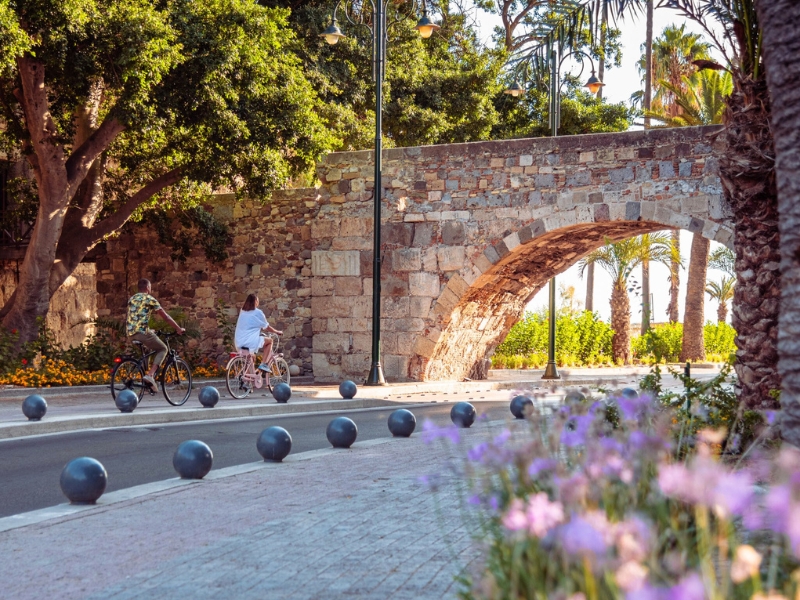
Kos Town packs two and a half thousand years into a few streets by the harbour: a castle of the Knights of St John, a plane tree tied to the father of medicine, a Roman concert hall and an Italian-era square with Ottoman mosques. This guide covers five of them, all stops on the same walk through the town centre, so you can see them in one easy loop. None of them is more than a short stroll from the next, and the walk between them takes you through the busiest and the quietest parts of town.
Nerantzia Castle
The fortress at the harbour entrance was built by the Knights of St John, the crusader order that ruled Rhodes and Kos, mainly in the 14th and 15th centuries. It has an inner and an outer ring of walls with round towers at the corners, and it once stood on its own, cut off from the town by a moat. Today that moat is the palm-lined Finikon avenue, and you still cross into the castle by a bridge.
The name comes from the Greek word for the bitter orange tree, nerantzi. The builders reused a great deal of older stone, so marble blocks, column drums and carved pieces from ancient Kos are set into the walls. The castle was damaged in the 2017 earthquake and parts of it were closed for repairs for a long time, so check what is open before you go.
- Ancient carved blocks and inscriptions built into the walls, especially around the gates.
- The coats of arms of the knights set into the stone.
- The view from the walls over the harbour and across the water to the Turkish coast.
- The castle gate, with the bridge in front of it, faces the plane tree.
The Plane Tree of Hippocrates
Just outside the castle bridge spreads the most famous tree on the island. Tradition says Hippocrates, the physician born on Kos in the 5th century BC, taught his students in the shade of a plane tree here. The tree you see is not that one: it is thought to be around 500 years old, which still makes it one of the oldest plane trees in Europe. Its hollow trunk measures about 12 metres around, and its heavy branches rest on metal supports.
- The scaffolding that holds up the old branches, and new shoots growing from the ancient trunk.
- The Ottoman fountain and the 18th-century Gazi Hassan Pasha Mosque, also called the Loggia Mosque, right next to the tree.
Eleftherias Square
Freedom Square is the main square of Kos Town and shows how the town was rebuilt by the Italians, who ruled the Dodecanese from 1912 to 1943, after an earthquake in 1933. The Archaeological Museum, completed in 1935, stands on one side; its collection includes a statue of Hippocrates found at the Roman Odeon. Across the square is the Defterdar Mosque from the late 18th century, which is not open to visitors.
- The arcaded front of the Archaeological Museum, typical of the Italian buildings of the 1930s.
- The minaret of the Defterdar Mosque.
- The covered market hall, a good place to buy local honey, herbs and fruit.
The same earthquake exposed large parts of the ancient city under the old houses, and Italian archaeologists dug them out in the years that followed. The Ancient Agora, the market and meeting place of ancient Kos, lies between the square and the harbour; you can look over its columns, foundations and the remains of a temple of Aphrodite from the paths around it.
Historical and Folklore Museum of Kos (the Hani)
A short walk from the square, a small museum looks at the island's more recent past and at traditional life on Kos. It is known locally as the Hani, the Greek word for an old-style inn. It is a quieter stop than the castle and the big museum, and a good place to see how people on Kos lived and worked before tourism changed the island.
The Roman Odeon
The Odeon is a small Roman theatre on Grigoriou Avenue, close to the excavated Roman house known as the Casa Romana. It once had a roof and was probably used for music and for meetings of the town council. It has 14 rows of seats, nine of which have been restored, and holds around 750 people. Concerts and cultural events still take place here in summer.
- The front rows, where the most important spectators sat.
- The vaulted passages beneath the seats, which you can walk through.
Hippocrates' name is everywhere in Kos, but the most direct link is in the museum, where the statue found here is displayed. Outside town, the Asklepieion, the ancient healing sanctuary where his followers are believed to have practised medicine, is the next place to see if you want more of the story.
How to see them in one walk
Start at Eleftherias Square and the Archaeological Museum, then walk south-west to the Roman Odeon. Come back through the old streets to the Hani, then head towards the harbour for the Plane Tree of Hippocrates. Finish by crossing the bridge over Finikon avenue into Nerantzia Castle, where the view over the harbour makes a good end to the walk. Early morning or late afternoon is the most pleasant time in summer, when the stones are not too hot.
See Kos with World City Trail
Our Kos treasure hunt turns the town into a game you play on your phone. The route links 10 stops, from the Statue of Hippocrates to Nerantzia Castle, and all five places in this guide are stops, along with Antagora Square, the Monument Park of the Kos Fighters and the Church of the Panagia Gorgoepikoos. At each stop you solve a puzzle and learn a story, at your own pace.
There is also a self-guided walking tour and an outdoor escape game in Kos, for people who prefer a different format.
Take the self-guided walking tour of Kos →
Play the outdoor escape game in Kos →
Facts checked in October 2026.