
Lisbon's centre runs downhill from the Bairro Alto to the river, and five of its best-known sights sit along that slope: a viewpoint, a Jesuit church with a chapel made in Rome, an 18th-century opera house, the great riverside square and the cathedral. This guide covers all five in the order you would meet them on foot, from the top of the hill to the bottom. Much of what you see was shaped by the earthquake of 1 November 1755 and the rebuilding that followed, so the stories connect from one stop to the next.
São Pedro de Alcântara viewpoint
This garden terrace on the edge of the Bairro Alto is one of the city's classic viewpoints. It is laid out on two levels, with trees, benches and a balustrade, and looks east across the Baixa to the Castelo de São Jorge and the hillside district of Graça. Because it faces east, it is at its best in the late afternoon, when the sun lights up the castle and the houses opposite.
The Glória funicular, which used to bring people up here from Restauradores, has been out of service since a fatal derailment in September 2025, and the city plans to replace it. Until then you reach the terrace on foot up the steep Calçada da Glória, or from the flat streets of the Bairro Alto.
- The tiled panel on the balustrade that names the hills, churches and monuments in front of you.
- The monument to Eduardo Coelho, founder of the newspaper Diário de Notícias, with the bronze figure of a young newspaper seller below him.
- The castle walls on the opposite hill, and the Baixa's grid of streets in the valley between.
Church of São Roque
From the outside, São Roque looks plain. It was one of the first churches of the Jesuit order, built in the second half of the 16th century on the site of a small shrine to St Roch, the saint invoked against the plague. It came through the 1755 earthquake with relatively little damage, so its interior is one of the best-preserved in Lisbon: a single wide nave with a painted wooden ceiling and a row of richly decorated side chapels.
The star is the Chapel of St John the Baptist, the last on the left. King João V ordered it from Rome in the 1740s. It was designed by Luigi Vanvitelli and Nicola Salvi, assembled in Rome and blessed by Pope Benedict XIV, then taken apart, shipped to Lisbon and rebuilt here. It is often described as one of the most expensive chapels ever made.
- The pictures in the Chapel of St John the Baptist: they are not paintings but mosaics of tiny stone pieces.
- The lapis lazuli, amethyst, agate and gilded bronze of the same chapel.
- The trompe-l'oeil painting on the wooden ceiling of the nave.
São Carlos National Theatre
Lisbon lost its royal opera house in the 1755 earthquake. The city's merchants paid for a replacement, and the Teatro de São Carlos opened in 1793, designed by the architect José da Costa e Silva and inspired by the San Carlo theatre in Naples. Its sober front faces a small square, Largo de São Carlos, while the horseshoe-shaped auditorium inside is all red and gold. The poet Fernando Pessoa was born in 1888 in a building on the same square.
The theatre closed in 2024 for a major renovation, and the national opera company has been performing in other venues while the work goes on. Check the theatre's own announcements before you plan a visit; the facade and the square can be seen at any time.
Praça do Comércio
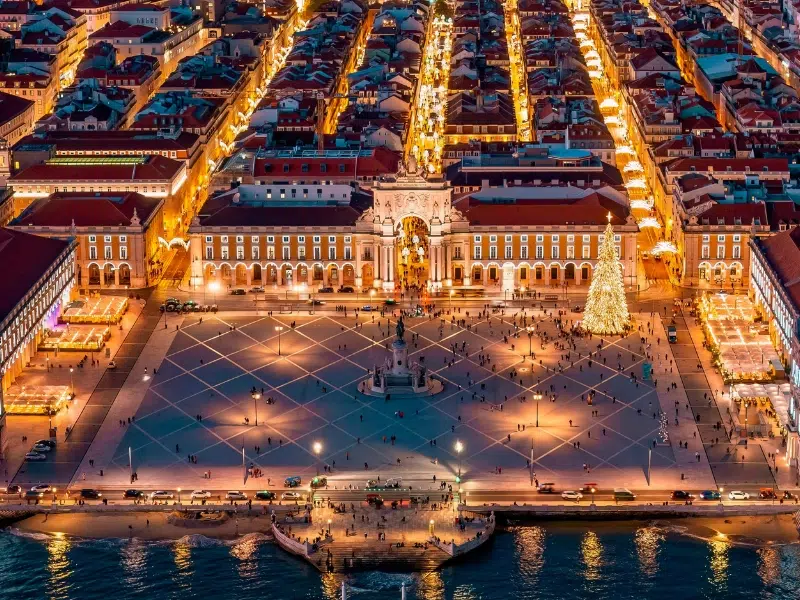
For centuries the royal palace stood on this riverbank, and the square was called Terreiro do Paço, the palace yard, a name many Lisboetas still use. The earthquake and tsunami of 1755 destroyed the palace. Under the Marquis of Pombal, the square was rebuilt as an open space framed on three sides by arcaded government buildings, with the fourth side open to the Tagus. It was here, on 1 February 1908, that King Carlos I and his heir were shot dead, an event that led to the end of the monarchy two years later.
- The bronze equestrian statue of King José I in the middle, by Joaquim Machado de Castro, unveiled in 1775.
- The triumphal Arco da Rua Augusta on the north side, finished in 1875, with figures of Vasco da Gama and the Marquis of Pombal; you can go up to a terrace on top.
- The Cais das Colunas, two columns and marble steps leading down into the river, once the ceremonial landing place.
Lisbon Cathedral
The Sé, as Lisboetas call the cathedral, was begun soon after 1147, when Portugal's first king, Afonso Henriques, took the city from the Moors. With its two crenellated towers it still looks half church, half fortress. It was damaged in 1755 and much of what you see today comes from a 20th-century restoration that tried to bring back its medieval look.
Behind the choir, the Gothic cloister has been excavated, revealing layers of Lisbon's past: a Roman street, remains from the Moorish period and medieval walls. By tradition, St Anthony, born nearby in the 1190s, was baptised in the cathedral's font.
- The large rose window between the two towers.
- The baptismal font linked by tradition with St Anthony, near the entrance.
- The yellow tram 28 rattling past the front of the cathedral.
How to see them in one walk
Start at the top, at the Miradouro de São Pedro de Alcântara, and walk south through the edge of the Bairro Alto to the Church of São Roque. Continue down past Praça Luís de Camões to Largo de São Carlos and the opera house, then descend through the Chiado and the Baixa to Praça do Comércio. From the square, walk east and climb the short slope to the cathedral. The route is mostly downhill, which makes it easier on Lisbon's steep, slippery cobbles.
See Lisbon with World City Trail
Our Lisbon scavenger hunt turns the city centre into a game you play on your phone. The route links 10 stops, from Rossio Square to Lisbon Cathedral, and all five places in this guide are stops, along with the Foz Palace, the Teatro da Trindade, Praça Luís de Camões and the Church of Saint Anthony. At each stop you solve a puzzle and learn a story, at your own pace.
There is also a self-guided walking tour and an outdoor escape game in Lisbon, for people who prefer a different format.
Play the Lisbon scavenger hunt →
Take the self-guided walking tour of Lisbon →
Play the outdoor escape game in Lisbon →
Facts checked in October 2026.