
Lyon grew rich on trade, banking and silk, and four places in the centre tell that story from different angles. This guide covers the Musée des Tissus, built on the city's silk industry, the neo-Gothic Church of Saint-Georges and the Temple du Change, the old merchants' exchange, both in Vieux Lyon, and the Hôtel de Ville on the Place des Terreaux. They lie on both banks of the Saône and fit into one walk from the Presqu'île across the river and back.
Musée des Tissus
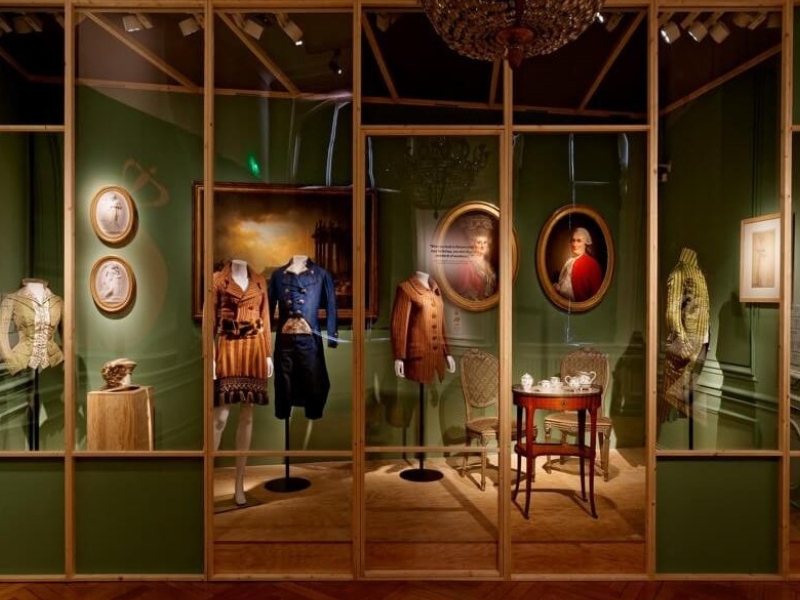
The textile museum was born from Lyon's silk trade. In 1856 the Chamber of Commerce decided to create a museum of art and industry to help the city's silk weavers, and it opened to the public in 1864; in 1890 it was refocused on the history of textiles. Since 1946 it has occupied the Hôtel de Villeroy on the Rue de la Charité, the 18th-century residence of the governor of the Lyonnais, while the decorative arts museum next door fills the Hôtel de Lacroix-Laval, built by Jacques-Germain Soufflot in 1739.
Together the two museums hold more than 2.5 million pieces, and the textile collection, spanning some 4,000 years, is the richest of its kind in France. After a financial crisis the buildings passed to the Auvergne-Rhône-Alpes region, and the museum is now closed for a major renovation designed by the architect Rudy Ricciotti, with only occasional openings for special events. Check its own website before you go. The museum is the first stop on our scavenger hunt.
- The two neighbouring mansions on the Rue de la Charité, seen from the street even while the museum is closed.
- The Hôtel de Lacroix-Laval, the decorative arts wing, a work by Soufflot from 1739, the same architect you will meet again at the Temple du Change.
Church of Saint-Georges
On the bank of the Saône at the southern end of Vieux Lyon, the Church of Saint-Georges gave its name to the whole neighbourhood around it. A church stood here as early as the 6th century, founded by Bishop Sacerdos and dedicated to Saint Eulalia; around 800 Bishop Leidrade restored it and dedicated it to Saint George. From 1315 the site was the commandery of the Knights of the Order of Saint John of Jerusalem.
The present church is neo-Gothic and was designed by Pierre Bossan, the architect who also drew the plans for the basilica of Fourvière on the hill above; it was rebuilt in the 1840s. Its later history was turbulent: the churches were closed in 1792 and the bell tower partly collapsed, and from the late 1970s until 1989 the building stood unused. It then reopened with Masses in the old Lyon rite, and since 2006 it has again been a regular church of the diocese. Saint-Georges is one of the stops on our scavenger hunt.
- The neo-Gothic front facing the river, by the same architect as Fourvière, best seen from the quay.
Temple du Change
On the small Place du Change in the north of Vieux Lyon stands a building that looks more like a stock exchange than a church, and that is exactly what it was. The Loge du Change was where money changers and merchants met to settle their accounts. The first building was put up between 1631 and 1653 to plans by Simon Gourdet, and between 1748 and 1750 it was rebuilt to plans by Jacques-Germain Soufflot, adding a fifth arch to the front and a large hall at the back.
After the French Revolution the loge was abandoned and for a time even served as an inn. In 1803 Napoleon gave it to the Protestant Reformed church, and it has been a Protestant temple ever since. In 1938 it hosted the founding synod of the Reformed Church of France. The facade has been a listed historic monument since 1913. The Temple du Change is a stop on our scavenger hunt.
- The arcaded front by Soufflot, with its classical columns: a trading hall, not a church, in its design.
- The name of the square itself, the Place du Change, a reminder of the money changers who once met here.
Hôtel de Ville
Lyon's town hall closes off the east side of the Place des Terreaux, which became the centre of the city in the 17th century. It was built between 1646 and 1672 under the architect Simon Maupin, with help from the mathematician Girard Desargues, whose staircases are admired for their ingenuity. Only two years after it was finished, in 1674, a fire destroyed the great hall and the chapel and damaged the belfry and roofs.
The building was restored between 1701 and 1703 to plans by Jules Hardouin-Mansart and his brother-in-law and assistant Robert de Cotte. Over the central entrance is a half-relief of Henri IV on horseback, carved in 1829 by Jean-François Legendre-Héral. It replaced a relief of Louis XIV in the same pose, which was removed during the Revolution. The Hôtel de Ville is a stop on our scavenger hunt, and so is the Place des Terreaux in front of it.
- The relief of Henri IV over the main door, a royal portrait put back up after the Revolution, with a different king.
- The belfry with its lunar clock, and the carillon, which has had 65 bells since 2000 and is described as the second largest in France.
- The Place des Terreaux in front, the best place to step back and take in the whole facade.
How to see them in one walk
Start at the Musée des Tissus on the Rue de la Charité, walk to the Place Bellecour and cross the Saône on the Pont Bonaparte. Turn left along the quay to the Church of Saint-Georges, then walk north through the lanes of Vieux Lyon past the cathedral of Saint-Jean to the Place du Change. Cross back over the river and walk up to the Place des Terreaux and the Hôtel de Ville. On the way you pass the Fresque des Lyonnais, a large painted wall that is also on our route.
See Lyon with World City Trail
Our Lyon scavenger hunt turns the city centre into a game you play on your phone. The route links 10 stops, from the Musée des Tissus to the Church of Saint-Nizier, and all four places in this guide are stops: the Musée des Tissus, Saint-Georges, the Temple du Change and the Hôtel de Ville, along with the Place Bellecour, the Pont Bonaparte, the cathedral of Saint-Jean, the Fresque des Lyonnais and the Place des Terreaux. At each stop you solve a puzzle and learn a story, at your own pace.
If you prefer a different format, there is also a self-guided walking tour and an outdoor escape game in Lyon.
Play the Lyon scavenger hunt →
Take the self-guided walking tour of Lyon →
Play the outdoor escape game in Lyon →
Facts checked in October 2026.