
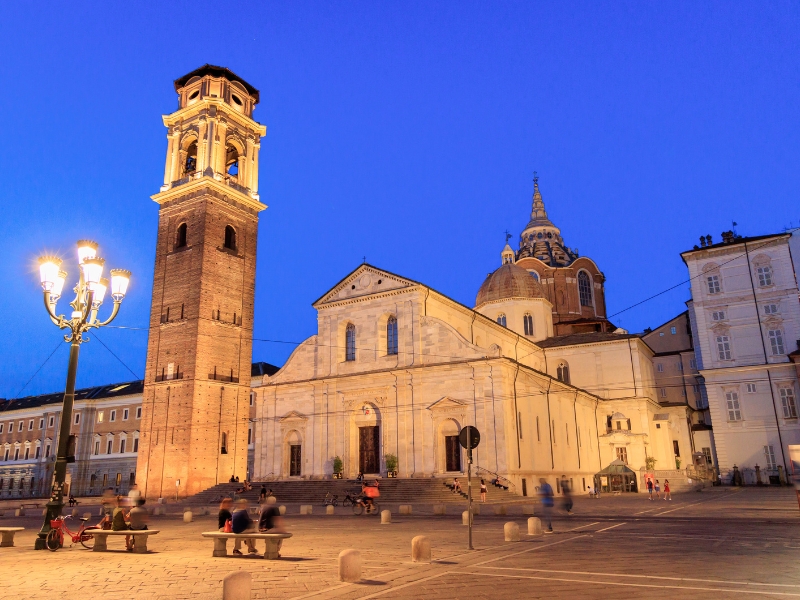
For centuries Turin was the capital of the House of Savoy, and in 1861 it became the first capital of united Italy. This guide covers eight places in the centre that tell that story: the cathedral, the Royal Palace and Palazzo Madama around Piazza Castello, the Mole Antonelliana, Palazzo Carignano with the Museum of the Risorgimento, Piazza Carlo Alberto behind it, the Egyptian Museum and Piazza Solferino. Almost all of them lie within a short walk of each other.
Turin Cathedral
The cathedral of Saint John the Baptist was built between 1491 and 1498 by Amedeo di Francesco da Settignano, known as Meo del Caprino, after three older churches on the site were pulled down, and it stands next to a bell tower completed in 1470. Behind the altar rises the Chapel of the Holy Shroud, designed by Guarino Guarini and added between 1668 and 1694; its dome was completed in 1694. A fire in 1997 seriously damaged parts of the chapel. Since 1993 the Shroud itself has been kept in a shrine inside the cathedral and is shown to the public only during rare official displays. The cathedral is the first stop on our scavenger hunt.
- The tall bell tower beside the church, older than the cathedral itself, and the view from outside of Guarini's dome rising behind the choir.
Royal Palace of Turin
The Royal Palace was the main residence of the Savoy court. Construction on the site of the former bishop's palace was ordered in 1645 by the regent Christine Marie, and architects from Ascanio Vittozzi and the Castellamonte family to Filippo Juvarra, Benedetto Alfieri and Pelagio Palagi worked on it over two centuries. It passed to the state in 1946, and in 1997 it was listed as a UNESCO World Heritage Site together with the other Savoy residences. Today it is the core of the Musei Reali, and it is a stop on our scavenger hunt.
- The royal gates with the golden head of Medusa, meant to ward off intruders, the Royal Armoury with its weapons from the 16th and 17th centuries, and Juvarra's Scala delle Forbici, the Scissors Staircase.
Palazzo Madama
In the middle of Piazza Castello stands a building with two faces. At the back are the towers of a Roman gate, where the main street of Roman Augusta Taurinorum began, and of the medieval castle that the Acaja branch of the Savoy family built around it. At the front is a white stone Baroque facade by Filippo Juvarra, begun in 1716 and left unfinished in 1721, only one bay deep. The palace takes its name from two royal widows who lived here, Christine of France and Marie Jeanne of Savoy, known as Madama Reale. It later housed the Subalpine Senate, and since 1934 it has been the City Museum of Ancient Art. It is one of the stops on the scavenger hunt.
- Walk round the building to compare Juvarra's facade with the medieval brick towers behind it, the clearest way to see two thousand years of Turin in one building.
Mole Antonelliana
Turin's landmark tower was designed by Alessandro Antonelli as a synagogue for the city's Jewish community. Work began in 1863, but the community withdrew from the project in 1876, and the city took it over; it was completed in 1889, a year after Antonelli's death. At 167.5 metres it dominates the skyline. On 23 May 1953 a storm destroyed the top 47 metres of the spire, which was rebuilt in 1961 as a metal structure faced with stone. Since 2000 it has housed the National Museum of Cinema, and it appears on the Italian 2-cent euro coin. The Mole is not on our scavenger hunt route, but it is a short detour from Piazza Castello.
- Look at a 2-cent coin before you go and compare it with the real thing: the slim spire on top of the square dome is the part rebuilt after 1953.
Palazzo Carignano and the Museum of the Risorgimento
Palazzo Carignano was begun in 1679 for Emmanuel Philibert, Prince of Carignano, to designs by Guarino Guarini. Its brick main front curves in and out, a rhythm borrowed from Borromini's church of San Carlo alle Quattro Fontane in Rome and used here, uniquely, on a civic building. King Victor Emmanuel II was born here in 1820, and an inscription on the facade, added in 1884, records it. From 1848 the palace housed the Chamber of Deputies of the Kingdom of Sardinia, and in 1861 the first parliament of united Italy met here, in a temporary hall in the courtyard.
Since 1938 the palace has been home to the National Museum of the Risorgimento, founded in 1878, which tells the story of Italian unification in 30 rooms. The visit includes the Subalpine Parliament chamber, kept intact with its original furniture, and the great hall built from 1864 for the Italian Parliament, which was never used for that purpose because the capital moved to Florence. Both the palace and the museum are stops on our scavenger hunt.
- The seats of Cavour, d'Azeglio, Balbo, Gioberti and Garibaldi in the Subalpine chamber, marked with tricolour rosettes, and Cavour's reconstructed study.
Piazza Carlo Alberto
Behind Palazzo Carignano lies Piazza Carlo Alberto, a pedestrian square since 2006. Its east side is the palace's 19th-century rear extension, designed by Domenico Ferri and built by Giuseppe Bollati in the 1860s, a complete contrast with Guarini's brick front. In the centre stands Carlo Marochetti's equestrian statue of King Charles Albert, unveiled on 21 July 1861 and surrounded by allegorical figures and soldiers. In 1888 and 1889 the philosopher Friedrich Nietzsche lived in a third-floor room of the corner building with Via Carlo Alberto, where he wrote The Antichrist, Twilight of the Idols and Ecce Homo; a plaque from 1944 recalls his stay. The square is a stop on the scavenger hunt.
Egyptian Museum
The Museo Egizio was founded in 1824 by King Charles Felix, who bought more than 5,000 objects collected by Bernardino Drovetti, including 100 statues and 170 papyri. It is considered the oldest museum dedicated entirely to ancient Egyptian culture and the second most important Egyptian collection after Cairo's. The papyri include the Turin King List, which Jean-François Champollion studied while deciphering hieroglyphs. The galleries were redesigned for the 2006 Winter Olympics and given a new layout in 2015. The museum is one of the stops on our scavenger hunt.
- The contents of the tomb of Kha and Merit, including Kha's outer coffin and Merit's cosmetic box, and the statue of Ramesses II with Amun and Hathor.
Piazza Solferino
Piazza Solferino is named after the battle of Solferino of 24 June 1859, when French and Piedmontese troops defeated the Austrians. At one end stands the Fontana Angelica by Giovanni Riva, unveiled in 1930, with four sculpted groups representing the seasons and twelve masks with the signs of the zodiac. Opposite is Alfonso Balzico's bronze monument of 1877 to Ferdinand of Savoy, Duke of Genoa, shown with his sword drawn on a wounded horse in memory of the battle of Novara in 1849. Piazza Solferino is the last stop on our scavenger hunt.
How to see them in one walk
Start at the cathedral and walk round to the Royal Palace and Piazza Castello with Palazzo Madama in the middle. Make a short detour east to the Mole Antonelliana, then come back through the Galleria Subalpina to Piazza Carlo Alberto and Palazzo Carignano. The Egyptian Museum is just around the corner. Finish by walking through Piazza San Carlo to Piazza Solferino. If you want to visit the museums inside, plan them over more than one day.
See Turin with World City Trail
Our Turin scavenger hunt turns the city centre into a game you play on your phone. The route links 10 stops, from the cathedral to Piazza Solferino, and seven of the places in this guide are stops: the cathedral, the Royal Palace, Palazzo Madama, Piazza Carlo Alberto, the Museum of the Risorgimento, Palazzo Carignano, the Egyptian Museum and Piazza Solferino, along with the Galleria Subalpina and Piazza San Carlo. At each stop you solve a puzzle and learn a story, at your own pace.
If you prefer a different format, there is also a self-guided walking tour and an outdoor escape game in Turin.
Play the Turin scavenger hunt →
Take the self-guided walking tour of Turin →
Play the outdoor escape game in Turin →
Facts checked in October 2026.