
Two periods shaped the old town of Rimini more than any other: the Roman city of Ariminum, where the Via Flaminia from Rome ended, and the 15th century, when the Malatesta family ruled here and Sigismondo Pandolfo Malatesta brought in some of the best artists of the Renaissance. This guide covers seven places from both ages and the centuries between: the Arco di Augusto, the Ponte di Tiberio, the Tempio Malatestiano, Castel Sismondo, the City Museum, the old fish market and the church of the Madonna della Scala.
Arco di Augusto
The Arch of Augustus was put up in 27 BC by the Roman Senate in honour of Augustus, the year he became Rome's first emperor. It marked the end of the Via Flaminia, the road from Rome, and the start of the city's main street, today Corso d'Augusto. It is often called the oldest surviving triumphal arch in Italy, although scholars point out that it worked mainly as a city gate. Between 1937 and 1939 the houses and walls built against it were pulled down, so it now stands alone. The arch is the first stop of our scavenger hunt.
- The four round shields above the arch with heads of Roman gods: Jupiter, Apollo, Neptune and a goddess read as Venus, Minerva or Roma.
- The battlements along the top, added in the Middle Ages; the oldest probably date from the 13th century.
Ponte di Tiberio
At the other end of Corso d'Augusto stands the Bridge of Tiberius, begun under Augustus in 14 AD and finished under Tiberius in 21 AD. Its five arches of white Istrian stone carried the road where the Via Aemilia and the Via Popilia met, and a Latin inscription on the central span names both emperors. In 1944 the retreating German army was ordered to destroy it, but several attempts to blow it up failed and it came through almost undamaged. It was closed to cars step by step from 2019 and has been for pedestrians only since May 2020. The bridge is one of the stops on our scavenger hunt.
Its nickname, the Devil's Bridge, comes from a legend: the devil helped to build it in exchange for the first soul to cross, and Tiberius tricked him by sending a dog over first.
- The inscription on the central span, where the names of Augustus and Tiberius can still be read.
Tempio Malatestiano
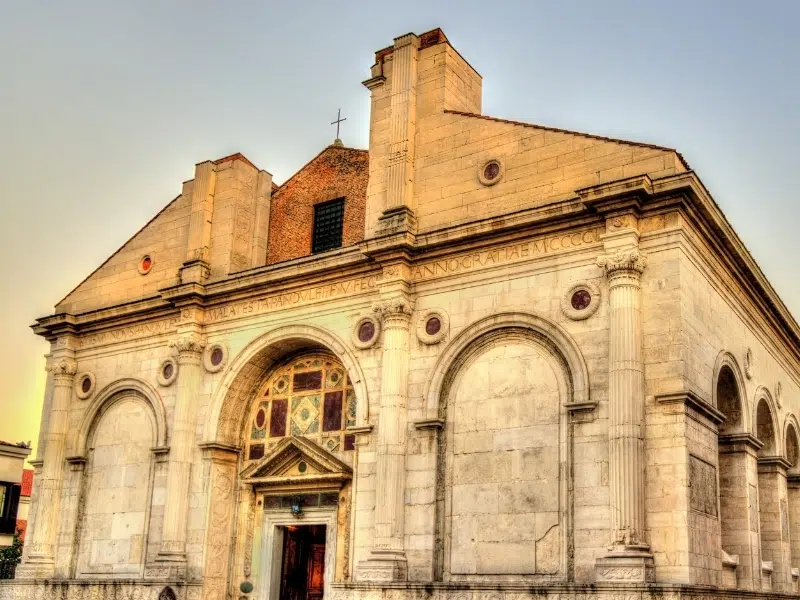
Rimini's cathedral began as the Gothic church of San Francesco. Around 1450 Sigismondo Pandolfo Malatesta, lord of the city, had it rebuilt as a monument to himself and to Isotta degli Atti, who later became his wife. Leon Battista Alberti designed a new marble shell around the old church, and Matteo de' Pasti ran the work. For the front Alberti borrowed from Roman triumphal arches, above all the Arch of Augustus a short walk away, and the deep arches along the sides recall Roman aqueducts. Sigismondo was excommunicated in 1460, his power declined, and the facade and the planned dome were never finished.
Inside, chapels decorated by Agostino di Duccio are full of reliefs, from dancing angels to the signs of the zodiac. Pope Pius II, Sigismondo's enemy, called the church full of pagan gods and profane things. The building was badly damaged in the Second World War and rebuilt, partly with pieces saved from the rubble. It is one of the stops on our scavenger hunt.
- The SI monogram of Sigismondo and Isotta, together with roses and elephants, carved all over the building.
- The fresco by Piero della Francesca from 1451, showing Sigismondo kneeling before his patron saint, Saint Sigismund.
- The crucifix attributed to Giotto, in the chapel with Isotta's tomb.
Castel Sismondo
Sigismondo began his castle in 1437, as a palace and a fortress at once. Several architects and engineers worked on it, among them Filippo Brunelleschi, who spent two months in Rimini in 1438 inspecting Malatesta fortresses. In 1821 it became a barracks for the Carabinieri, and in 1826 its outer walls were demolished and the moat filled in, so only the central block survives. Since 2021 it has been one of the three sites of the Fellini Museum. The castle is one of the stops on our scavenger hunt.
- The walls and towers of the surviving central block on Piazza Malatesta, which give an idea of the size of the whole fortress.
City Museum
The Museo della Città is housed in the former Jesuit college on Via Tonini, built between 1746 and 1755 to a design by Alfonso Torreggiani; after the Jesuits were suppressed it served as the city hospital for about 150 years. The museum opened in 1981 and carries the name of the local historian Luigi Tonini. Its collections run from prehistory to the modern age, with a large section on 14th-century painting of the Rimini school. The museum is one of the stops on our scavenger hunt.
- The finds from the Domus del Chirurgo, a Roman surgeon's house discovered in 1989 close by, whose surgical instruments are among the most important sets of ancient medical tools ever found.
- Giovanni Bellini's Pietà, painted around 1470, and works by Domenico Ghirlandaio, Guercino, Guido Cagnacci and Guido Reni.
La Pescheria Vecchia
Just off Piazza Cavour, the city's old main square, stands the old fish market, built in the middle of the 18th century and one of the historic buildings of Rimini's seafaring past. Under its arcades fish was sold for generations; today the arcades and the lanes around them are one of the liveliest corners of the old town in the evening, full of bars and small restaurants. The fish market is not one of our scavenger hunt stops, but the square is close to the route.
- Piazza Cavour itself: the Gothic Palazzo dell'Arengo of 1204, the Fontana della Pigna, for centuries the only monumental fountain in the city, and the monument to Pope Paul V of 1614.
Madonna della Scala
The last stop of our scavenger hunt is a small church in the Borgo San Giuliano, the old fishermen's quarter across the Ponte di Tiberio. Its name comes from an image of the Virgin, dated 1608 and attributed to Alessandro Codrini, painted under the stair of a tower in the city walls. According to tradition, that year a young man who fell into the Marecchia with his horse called on this Madonna and was saved. The image was taken from the wall, the first chapel was blessed in 1610, and the church, paid for with offerings from sailors' families, was enlarged in 1718. In the Second World War the painting survived because it had been taken away to safety, while the church was hit by the bombing.
- The painted image of the Madonna above the altar, and the rebuilt apse with Jacob's Dream by Francesco Brici.
How to see them in one walk
Start at the Arco di Augusto and walk up Corso d'Augusto to Piazza Tre Martiri, then turn off to the Tempio Malatestiano. Head on to the City Museum on Via Tonini, return to the Corso and continue to Piazza Cavour and the old fish market. From there Castel Sismondo is just behind the square. Finish by walking down to the Ponte di Tiberio, crossing it into the Borgo San Giuliano and ending at the Madonna della Scala.
See Rimini with World City Trail
Our Rimini scavenger hunt turns the old town into a game you play on your phone. The route links 10 stops, from the Arco di Augusto to the Madonna della Scala, and the arch, the Tempio Malatestiano, Castel Sismondo, the City Museum, the Ponte di Tiberio and the Madonna della Scala are all stops, along with Piazza Tre Martiri, the Teatro Galli, the Domus del Chirurgo and the murals of the Borgo San Giuliano.
There is also a self-guided walking tour and an outdoor escape game in Rimini, for people who prefer a different format.
Play the Rimini scavenger hunt →
Take the self-guided walking tour of Rimini →
Play the outdoor escape game in Rimini →
Facts checked in October 2026.