
This guide follows a line from the top of Castello, Cagliari's walled old town, down into the Stampace quarter and the port: the two Pisan towers of San Pancrazio and the Elephant, the Bastion of Santa Croce, the church and festival of Sant'Efisio, Piazza Yenne and the Palazzo Civico on Piazza Matteotti. It is the story of the city from its medieval defences to the great procession that leaves Stampace every 1 May.
Torre di San Pancrazio
The Tower of San Pancrazio stands at the highest point of Castello, on Piazza Indipendenza next to the museum quarter. It was built in 1305, when Pisa ruled Cagliari, by the Sardinian architect Giovanni Capula, and it is the tallest of the city's towers. Its three outer walls are very thick, with only narrow slits, because they faced the enemy.
The fourth side, towards the town, was left open, Pisan style, showing the wooden floors inside; under the Aragonese the tower was used as a prison, and later walls closed it in until a restoration in 1906 opened it up again. The tower is not on our scavenger hunt route, but it is a short walk from Porta Cristina. When it is open you can climb it for views over the city and the gulf.
- The open inner side with its four levels of wooden floors and balconies, seen from Piazza Indipendenza.
- The thick white limestone walls on the outer sides, with their narrow arrow slits.
Torre dell'Elefante
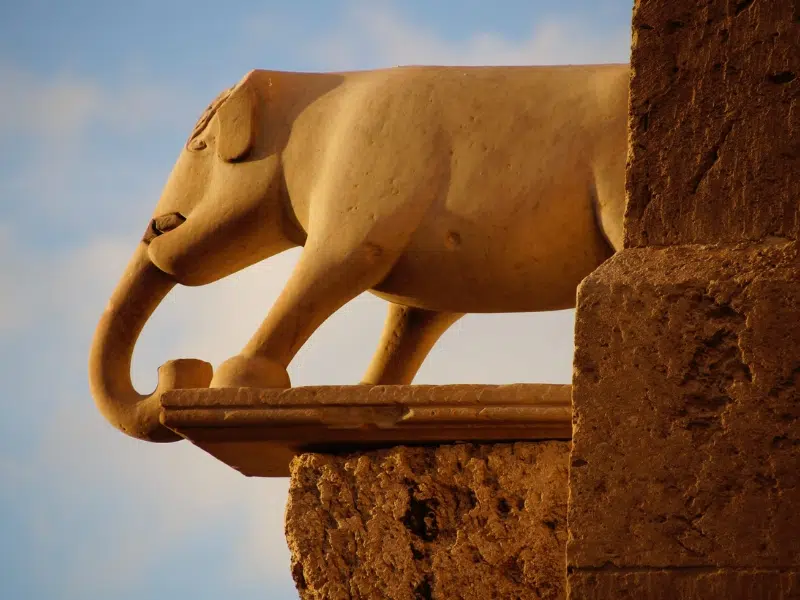
Two years later the same Giovanni Capula began the Elephant Tower, in 1307, to guard one of the gates of Castello. It is about 30 metres high, built of pale limestone from the Bonaria quarries, and like San Pancrazio it is open on the side facing the town. It takes its name from a small sculpted elephant on a ledge on the outer side, one of the symbols of Pisa.
The tower had a grim job. In the Spanish period it was a prison, and the heads of prisoners executed nearby were hung at its gate as a warning; in the second half of the 17th century the head of the Marquis of Cea, involved in the murder of the viceroy Camarassa, was left there for several years. The Torre dell'Elefante is one of the stops on our scavenger hunt, and it can be climbed when open.
- The little elephant on its bracket, high above the arch of the gate.
- The deep gate passage beneath the tower, which once had three heavy doors and two portcullises.
Bastione di Santa Croce
The Bastion of Santa Croce is a long terrace on the western edge of Castello, facing over Stampace towards the setting sun. Behind it lies the old Jewish quarter of Castello, the Giudaria, which already existed in the 13th century. When Ferdinand and Isabella expelled the Jews from their kingdoms in 1492, the Jews of Cagliari were expelled too, and their synagogue soon became the church of Santa Croce.
In 1564 the Jesuits took over the church and the houses around it for their first college in the city; today the former college houses the university's architecture faculty. The church was damaged by bombs in 1943 and reopened for worship in 2007. The bastion is one of the stops on our scavenger hunt and a good place to stop at sunset.
- The Basilica of Santa Croce on the bastion, the former synagogue of the Giudaria.
- The view west over the rooftops of Stampace, from the parapet of the bastion.
Sant'Efisio: the church and the festival
The church of Sant'Efisio stands on Via Sant'Efisio in Stampace. It was rebuilt in the late 18th century on a 16th-century church, which itself replaced one from the 13th century, and inside a 17th-century statue of the saint stands in the second chapel on the right. Under the church is an underground room that, according to popular tradition, was the cell where Efisio, a Roman soldier who became a Christian, was held before he was taken to Nora and beheaded.
Every year on 1 May the saint's statue leaves this church in the Festa di Sant'Efisio. It fulfils a vow made by the city during the plague of 1652 and renewed in 1656. The statue is carried on foot to Nora, near Pula, the place of his martyrdom, and comes back to Stampace on the evening of 4 May. The procession has been held every year since 1657, with very few exceptions: it went ahead in 1943 despite the bombing, and the only years it could not take place were 2020 and 2021, when a small ceremony at Nora fulfilled the vow. The church is not a scavenger hunt stop.
- The traccas, carts decorated with flowers and pulled by oxen, that open the procession, followed by folk groups in costume and riders on horseback.
- The Alter Nos, the official who represents the mayor during the festival, appointed by the mayor and invested at the Palazzo Civico on 1 May.
Piazza Yenne
Piazza Yenne is the lively square where Stampace meets the lower town, at the top of Largo Carlo Felice. Its first stone was laid in 1822, and it takes its name from the viceroy who wanted it, the Marquis Ettore Veuillet d'Yenne. It has been a pedestrian square since a redesign in 1980, lined with bars and tables.
In 1822 the viceroy also set up a milestone column here, marking the start of the royal road to Porto Torres in the north of the island; that road is today the SS 131 Carlo Felice, Sardinia's main highway. Piazza Yenne is one of our scavenger hunt stops.
- The statue of King Charles Felix by the sculptor Andrea Galassi, set up in 1860 on a base by the architect Gaetano Cima.
- The milestone column from 1822 that marks the start of the Carlo Felice road.
Palazzo Civico and Piazza Matteotti
Cagliari's town hall, the Palazzo Civico, faces the harbour on Via Roma, at the bottom of Largo Carlo Felice. Its first stone was laid in 1899 and it was inaugurated in 1907, designed by the engineer Annibale Rigotti in the studio of Crescentino Caselli. The style mixes Catalan Gothic with Art Nouveau decoration, in pale local limestone, with two octagonal towers. Bombing in 1943 badly damaged it, and it was rebuilt between 1946 and 1953.
Next to it lies Piazza Giacomo Matteotti, a garden square laid out in the second half of the 19th century in front of the railway station. The square is the last stop of our scavenger hunt. If the town hall is open, look inside for the large paintings by Filippo Figari in the council hall, a 16th-century altarpiece by Pietro Cavaro and a Flemish woven wall hanging from 1620.
- The facade with its portico of arches and bronze decorations by Andrea Valli.
- The four small obelisks at the corners of the building, with the heads of blindfolded Moors on their bases, the emblem of Sardinia.
How to see them in one walk
Start at the top, at the Tower of San Pancrazio on Piazza Indipendenza. Walk south through Castello, turn west to the Bastion of Santa Croce and the basilica, and continue to the Elephant Tower. Go down through the gate into Stampace and find the church of Sant'Efisio on Via Sant'Efisio. From there it is downhill to Piazza Yenne, then along Largo Carlo Felice to the Palazzo Civico and Piazza Matteotti by the port. If you are in Cagliari around 1 May, plan the day around the procession, which fills these same streets.
See Cagliari with World City Trail
Our Cagliari scavenger hunt turns the old town into a game you play on your phone. The route links 10 stops, from the Giardini Pubblici to Piazza Giacomo Matteotti, and the Elephant Tower, the Bastion of Santa Croce, Piazza Yenne and Piazza Matteotti are all stops, along with the Giardini Pubblici, the Roman amphitheatre, Porta Cristina, the National Archaeological Museum, the cathedral and the Bastion of Saint Remy. At each stop you solve a puzzle and learn a story, at your own pace.
There is also a self-guided walking tour and an outdoor escape game in Cagliari, for people who prefer a different format.
Play the Cagliari scavenger hunt →
Take the self-guided walking tour of Cagliari →
Play the outdoor escape game in Cagliari →
Facts checked in October 2026.