
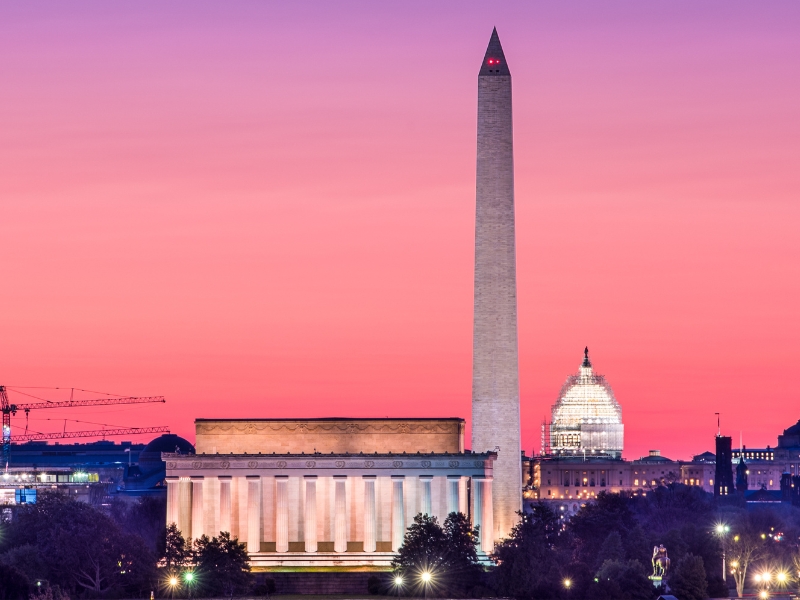
The National Mall is laid out on one long east–west line: the United States Capitol at one end, the Lincoln Memorial at the other, and the Washington Monument in between. This guide covers those three and the World War II Memorial, which sits on the same axis. Seen one after another, they tell the story of the country from its founding through the Civil War to the Second World War.
United States Capitol
The Capitol, home of the Senate and the House of Representatives, stands on Capitol Hill at the eastern end of the Mall. George Washington laid its cornerstone on 18 September 1793, in a Masonic ceremony, and the building followed a design by William Thornton, changed by several architects as work went on. In 1814, during the war with Britain, British troops set it on fire. Benjamin Henry Latrobe restored it, and Charles Bulfinch gave it its first, low dome.
The dome you see today came later. As the Senate and House wings grew, the old dome looked too small, and Thomas U. Walter designed a much larger one in cast iron, built from 1855 to around 1866, right through the Civil War. On 6 January 2021 a mob broke into the building during the count of the electoral votes, the first violent seizure of the Capitol since 1814. Visitors enter through the underground Capitol Visitor Center, opened in 2008.
- The Statue of Freedom on top of the dome, a bronze female figure raised into place in 1863.
- The Apotheosis of Washington inside the dome, a fresco by Constantino Brumidi, who painted it high above the floor of the rotunda.
- The view west from the terrace, straight down the Mall to the Washington Monument and the Lincoln Memorial.
Washington Monument
The white marble obelisk in the middle of the Mall honours George Washington. Its architect was Robert Mills, whose original design included a colonnade around the base that was never built for lack of money. The cornerstone was laid on 4 July 1848, but work stopped in 1854, held up by lack of funds, a takeover of the building society by the anti-immigrant Know-Nothing party, and then the Civil War. It did not restart until 1879.
The monument was finished in December 1884, dedicated in 1885 and opened to the public in 1888. At 555 feet it was the tallest structure in the world until the Eiffel Tower was completed in 1889. The tip is a small pyramid of aluminium, at the time the largest piece of that metal ever cast, when aluminium was as valuable as silver. An elevator takes visitors to the observation level at the top.
- The change in colour about a third of the way up: the marble came from different quarries before and after the long pause in construction.
- The ring of American flags around the base.
- Inside, the memorial stones given by states, cities and organisations, set into the inner walls.
World War II Memorial
The National World War II Memorial stands at the eastern end of the Reflecting Pool, between the Washington Monument and the Lincoln Memorial, on the site of the old Rainbow Pool. It honours the Americans who served in the armed forces and on the home front. Designed by the architect Friedrich St. Florian, it opened in April 2004 and was dedicated in May of that year.
The memorial is a sunken plaza with a pool and fountains, framed by 56 granite pillars arranged in a semicircle, one for each state and territory of the time and the District of Columbia. Two arches mark the two theatres of the war, the Atlantic and the Pacific. Twenty-four bronze bas-relief panels show scenes of combat and of life at home.
- The Freedom Wall with its 4,048 gold stars, each standing for 100 Americans who died in the war.
- The two small engravings of Kilroy, the cartoon face with a long nose peering over a wall that American soldiers drew everywhere they went. They are hidden in the memorial, and finding them is part of the fun.
- The view west along the Reflecting Pool to the Lincoln Memorial.
Lincoln Memorial
At the western end of the Mall, the Lincoln Memorial honours Abraham Lincoln, president during the Civil War. The architect Henry Bacon designed it as a Greek temple, and it was dedicated on 30 May 1922, in the presence of Robert Todd Lincoln, the president's only surviving son. Its 36 outer columns stand for the 36 states of the Union at the time of Lincoln's death.
Inside sits the huge marble statue of Lincoln, designed by Daniel Chester French and carved by the Piccirilli brothers. The walls carry the texts of two of his speeches, the Gettysburg Address and his second inaugural address, with murals by Jules Guérin above them.
The steps have their own history. In 1939 the singer Marian Anderson gave an open-air concert here after she had been refused the use of Constitution Hall, and on 28 August 1963 Martin Luther King Jr. gave his I Have a Dream speech from the steps during the March on Washington.
- The inscription on the landing, 18 steps below the statue, that marks the spot where King stood.
- The Gettysburg Address carved on the south wall.
- The view east across the Reflecting Pool to the Washington Monument and the Capitol, best in the evening.
How to see them in one walk
Start at the Capitol and walk west down the Mall, between the Smithsonian museums, to the Washington Monument on its low hill. Cross 17th Street to the World War II Memorial, then follow either side of the Reflecting Pool to the Lincoln Memorial. On the way you pass the Korean War Veterans Memorial on the south side. The walk is long, so allow plenty of time, especially in summer heat.
See Washington D.C. with World City Trail
Our Washington D.C. scavenger hunt turns the National Mall into a game you play on your phone. The route links 10 stops, starting at the United States Capitol and finishing at the Lincoln Memorial, and the Washington Monument and the World War II Memorial are stops too. Along the way it also takes in the Library of Congress, the National Gallery of Art, the Air and Space, Natural History and American History museums and the Korean War Veterans Memorial. At each stop you solve a puzzle and learn a story, at your own pace.
There is also a self-guided walking tour and an outdoor escape game in Washington D.C., for people who prefer a different format.
Play the Washington D.C. scavenger hunt →
Take the self-guided walking tour of Washington D.C. →
Play the outdoor escape game in Washington D.C. →
Facts checked in October 2026.