
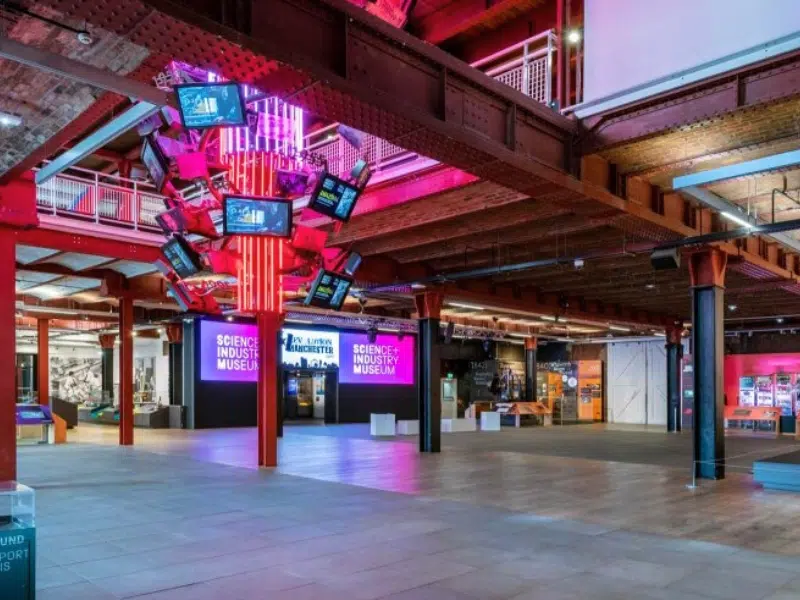
Manchester grew rich on cotton in the 19th century, and much of the centre still reflects that boom. This guide covers six places that show it: the Royal Exchange where cotton was traded, Piccadilly Gardens on the site of the old infirmary, Manchester Art Gallery, St Peter's Square, the Town Hall on Albert Square, and the Science and Industry Museum in the world's first inter-city railway station. All six are stops on our scavenger hunt.
Royal Exchange
For more than a century this was where Manchester's cotton was bought and sold. The present building was begun in 1867 and extended until 1931; after the extension its trading hall, under three glass domes, was described as the largest in England. Trading stopped in 1968, and in 1976 the Royal Exchange Theatre opened in the empty hall: a seven-sided steel and glass module designed by Richard Negri, so heavy that it hangs from the four columns of the central dome rather than resting on the floor. It seats around 800 people and is often described as the largest theatre in the round in the world. The IRA bomb of 15 June 1996, which exploded less than 50 yards away, shifted the dome, and the theatre only reopened in November 1998.
- The theatre module standing in the middle of the old trading floor, which you can see from the hall even without a ticket.
- The three domes and the scale of the hall, a reminder of how much money moved through this room.
Piccadilly Gardens
Piccadilly Gardens is the busy open space between the shopping streets and the Northern Quarter. From 1755 the Manchester Royal Infirmary stood here; the hospital moved to Oxford Road in 1908 and its buildings were cleared by 1910. In the 1930s the site became a sunken garden of flower beds and cherry trees, which was filled in during a redesign in 2002, when the Japanese architect Tadao Ando added a concrete pavilion and a long curved wall. The wall was never popular, and part of it was taken down in 2020. Plans for a greener, more open redesign were put forward in 2025, so the gardens may change in the coming years.
- The four statues on the old infirmary esplanade: Robert Peel, the Duke of Wellington, James Watt and Queen Victoria, the last by Edward Onslow Ford from 1901.
- The trams that glide through the square, part of the Metrolink network that has run through the city centre since 1992.
Manchester Art Gallery
The gallery's main building on Mosley Street, with its Greek Ionic columns, was designed by Charles Barry, later the architect of the Houses of Parliament, and built from 1824 to 1835 for the Royal Manchester Institution, a learned society founded in 1823. In 1882 the building and its collection passed to the city. Barry also designed the Athenaeum next door, and in 2002 a glass link building by Hopkins Architects joined the two. Entry is free. The collection is strongest in Victorian art, and especially the Pre-Raphaelites; it includes a version of William Holman Hunt's The Light of the World. In 2018 the gallery briefly took down John William Waterhouse's Hylas and the Nymphs to start a debate about how art shows women, and rehung it about a week later.
- The Pre-Raphaelite rooms, with their bright colours and finely painted detail.
- Paintings of foggy Manchester streets and canals by the French painter Pierre Adolphe Valette, who taught L. S. Lowry.
St Peter's Square
The square is named after St Peter's Church, a neoclassical church by James Wyatt built in 1788 to 1794 and demolished in 1907; a stone cross by Temple Moore has marked the spot since 1908. The square's darkest memory is Peterloo: in August 1819 a crowd gathered on St Peter's Field, just west of the church, to demand parliamentary reform, and was charged by cavalry. Between 2010 and 2017 the square was rebuilt, with a new tram stop and new office blocks, and the Cenotaph by Edwin Lutyens, unveiled in 1924, was moved to its north-east corner.
- The round Central Library by Vincent Harris, opened in 1934, which closes one side of the square.
- Rise Up, Women, the bronze statue of the suffragette leader Emmeline Pankhurst by Hazel Reeves, unveiled in the square in 2018.
Town Hall and Albert Square
Manchester Town Hall was designed by Alfred Waterhouse and built between 1868 and 1877 in Gothic Revival style. Queen Victoria declined to come to the opening, so on 13 September 1877 the mayor, Abel Heywood, opened it himself; the great bell in the clock tower, which rises to about 85 metres, is called Great Abel after him. The Great Hall is lined with the Manchester Murals by Ford Madox Brown, twelve paintings of the city's history, and the landing outside has a mosaic floor of bees, a symbol of busy, industrious Manchester. The building has stood in for the Palace of Westminster in several films and TV series.
The Town Hall has been closed since 2018 for a major restoration and is due to reopen in spring 2027, so for now you see it from outside. In front of it lies Albert Square, laid out in the 1860s to make room for the Albert Memorial, a Gothic canopy by Thomas Worthington sheltering a marble statue of Prince Albert by Matthew Noble.
- The statues around Albert Square, including William Gladstone by Mario Raggi, John Bright and Bishop James Fraser.
- The clock tower above the main entrance, best seen from the far side of the square.
Science and Industry Museum
The museum fills the buildings of Liverpool Road station, opened in 1830 by the Liverpool and Manchester Railway as the world's first inter-city passenger railway station; the station building and the 1830 warehouse are Grade I listed. It opened here in 1983 and is part of the Science Museum Group. Its collections tell the story of Manchester as a city of invention, from cotton spinning to computing, and it is the final stop of our scavenger hunt.
Look out for Arkwright's water frame in the textiles gallery, the huge mill engines of the Power Hall, and a working replica of the Manchester Baby, one of the ancestors of the modern computer.
How to see them in one walk
Start at the Royal Exchange on St Ann's Square and walk east along Market Street to Piccadilly Gardens. From there head down Mosley Street to Manchester Art Gallery and on to St Peter's Square. The Town Hall and Albert Square are just to the west. Finish by walking along Peter Street and Quay Street to Liverpool Road and the Science and Industry Museum on the edge of Castlefield.
See Manchester with World City Trail
Our Manchester scavenger hunt turns the city centre into a game you play on your phone. The route links 10 stops, from the National Football Museum to the Science and Industry Museum, and the Royal Exchange Theatre, Piccadilly Gardens, Manchester Art Gallery, St Peter's Square, the Town Hall, Albert Square and the Science and Industry Museum are all stops, along with Manchester Cathedral and the John Rylands Library. At each stop you solve a puzzle and learn something about the place, at your own pace.
There is also a self-guided walking tour and an outdoor escape game in Manchester, for people who prefer a different format.
Play the Manchester scavenger hunt →
Take the self-guided walking tour of Manchester →
Play the outdoor escape game in Manchester →
Facts checked in October 2026.