
Between the mouth of the Chicago River and the museums at the south end of Grant Park, the lakefront is a chain of public spaces: a bridge opened by a president, two parks laid out on top of rail lines and parking garages, the city's grandest fountain and the spot where a queen stepped ashore. This guide covers those five places in order from north to south. They show how Chicago turned its shore into a front garden, and all five are stops on our scavenger hunt.
Franklin Delano Roosevelt Memorial Bridge
Lake Shore Drive crosses the mouth of the Chicago River on a double-deck bascule bridge, built from 1929 as a public works project and opened on 5 October 1937. When it was finished it was described as the longest, widest and heaviest bascule bridge in the world. It was long known as the Outer Drive Bridge or the Link Bridge, because it finally joined the northern and southern halves of the lakeside drive; in 1982, the centenary of his birth, it was officially named after Franklin D. Roosevelt.
Roosevelt himself came to dedicate it, and used the occasion for one of the best-known speeches of his presidency. In what became known as the Quarantine Speech he warned Americans about the spread of aggression abroad and suggested that peace-loving nations should 'quarantine' the aggressors. It is the first stop after Navy Pier on our scavenger hunt.
- The two decks: cars on top, and the lakefront path for walkers and cyclists alongside.
- The view west up the river into the canyon of skyscrapers, and east to the lake and Navy Pier.
Maggie Daley Park
Maggie Daley Park opened on 13 December 2014 in the north-east corner of Grant Park, replacing an older park, Daley Bicentennial Plaza, that sat on top of an underground garage; the garage was rebuilt at the same time. It is named after Maggie Daley, wife of Mayor Richard M. Daley, who founded the After School Matters programme for Chicago teenagers and died in 2011. The landscape architects Michael Van Valkenburgh Associates gave it rolling hills and a string of play and sports areas, and the Gehry footbridge links it with Millennium Park. It is a stop on our scavenger hunt.
- The Skating Ribbon, a looping path about a quarter of a mile long that winds over the hills and is used for ice skating in winter.
- The climbing walls, shaped like rock outcrops, and the Play Garden, a large children's play area.
- The Cancer Survivors Garden in the north-east corner, kept from the older park.
Millennium Park
Millennium Park was meant to open for the year 2000, hence the name, but opened on 16 July 2004, four years late. It was built over old railway tracks and parking garages, so the whole park is in effect a roof, and it is counted among the largest green roofs in the world. Its art and architecture made it an instant favourite: a polished steel sculpture, an open-air concert stage, a fountain with giant faces and a quiet garden.
The Lurie Garden, by Gustafson Guthrie Nichol with the Dutch planting designer Piet Oudolf, hides behind tall hedges and is filled with perennials and grasses. In winter the McCormick Tribune Ice Rink, the park's first attraction, opened in 2001, draws skaters below the skyline. Millennium Park is one of the stops of our scavenger hunt.
- Cloud Gate by Anish Kapoor, known to everyone as the Bean, whose seamless stainless-steel skin reflects the skyline and the people walking underneath it.
- The Crown Fountain by Jaume Plensa: two glass-brick towers that show video faces of almost a thousand Chicagoans, whose lips pucker as water spouts out of them in summer.
- The Jay Pritzker Pavilion by Frank Gehry, with its curling steel ribbons and the trellis of pipes that carries the sound system over the lawn.
- The Millennium Monument in Wrigley Square, a near full-size copy of a ring of Doric columns that stood in Grant Park from 1917 to 1953.
Clarence Buckingham Memorial Fountain
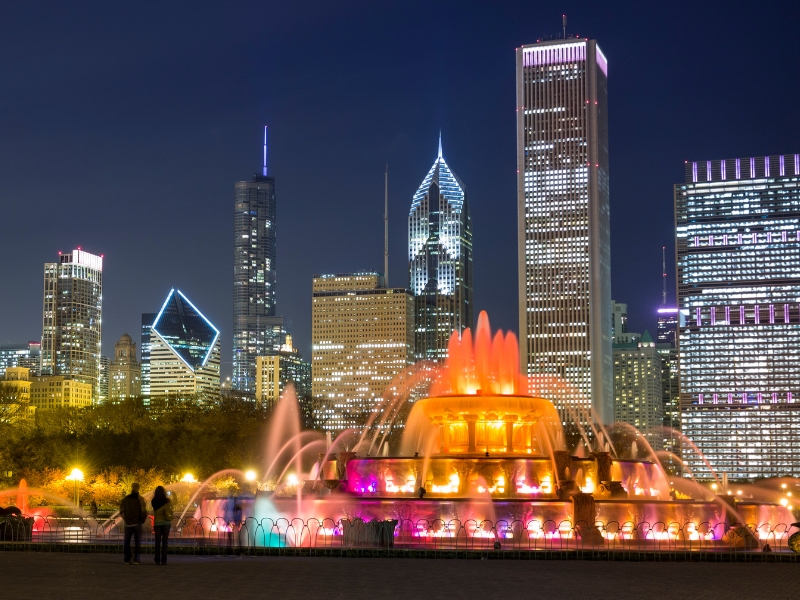
Buckingham Fountain, in the centre of Grant Park, was dedicated on 26 August 1927. It was a gift from Kate Sturges Buckingham in memory of her brother Clarence, and it was designed by the architect Edward H. Bennett with sea horses by the French sculptor Marcel Loyau. Bennett took the Latona Fountain at Versailles as his model, and the result is one of the largest fountains in the world.
The fountain is built of pink Georgia marble and is meant to represent Lake Michigan. In the warm months it runs a water show every hour, and after dark the shows come with lights and music. Despite the name, it has nothing to do with Buckingham Palace. It is a scavenger hunt stop.
- The four pairs of bronze sea horses, which stand for the four states that border Lake Michigan: Illinois, Wisconsin, Michigan and Indiana.
- The central jet, which shoots up about 150 feet during the main water display.
- The view from the east side, with the lake behind you and the skyline rising beyond the park.
Queen's Landing
Directly across Lake Shore Drive from Buckingham Fountain, a plain concrete pier marks one of the city's grand occasions. On 6 July 1959 Queen Elizabeth II and Prince Philip, travelling through the newly opened St. Lawrence Seaway, anchored the royal yacht Britannia off Chicago and came ashore here by barge. It was the first visit to Chicago by a reigning British monarch, and more than a million people gathered along the lakefront to see them.
The Queen gave a short speech on landing and then toured the city for the rest of the day; the place has been called Queen's Landing ever since. A crosswalk across the drive links it with the fountain. It is a stop on our scavenger hunt.
How to see them in one walk
Start on the Roosevelt bridge, coming from Navy Pier along the lakefront path, and look back at the river before heading south. Leave the lake for Maggie Daley Park, cross the Gehry footbridge into Millennium Park and take your time around the Bean, the Crown Fountain and the Lurie Garden. Then walk south through Grant Park to Buckingham Fountain, ideally when a water show is due, and cross to Queen's Landing for the view back over the fountain to the skyline. From there the lakefront path continues south to the museums at the end of the park.
See Chicago with World City Trail
Our Chicago scavenger hunt turns the lakefront into a game you play on your phone. The route links 10 stops, from Navy Pier to the Adler Planetarium, and all five places in this guide are among them, along with Navy Pier, the Art Institute of Chicago, the Field Museum, the Shedd Aquarium and the Adler Planetarium. At each stop you solve a puzzle and hear a short story, at your own pace.
There is also a self-guided walking tour and an outdoor escape game in Chicago, for people who prefer a different format.
Play the Chicago scavenger hunt →
Take the self-guided walking tour of Chicago →
Play the outdoor escape game in Chicago →
Facts checked in October 2026.